I carried him out the front door.
I did not pack. I did not clean the sink. I did not finish the floors I’d been paid to finish. I wrapped that baby in the cleanest blanket in that cold room, and I held him against my chest, and I walked down the grand staircase with my heart slamming and my old knees screaming, and I did not stop.
The housekeeper on the landing saw me. She opened her mouth. I looked at her, and whatever was on my face, she closed it again and stepped aside.
The gate at the end of the drive was the last test. There’s a man there, a guard, and he looked at me and looked at the bundle in my arms, and for one long second I thought that was where it ended.
“Baby’s got a doctor’s appointment,” I said, steady as I could. “They forgot to tell you.”
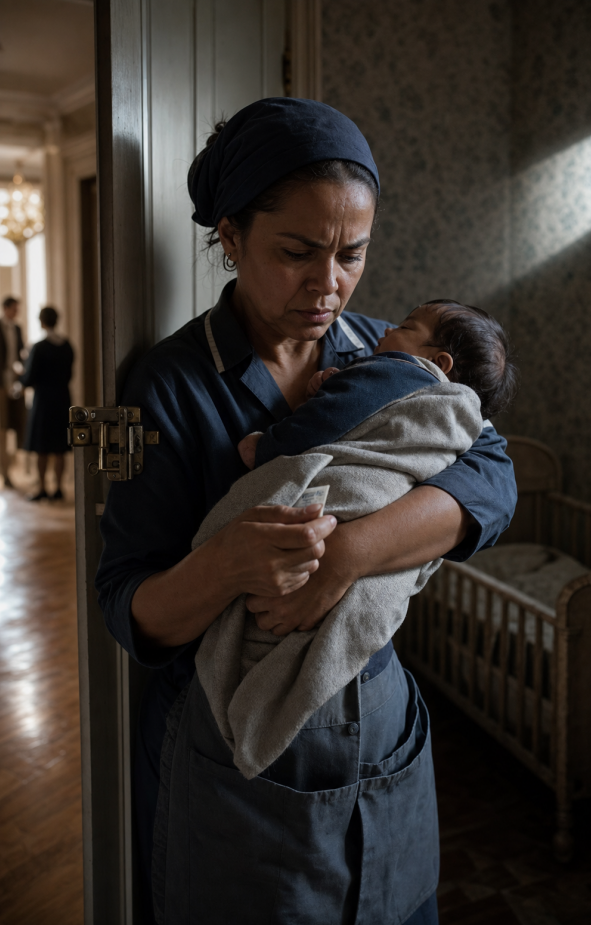
He waved me through. People believe a tired woman who acts like she belongs somewhere. That is the whole reason they never saw me at all.
I walked six blocks with that child before my hands stopped shaking enough to call my nephew, who drives a cab, and he took us straight to the county hospital and I told them everything. A malnourished infant, weeks of neglect, a locked room, a laundry tag with a name that wasn’t the family’s.
That name turned out to be everything.
The baby’s name was Elias. And Elias, it turned out, was the son of the family’s youngest daughter, a girl named Marguerite who had married against her father’s wishes and then died in a car accident when the baby was two months old. Marguerite’s husband had died in the same crash. Which made little Elias, by a trust his grandfather had set up years before anyone imagined how it would matter, the sole heir to the entire family fortune.
The relatives who signed my checks were his aunts and uncles. Cousins of the dead girl. And if Elias were to quietly fail to thrive, if a sickly orphan simply didn’t make it through his first winter the way sickly orphans sometimes tragically don’t, the trust would revert, and split, and every one of them would become very, very rich.
They weren’t going to smother him. Nothing so bold, nothing a coroner could catch. They were just going to forget. Forget a feeding here, a doctor there. Keep him in a locked room where no one counted his ribs. Let neglect do the work that a pillow would have made obvious.
The laundry tag saved his life. Some service the dead mother had used still stitched the family name into his clothes, out of habit, from an account no one had cancelled. It was the one thread that tied that starving baby in the locked room to the fortune he was being erased to unlock.
I gave my statement four times. To the hospital, to a social worker, to two detectives, and finally to a lawyer who represented the trust itself, an old man who had drawn up the grandfather’s wishes decades ago and had been trying for months to lay eyes on a child the family kept saying was “sleeping” or “at the pediatrician” or “not up to visitors.”
When I described the room, the bolt, the tag, the weight of him, that old lawyer took off his glasses and pressed his hand over his eyes.
“You understand what you’ve done,” he said. “You didn’t just find a neglected child. You found the heir they’d hidden. You’re the only witness who was ever inside that room.”
The aunts and uncles were arrested. It took a while; money buys delay if it can’t buy escape. But the case was clean, because I had done the one thing they never expected the invisible cleaning woman to do. I had looked. I had picked him up. I had read the tag.
Elias is with a real family now, a cousin on his father’s side, screened and vetted and warm, and the trust pays for everything a growing boy could need. I get a photo every few months. He’s fat now, gloriously fat, the kind of fat where the cheeks eat the eyes when he laughs. There’s one on my refrigerator where he’s shoving birthday cake into his mouth with both fists.
People ask me if I was scared, carrying him out like that. If I thought about what would happen to me, an old cleaner walking off with a rich family’s child.
I tell them the truth. I didn’t think about any of it. I have grandchildren. I know the exact weight a healthy baby is supposed to be. And when I picked up Elias and felt how little there was of him, felt him go still and trusting against me the way a baby does when it’s decided you might be the one who finally came, there was no decision left to make.
You don’t clean around a locked door forever. One day you open it. And then you carry out whatever you find, and you don’t set it down, no matter who’s standing at the gate.
Comments are closed.