The pill organizer is what did it. I keep coming back to that, because of all the things that could have given me away that night, it was a cheap plastic box from a drugstore that turned my whole life over.
Let me tell you how I ended up snowbound in a stranger’s mountain lodge in the first place.
I’m a home-care nurse. Not glamorous, not well-paid, but I’m good at it, and I take the assignments other people won’t — the far-out ones, the difficult families, the cases up in the mountains where the roads get dicey in winter. That week I’d been driving back from a patient two valleys over when the storm came in faster than the forecast promised. Whiteout. My little car started sliding on the grade, and I did the only sane thing: I pulled off at the first light I saw, which turned out to be a huge timber lodge set back from the road, and I banged on the door praying someone would let me wait out the worst of it.
A man answered. Late forties, expensive flannel, the kind of tired that goes deeper than sleep. He looked at me, looked at the wall of snow behind me, and stepped back to let me in without a word. I remember thinking he moved like a man braced for bad news.
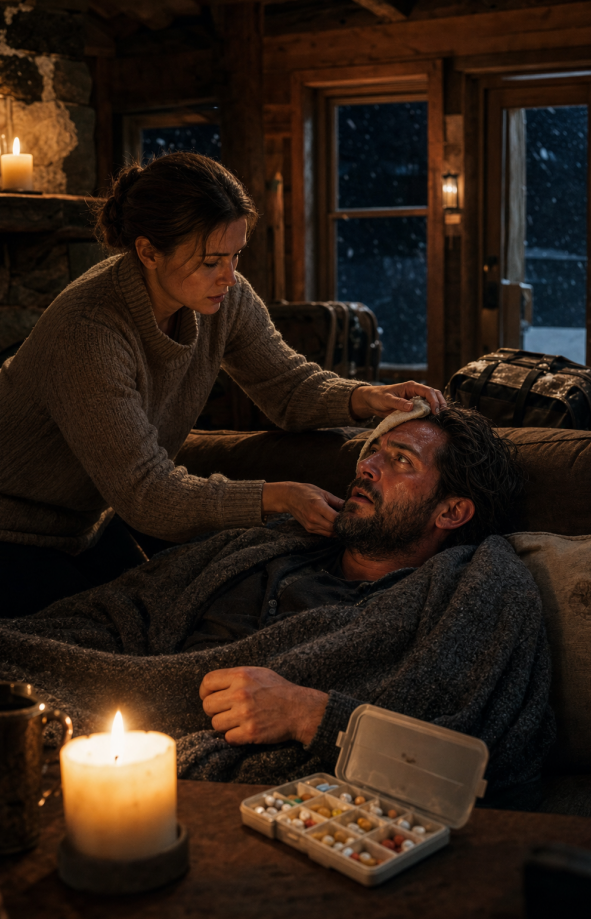
Within the hour, the bad news was him. He’d been fighting a fever for two days, too stubborn and too isolated to do anything about it, and by the time I got there it had spiked hard. He was shaking, disoriented, burning up. The power flickered and then died completely around ten, and the phones were out, and it was just the two of us and a fireplace and a storm that had swallowed the whole mountain.
So I did my job. By candlelight and firelight I brought his fever down the old way — cool cloths, fluids, watching, waiting, the patient tedious work of nursing someone through a hard night with no equipment and no backup. I didn’t know who he was. I didn’t care. He was a sick person and I was a nurse and the rest was noise.
He drifted in and out. Sometime past two in the morning, lucid for a stretch, he watched me sorting the little emergency kit I carry everywhere — and in it, my pill organizer. A specific one. Seven days, four compartments each, with a distinctive hand-painted pattern of small birds along the lid that a girl I’d once cared for had painted for me years ago, in another life, in another state.
He went very still. “Where,” he said, and his voice was different, all the fever gone out of it for a moment, “did you get that.”
I told him the truth, because there was no reason not to. Years ago, I said, I’d done a stretch of private care for a teenage girl — a sad, frightened kid whose family situation I never fully understood, moved around a lot, lots of security, never explained. She’d been sweet and lonely and she’d painted this for me the week before her family abruptly moved her again and I never saw her after. I’d kept it because it made me think of her and hope she was okay.
The man started to cry. A grown man, weak with fever, crying in the firelight.
Because the girl I’d described — the sad, guarded, over-secured teenager who’d painted birds on a pill box — was his daughter. She had been taken, years before, in a kidnapping-for-ransom that made national news in a world I don’t move in; recovered, eventually, but never the same, and the family had scattered her among trusted private caregivers under false names during the long frightening aftermath while they hunted the people responsible. I was one of those caregivers. I’d never been told the real story. I’d just been a kind stranger to a scared kid for a few months, and then she was gone.
“She talked about you,” he said. “For years. ‘The nurse who wasn’t scared of the dark.’ We could never find you. The agency that placed you folded, the records were a mess, and she only ever knew your first name.” He looked at the pill box like it was a holy thing. “She painted three of those. She kept one. She gave one to her mother. And she gave one to you. I have looked at the one on my own shelf every day for six years.”
The storm broke by morning. The power came back. And the man I’d nursed by candlelight turned out to be someone whose name I did recognize once he said it — a very wealthy, very private man who had spent years and a fortune putting his family back together after the worst thing that can happen to a family.
Here’s the part that matters, though, the part that isn’t about money.
He didn’t offer me a reward. He understood, somehow, that offering me money for the night would have cheapened it, would have turned a human thing into a transaction. Instead, when the roads cleared, he asked if I would come to dinner. To meet her. His daughter — a young woman now, twenty-two, in college, doing better than the family had once dared hope.
She recognized me across the room before anyone said a word. “You kept it,” she said, when she saw the pill box I’d brought to show her. And then she was hugging me and crying and laughing all at once, this grown woman who’d been a terrified girl the last time I saw her, telling me that on the worst nights, back then, she used to imagine I was still down the hall.
We stayed in touch. Not as employer and employee, not as rich man and hired nurse — as something harder to name. I go to her college things. I was at her graduation. Her father, the billionaire who watched me work by candlelight, told me once that he’d spent years learning that the people who help you when they don’t know who you are, and can’t gain anything by it, are the only ones you can truly trust. I hadn’t known who he was. I couldn’t have gained anything. I’d just done my job for a sick stranger in the dark.
I still take the hard assignments. I still carry the pill box, birds and all. And every winter when the first snow comes down the mountain, I think about a fevered man asking me a question in the firelight, and how the smallest kept promise turned out to be the thread that led a broken family the last few steps home.
Comments are closed.