The officer who stopped the whole formation was a captain, and he was younger than my husband would have been, and he had the careful, sorry face of a man who had been dreading this moment for a very long time.
He crossed the street to me while three hundred people watched. My daughter had caught up and grabbed the back of my shirt, and I could feel her small fist twisting the fabric, and behind the captain, still standing at a halt in the road, was the man in the third row with the dog tag. My dog tag. The one I’d had engraved.
“Ma’am,” the captain said. “I’m going to need you to come with me. Both of you. There are people who need to explain some things to you, and this is not the place.”
I said the only thing I could get out. “That’s my husband.”
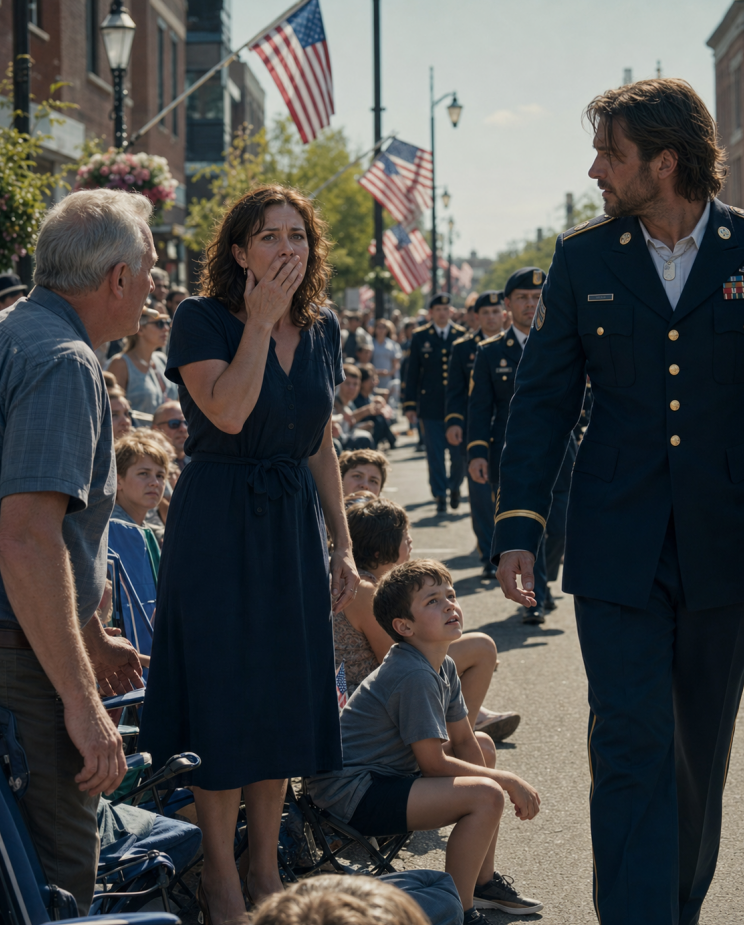
The captain didn’t tell me I was wrong. That’s how I knew. In two years, everyone had always told me I was wrong — my mother, my sister, the grief counselor, the kind faces at church. Nobody had ever just gone quiet and looked at the ground. The captain looked at the ground.
They took us to a room in the VFW hall a block off the parade route, and they brought me a paper cup of water I didn’t drink, and after a while two men in civilian clothes came in with a folder and a lot of careful language, and behind them, finally, they let him in.
Ethan.
He was thinner. There was gray in his beard that hadn’t been there, and a stillness to him that was new, the stillness of a man who has spent two years being someone else. He stood just inside the door with his cover in his hands and he looked at me like I was a ghost, which was rich, considering.
“Hi, Mel,” he said.
I didn’t run to him. I want that understood. Two years of a folded flag on my mantel and a sealed casket in the ground and a daughter who cried herself to sleep asking why her daddy’s plane fell in the ocean — you don’t run to that. You sit very still and you wait to find out how badly you’ve been lied to.
The men with the folder explained it the way they explain things they’d rather not: in the passive voice, in fragments, with long pauses. Ethan’s helicopter had gone down over the water. That part was true. But Ethan hadn’t been on it when it hit. His unit had been doing work that didn’t officially exist, in a place we didn’t officially have people, and when the operation went wrong, the cleanest thing — the thing that protected the mission and the men still in the field and a source whose life depended on silence — was for Sergeant Ethan Reyes to have died in that crash. On paper. With a flag and a casket and a widow who genuinely, uncontrollably grieved, because a real widow’s grief is the most convincing cover there is.
They didn’t tell me. They couldn’t tell me. That was the whole point. My grief had to be real, and it was, God help me, it was.
I looked at my husband across that VFW hall and I asked him the only question that mattered. “Did you know? The whole time? Did you know I was burying you?”
He said yes.
I threw the paper cup of water at him. It bounced off his chest, harmless, and water went everywhere, and my daughter started crying, and one of the civilian men started to stand and Ethan held up a hand to stop him and just stood there, dripping, taking it, because he knew he had it coming.
“I asked them every week,” he said quietly. “Every week for two years I asked if I could send you a sign. Anything. They said no. They said the day you stopped grieving was the day someone might start asking questions, and questions could get people killed. So I let you think it. I let Katie think it. And I hated myself every single day, and I’d do it again, because there were men whose lives were in my silence, and I couldn’t — I couldn’t trade their kids’ fathers for mine.”
I sat down. My legs just stopped holding me.
Because here is the terrible thing, the thing I’ve had to make my peace with: I understood him. I hated it, and I understood it. The man I married was exactly the kind of man who would carry that, who would let his own wife bury him rather than let another family get the folded flag for real. It was the thing I’d loved about him, turned into the thing that nearly destroyed me. Both at once. That’s the part nobody warns you about.
The operation is over now. That’s why the tag came home. That’s why he could march down Main Street in his own name for the first time in two years and finally, finally get caught. He told me later he’d requested that parade specifically, in our town, on the chance I’d be on that curb — that after everything, he couldn’t bear to just knock on the door, so he’d let the dog tag do it. Let me see it first. Let me choose to step off the curb.
Katie warmed to him faster than I did. Kids are like that — she’d been so young that the two years were half her remembered life, and here was her daddy, solid and real, and she decided almost at once to forgive the ocean for giving him back. It took me longer. It’s still taking me. We’re in counseling, the kind for couples where one of them was legally dead. There aren’t many books about that.
Some nights I’m so angry I can’t look at him. Some nights I wake up and put my hand on his chest just to feel it move, the way I used to lie awake terrified I’d forget the sound of his breathing. Both of those are true in the same marriage, in the same week, sometimes in the same hour.
I took the flag off the mantel. I didn’t throw it out — I couldn’t, it meant too much, it held two years of a love that was real even when the death wasn’t. I folded it into a box and put it in the closet, and I told Ethan that someday, when I’ve forgiven him all the way, we’ll figure out together what to do with it.
He said he’d wait. He said he was good at waiting now.
I believe him. It’s the one thing these two years made him better at than anyone alive.
Comments are closed.