Her name is Claire. I didn’t know that until she told the room. I didn’t know she existed — or I’d made myself not know, which I’ve come to understand is a different and worse thing.
Let me tell you the truth, since I spent thirty years telling everyone else a lie.
When I was twenty-seven I was poor, ambitious, and ashamed of both. I worked nights and took classes and I met a girl named Rosa who worked at the laundromat below my apartment. She was nineteen, gentle, funny in a quiet way, and she loved me with the kind of uncomplicated faith I have never deserved from anyone before or since. For about a year I loved her too, or I loved how she made me feel, which at twenty-seven I couldn’t tell apart.
Then Rosa got pregnant. And around the same time, I got noticed — by a man at the firm where I clerked, a powerful man with a daughter, who saw something in me and started opening doors. The kind of doors that do not open twice. The kind that, in those days, would slam shut forever if the golden young man they were about to invest in turned out to have a pregnant laundromat girl and a baby in a walk-up apartment.
I chose the doors.
So you can imagine what it did to me to hear that lullaby in that ballroom.
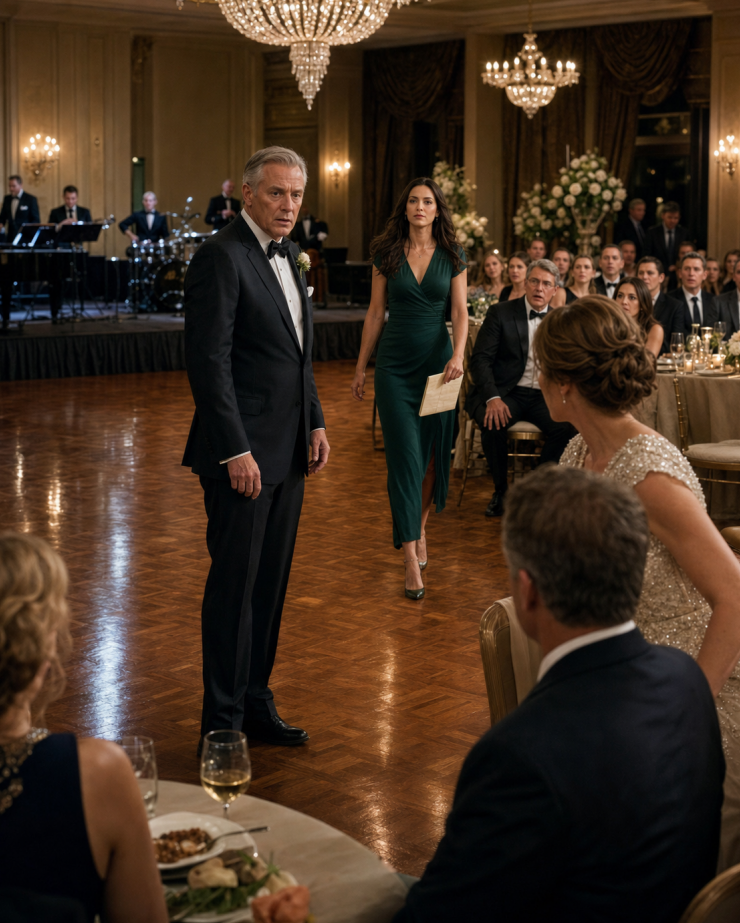
Claire told the story better than I ever could, standing there in her green dress while two hundred people forgot to eat. She told them her mother, Rosa, had raised her alone, working two and sometimes three jobs, in apartments that got smaller when times got hard. She told them her mother never once spoke badly of her father — that Rosa had told her, over and over, that he was a good man who was just too frightened of being poor to be brave, and that the lullaby was the only piece of him she had, and that she’d sung it to Claire every night of her childhood so that “your father is still with us in some way.”
She told them she’d become a nurse. That she’d put herself through school. That her mother had died two years ago, of the kind of illness that catches people who spend their lives too busy and too poor to see a doctor, and that among Rosa’s few possessions Claire had found an old photograph, a name, and a birth record with the father’s name filled in, in Rosa’s hopeful handwriting: Gerald Hartman.
She’d found me, she said, the way anyone finds anyone now. She’d read about the wedding in a society column — the self-made philanthropist, the storybook second marriage. She said she almost didn’t come. She said she’d told herself a hundred times to leave it alone, that a man who could walk out on a sleeping pregnant girl wasn’t a man worth knowing.
“But I didn’t come for you,” she said, looking right at me. “I came for her. My mother spent thirty years defending you to me. She died believing you were a good man who was just scared. I needed to know if she was right. I needed to see your face when you heard that song, and know whether there was anything in you worth all the love she wasted.”
The room was so silent I could hear the ice settling in the glasses.
Vivian, my new wife, was staring at the birth record on the tablecloth, and then at me, and I watched thirty years of my carefully edited biography rearrange itself behind her eyes. She is not a stupid woman. She understood immediately that the man she’d married had a daughter he’d hidden, a woman he’d abandoned, and a past he’d sold her a lie about.
I didn’t do anything noble. I just started to cry, in front of everyone, in a way I hadn’t since I was a boy. Ugly, silent, shaking. Because there is no editing your way out of your own daughter standing in front of you with your own lullaby and asking, in effect, whether her dead mother had loved a ghost.
I walked over to her. My legs barely worked. And I said the only true thing I had. I said, “She was right about the scared part. She was wrong about the good man. But you — look at you. You are the one good thing I never had any right to.”
Then she left.
The wedding, as you can imagine, did not recover. Vivian and I have a great deal to work through, and I don’t know yet if we will. My guests learned in one song that the self-made man was self-invented. I have spent the weeks since sitting with the wreckage of a lie I told for so long I mistook it for my life.
But here is the strange thing. The wreckage is the first honest ground I’ve stood on in thirty years.
I don’t know how this ends. But I know how it started, and for the first time I’ve said it out loud, so I’ll say it here, where the people who watched me shatter that night can read it.
Her name was Rosa. She was nineteen and brave and she loved a coward. She raised our daughter alone and never poisoned the child against the man who left them, which is a grace I will never understand. And our daughter grew up to be a nurse who spends her days caring for strangers, and who walked into a ballroom full of people who could have crushed her, and made two hundred rich strangers learn a poor dead woman’s name.
I asked the band to skip the sad songs.
I’ve come to believe I was played that lullaby on purpose by something bigger than a bandleader and a folded bill — that some debts sit quiet for thirty years and then collect themselves, all at once, in front of everyone, set to the only tune you were ever foolish enough to think you could forget.
Comments are closed.