The colonel’s name was Aaron Briggs, and he had served with my husband for eleven years.
I didn’t know that yet, standing in the back of that auditorium with my knees threatening to give out. I only knew that a man in dress blues had risen from the second row, walked to the podium where a stranger was clutching my husband’s folded flag, and held up a small creased photograph so the whole room could see it.
“This is Sergeant First Class Daniel Reyes,” he said, “on his wedding day. And this,” he turned the photo toward Vanessa, “is his wife. I was the best man. I know her face. And that is not her.”
The auditorium made a sound I’ll never forget. Two hundred people inhaling at once.
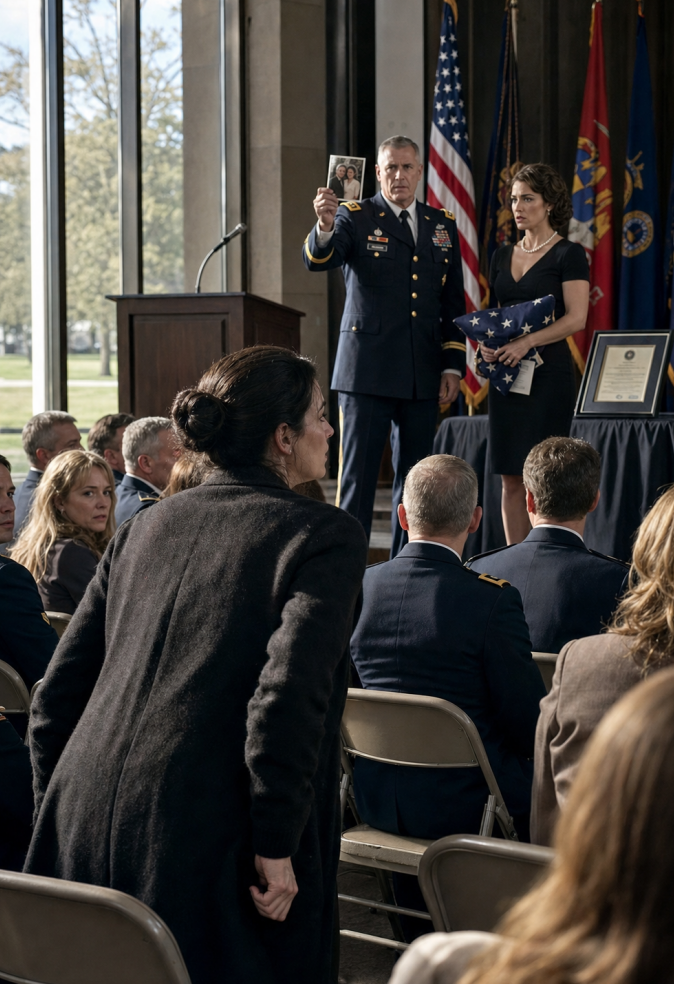
Vanessa’s serene mask cracked. She started to say something about a private ceremony, a second marriage, paperwork that would explain everything. Colonel Briggs let her talk. He was patient in the way only a man who has already won can afford to be. When she ran out of words, he simply said, “Ma’am, I’d like to see the marriage license you submitted to claim these benefits. Right now. In front of these people.”
She didn’t have it, of course. Not a real one.
Here is what I learned in the weeks that followed, once the Army’s investigators pulled the thread that colonel handed them.
Vanessa Kilbride had been a clerk at a records office. When Daniel was killed overseas, his file crossed her desk before it crossed mine. She saw a decorated soldier with a substantial death benefit, a life-insurance payout, and a widow who lived four states away and had no idea the ceremony had even been scheduled yet. So she forged a marriage license, backdated it, and inserted herself into the system as his spouse. She was good at it. She’d done it before, to two other families, in two other states. I was not her first widow. I was just the first one who had a colonel in the room who happened to keep a wedding photo in his breast pocket for eleven years.
I need to tell you why he had it.
Daniel and I got married in a courthouse because we were broke and in love and couldn’t wait. Aaron Briggs was the only guest. He took exactly one photograph on a disposable camera, and he had it printed, and he carried it in his uniform through three deployments because, he told me later, “your husband saved my life outside Kandahar, and I promised myself I’d never forget the day he became a married man. Felt like bad luck to leave it home.”
He carried my wedding photo into a war and back for over a decade. And it was still in his pocket the morning a stranger tried to steal my husband’s memory.
When the truth came out, the room turned. I felt a hundred faces swing toward the back rows where the ushers had parked me like an inconvenience, and I saw the exact moment they understood what they’d done. A young lieutenant who had waved me away twice went pale. An officer’s wife who had offered Vanessa tissues put her hand over her mouth.
Colonel Briggs walked down the center aisle, past the podium, past the stranger, all the way to the back of the room. He stopped in front of me and he saluted. Slowly. Deliberately. In front of everyone.
“Mrs. Reyes,” he said. “Ma’am. Would you come forward and receive your husband’s flag?”
I don’t remember walking up that aisle. People tell me the whole room stood. I remember the flag being placed in my arms, and I remember it was heavier than I expected, and I remember thinking that Daniel would have hated all the fuss and loved that Aaron was there.
Vanessa was arrested three weeks later. She’s facing federal charges in three states now, for the families she defrauded and for the ones she was still working on. One of the other widows called me. She was in her seventies. She’d nearly signed away a portion of her late husband’s pension to a woman she believed was a distant daughter-in-law. When I told her what happened at the ceremony, she cried, and then she laughed, and then she said, “God bless that colonel and his little photograph.”
I got the benefits, eventually. The paperwork took months to untangle, and every form felt like reopening the same wound. But that was never what the day was about. Money was never what Vanessa stole that hurt the most. She’d tried to stand in my place at the last public moment my husband would ever have, tried to be the face the Army honored, tried to erase eleven years of a marriage into a courthouse photo nobody was supposed to see.
She almost got away with it. She would have, if a man hadn’t loved my husband enough to carry our wedding into a war.
I keep the photo now. Aaron gave it to me after the funeral, pressed it into my hand and closed my fingers over it. “He’d want you to have it,” he said. “I had it long enough.”
It sits on my mantel in a little frame, this cheap disposable-camera picture of two broke kids in a courthouse, the only wedding photo we ever took. For eleven years it lived in a soldier’s pocket. It turned out to be the one piece of evidence in the world that no impostor could forge, because you cannot fake being loved that long by that many people.
They tried to honor the wrong widow. A creased photograph and an old soldier’s memory wouldn’t let them.
Comments are closed.