The officer set the box down on the little side table in the vault and stepped back, and I crouched to the boy’s level because he was too small for me to talk down to him from where I stood.
“Go ahead,” I told him. “It’s yours to open. You brought the key.”
He looked at me for a long second with those solemn eyes, and then he turned the brass key in the lock the way someone had clearly taught him to, careful, deliberate, and lifted the lid.
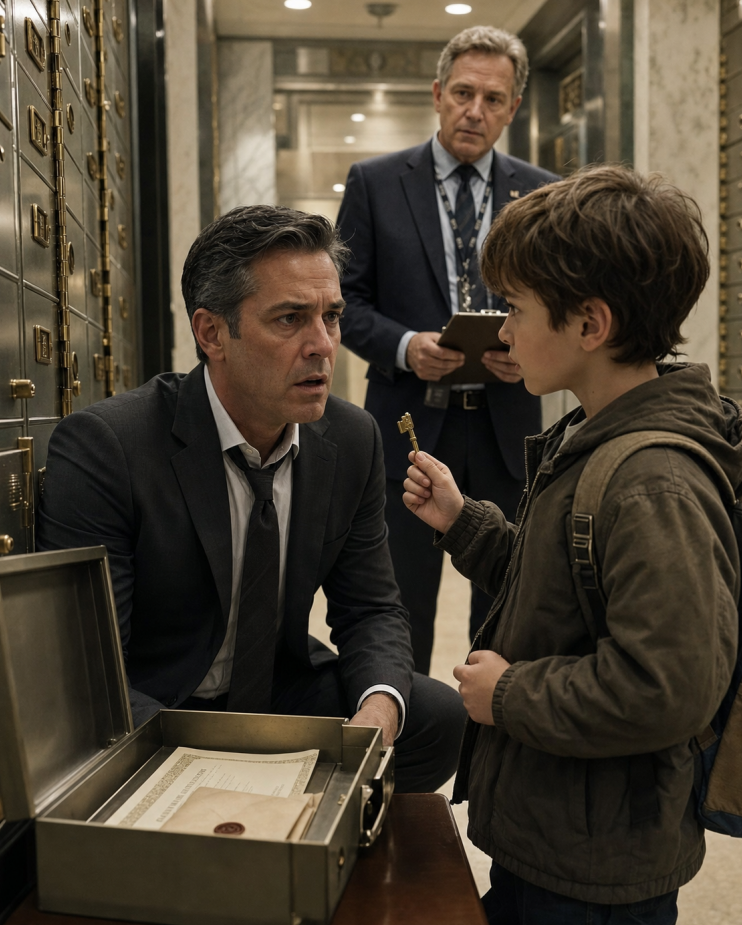
There wasn’t much inside. A single folded document. A sealed envelope, cream-colored, gone soft at the edges from being handled. And a photograph — a woman with dark hair and a tired, warm smile, holding a newborn against her shoulder.
I knew the woman. Of course I knew the woman.
Her name was Rebecca, and eight years ago I had stood in my glass office forty floors above this vault and told her she was a liar. I told her the pregnancy was a manipulation. I told her that if she thought she could attach herself to my name, she’d chosen the wrong man, and I had her walked out of the building by security while my brother stood in the corner and said nothing.
My brother, who I would learn much later had been the one who set the whole thing in motion — who needed Rebecca gone because she’d seen the accounts, because she’d figured out what he was moving through the family firm, because she was the kind of person who couldn’t unsee a wrong once she’d found it. He’d fed me exactly the story he needed me to believe, and I’d been so proud, so certain, so eager to protect myself, that I swallowed all of it.
I picked up the folded document. It was a birth certificate. And there, in the box marked for the father, was my name.
The boy watched me read it. He didn’t say anything. He’d been coached, I think, for this exact moment, coached by a mother who knew she might not be there to explain it herself.
I opened the envelope.
Her handwriting hadn’t changed. The letter was short. She wrote that she’d never wanted anything from me — not money, not a name, not an apology. She wrote that after she testified against my brother, after she gave the regulators what she’d found, she’d had to disappear, because men like my brother don’t forgive being seen. She’d raised the boy quietly, under a different name, in a different city, and she’d made an arrangement with a trustee: if anything ever happened to her, the key would come to me. Not because she forgave me. Because a boy should not grow up with no one, and I was, whatever else I was, his father.
“Your mom,” I said, and my voice came out wrong, cracked in the middle. “Where’s your mom, son?”
The bank officer answered for him, gently, from where he stood. There’d been an accident four months ago. The trustee had spent the time since locating me, verifying everything, making sure the boy was really who the papers said before they brought him into a stranger’s bank and put a key in his hand.
Four months. My son had been alone in the world for four months while lawyers confirmed what a photograph could have told me in a heartbeat.
I have made a great deal of money in my life by being decisive, by trusting my own read of a situation, by never letting sentiment slow me down. I have been proud of that. Kneeling on the marble floor of that vault, I understood for the first time what it had cost — not in dollars, in the only currency that had ever actually mattered, and I had spent eight years of it without noticing.
“Do you know who I am?” I asked him.
He nodded. “Mom said you’re my dad,” he said. “She said you didn’t know about me. She said it wasn’t your fault, but you’d be sad when you found out.” He paused, and then, with the terrible directness of a child, he added, “Are you sad?”
I pulled him into me before I could answer, because I didn’t want him to see my face while I found the word. He was so light. He smelled like a kid, like the outside, like a life I’d had no part in. He held on carefully, the way you hold on to something you’re not sure will hold you back.
“Yeah,” I finally said, into his hair. “I’m sad about the part I missed. But I’m not sad you’re here. I’m the opposite of sad you’re here.”
He thought about that, and then he nodded against my shoulder like it was an acceptable answer.
That was fourteen months ago. He lives with me now. There were papers, of course — there are always papers, and I know how to make papers happen — but the papers were the easy part. The hard part is the thing no fortune buys back: the eight years of lullabies and scraped knees and first words that belonged to a woman I ran out of my building, and that I will never get.
I keep her photograph on my desk now, next to a crayon drawing he made of the two of us standing in front of “the big bank.” I look at her every morning. I don’t get to apologize to her. So instead I get up, and I make his toast the way he likes it, and I try to be the man she decided — against every reason I ever gave her — that our son deserved to find.
Comments are closed.