The milk jug sat on the counter, a thin crack running down its side where it had hit the edge. A small pool of white seeped onto the linoleum, dripping slowly toward the floor. Tyler stared at my hand on his wrist, his smirk faltering, his mouth opening and closing like a fish.
“Ma’am, you need to let go,” he said, trying to pull away. “He can’t pay. Store policy.”
“I’ll pay for it,” I said. My voice was steady, but my heart was hammering against my ribs like a trapped bird. I didn’t let go of Tyler’s wrist. I kept my eyes locked on the old man’s forearm. The tattoo. 4471. The compass rose.
The old man pulled his sleeve down quickly, his weathered fingers fumbling with the frayed wool. He didn’t look at me. He kept his eyes on the floor, his shoulders hunched, his breathing shallow and uneven.
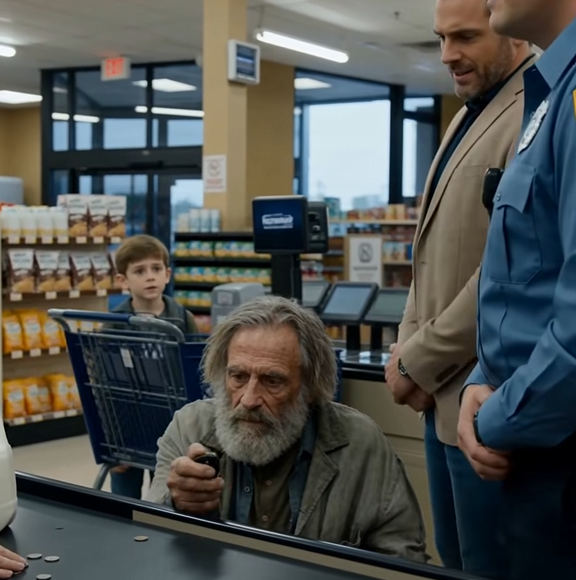
“I don’t need your charity,” he muttered. His voice was a dry rasp, like sandpaper dragging across stone. “I just need to get home. My wife is waiting.”
“What’s your name?” I asked. My voice cracked on the last word.
He finally looked up. His eyes were pale blue, watery, surrounded by deep creases carved by decades of sun and grief. There was something in them. A flicker. A ghost of recognition.
“Arthur,” he said. “Arthur Hayes.”
The name hit me like a physical blow to the chest. Arthur Hayes. The name on the letter my mother kept in a shoebox under her bed. The letter that arrived in 2003, written in shaky handwriting, saying he was sorry he couldn’t save him. Saying he carried Thomas Jenkins as far as he could. Saying the jungle was too dark and the bullets were too fast.
“You knew my father,” I whispered.
Arthur’s face changed. The stoic, defeated mask cracked. His pale blue eyes widened, searching my face, tracing the line of my jaw, the shape of my nose. His trembling hand reached up and pressed against his own chest, right over his heart.
“Thomas?” he choked out. “You’re Thomas’s girl?”
“I’m Sarah,” I said. Tears spilled over my lashes, hot and fast. “He named me after his sister. The one he left behind in Dayton.”
Arthur’s knees buckled. He caught himself on the counter, his knuckles white against the scratched laminate. The milk jug wobbled. Tyler stepped back, his eyes wide, suddenly understanding that he was witnessing something far bigger than a failed transaction.
“I looked for you,” Arthur whispered. His voice broke into jagged, uneven pieces. “After the VA, after they discharged me, I tried to find your mother. I tried to tell her what happened. But the records were sealed. The unit was classified. I spent twenty years writing letters that came back unopened.”
He reached into the deep pocket of his brown coat. His hand emerged clutching a thick, rubber-banded stack of envelopes. They were yellowed, creased, covered in red RETURN TO SENDER stamps. Dozens of them. Maybe a hundred. All addressed to Mrs. Elaine Jenkins, Dayton, Ohio.
“I never stopped writing,” he said. He placed the stack on the counter, right next to the cracked milk jug. The envelopes fanned out under the fluorescent lights. “Every year. On the anniversary. I told her everything. I told her he was brave. I told her he wasn’t afraid. I told her his last word was your name.”
The store was dead silent. The only sound was the hum of the refrigerator cases and the distant rattle of the ice machine.
Tyler didn’t say a word. He just quietly rang up the milk. He scanned it. He placed it in a plastic bag and set it gently on the counter in front of Arthur.
“It’s on me,” Tyler said. His voice was barely a whisper. His eyes were wet.
I didn’t just buy the milk. I took Arthur to the diner across the street. We sat in a red vinyl booth for three hours. He told me everything. How my father saved his life in the jungle. How he carried him three miles to the extraction point. How my father died in the helicopter, gripping a photo of me as a baby.
Arthur had kept that photo for fifty years. He pulled it from his wallet with trembling fingers. The edges were soft, worn smooth by decades of handling. I was six months old, wrapped in a yellow blanket, my fist curled around my father’s thumb.
“I promised him I’d look after you,” Arthur said. “I failed.”
“You didn’t fail,” I said. I reached across the table and took his hand. “You’re here.”
I drove him home that night. A small, one-bedroom apartment above a laundromat on the South Side. His wife, Martha, sat in a wheelchair by the window. She has dementia now. She didn’t recognize him when he walked in. But she recognized the milk. She smiled.
I come back every Sunday now. I bring groceries. I sit with Martha while Arthur reads the letters aloud—the ones that came back unopened, the ones that finally found their destination.
The cracked milk jug still sits on the diner counter, catching the pale morning light through the window.
Comments are closed.