Jackson Hale had been riding with the Iron Sons Motorcycle Club for twenty-three years. He founded it in a garage after he came back from overseas with a bad leg and a worse attitude. The club had started as a way for veterans to stay connected. Over the years it had become something else — a family for people who had lost theirs, a safety net for kids who had none, and occasionally, a wall that authorities had to deal with.
Today the wall was on Interstate 80, and it was not moving.
The call had come at 6:17 that morning. Tommy Rivera, one of their youngest members, had a six-year-old son named Mateo who was fighting leukemia. The boy had taken a turn for the worse during the night. The hospital in the city could no longer help him. The only chance was a specialized treatment center two hundred miles away. The ambulance was ready. The doctors were ready. But the window was closing fast.
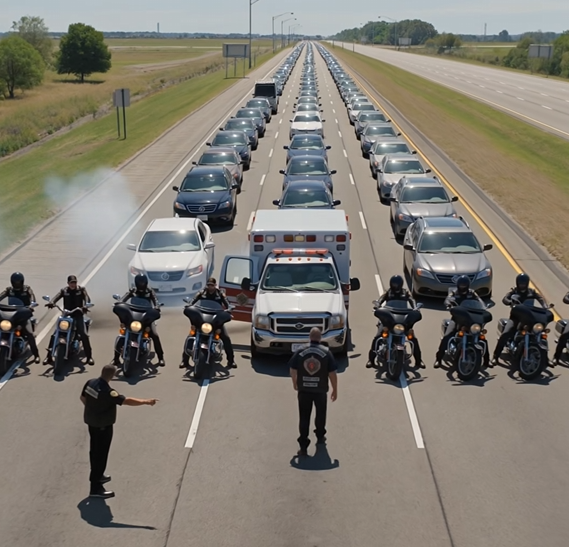
Jackson had made one phone call. Within forty minutes, thirty-five Iron Sons were on their bikes. They met the ambulance at the on-ramp and formed up around it like a rolling honor guard.
They had not expected the state police to be waiting at mile marker 47.
The first officer who approached looked young and nervous. He kept one hand near his holster even though every biker had both hands visible on their handlebars.
“You need to clear the lanes,” the officer said. “This is a public highway.”
Jackson killed his engine and stepped off his bike. At sixty-one, with a white beard and a limp that got worse when he was tired, he still moved like a man who had once carried sixty pounds of gear through desert heat.
“We’re escorting a dying child,” he said. The words were simple. He did not raise his voice.
The officer tried again. “You’re creating a hazard. Traffic is backed up for eight miles.”
Jackson looked past him at the line of red taillights stretching into the heat shimmer. Then he looked back at the ambulance where Tommy Rivera sat in the back with his son’s small hand in his.
“We’ll move when the boy is safe,” Jackson said. “Not before.”
More officers arrived. Radios crackled. Someone mentioned calling for backup. One of the younger Sons, a kid named Rico who had only been patched for six months, started to reach for something under his vest. Jackson caught his eye and shook his head once. Rico’s hand dropped.
The confrontation lasted eleven minutes. In that time, Mateo’s oxygen levels dropped twice. The paramedic in the back radioed the driver. They were losing time they did not have.
Jackson walked straight up to the lead officer until they were only two feet apart. Close enough that the officer could see the faded tattoo of a cross on Jackson’s neck and the name “Mateo” written in small letters on the leather vest right over his heart.
“That boy in there,” Jackson said quietly, “is the reason some of us still believe we can be good men. You can write every ticket you want after we deliver him. But if you make us move right now, and that kid dies because we were stuck in traffic, I promise you will remember this day for the rest of your life.”
The officer looked at the ambulance. He looked at the line of bikers who had not moved, not even when the shouting started. Then he looked at the traffic that had gone strangely quiet behind the barricade of chrome and leather.
He stepped back.
“Escort only,” he said into his radio. “No pursuit. Let them through.”
The motorcycles roared back to life. Jackson took the lead position. The ambulance followed, lights still flashing. The formation moved at a steady sixty miles an hour, taking up both lanes so nothing could cut in front of them. Cars pulled onto the shoulder to let them pass. Some drivers got out and stood with their hands over their hearts.
They reached the treatment center at 2:41 in the afternoon. Mateo was rushed inside. Jackson and the rest of the Sons stayed in the parking lot for three hours until a nurse came out and told Tommy that his son was stable enough for the first round of treatment.
Only then did Jackson allow himself to sit down on the curb. His bad leg was screaming. His phone had seventeen missed calls from the state police liaison.
He ignored all of them.
Rico sat down beside him and handed him a bottle of water.
“You think they’re gonna arrest us?” the younger man asked.
Jackson took a long drink. “Probably. Worth it.”
Rico nodded. They sat in silence for a while.
Two days later, Mateo’s doctor called Tommy with news. The treatment was working better than expected. The boy had a real chance.
That evening, Jackson received a different call. It was from the same state police lieutenant who had been at the highway.
“We’re not filing charges,” the lieutenant said. “The officer on scene wrote it up as a medical escort. Said you were… persuasive.”
Jackson grunted. “Tell him thanks.”
There was a pause.
“My nephew had leukemia two years ago,” the lieutenant said. “Didn’t make it. I just wanted you to know that… what you did mattered.”
Jackson looked out the window of the garage where the club met. His bike was parked in its usual spot, still dusty from the highway run.
“Tell your nephew’s memory we rode for him too,” Jackson said.
He hung up before the lieutenant could answer.
Outside, the sun was going down. Somewhere in the city, a six-year-old boy was fighting for one more tomorrow. And on a stretch of interstate that had been completely blocked two days earlier, traffic was moving again like nothing had ever stopped it.
But the people who had been there knew better.
Some roads were never meant to be cleared until the right people had passed through them.