I walked my children up the aisle of my ex-husband’s second wedding, and I have never felt so calm in my life.
You have to understand how quiet I had become by then. Three years of being “the wife who couldn’t give him children” teaches you to fold yourself small. When a marriage ends over your own body, over a thing you supposedly failed to do, you stop arguing. You start apologizing for existing. I signed the papers. I didn’t fight the settlement. I let his mother tell the story her way at every family gathering I was no longer invited to, because I believed the letter too. “Irreversible.” A doctor said it. Who was I to know better?
But I want to tell you what I found out, six months after I moved away, sitting in a clinic three hours from anyone who knew my name.
I was pregnant. Not a little pregnant. Pregnant with twins.
I sat in that exam room and I laughed, and then I cried, and then I got very, very quiet in a different way than before. Because a pregnancy that isn’t supposed to be possible forces a question you can’t un-ask: if the letter was wrong, why was it wrong? So I did something the old me never would have done. I pulled every record. I got a second opinion, then a third. And a specialist with no connection to my former life looked at the original diagnosis, frowned, and told me there was nothing in my file that supported the word “irreversible.” Nothing that supported the diagnosis at all.
The letter had come from a doctor. A doctor who golfed every Saturday with my former father-in-law.
I’m not going to tell you I can prove, in a court, exactly what was said on that golf course. I can tell you that a wealthy family who wanted their son out of a marriage got a convenient, unquestionable letter from a friendly hand, and that letter did the work no honest conversation could. It gave Nathan a clean reason. It made me the one who failed. It let everyone keep their conscience.
I had my twins alone. A boy and a girl. I named them, I raised them, I stopped being quiet in the ways that had cost me everything and stayed quiet only about this — because I was waiting. Not for revenge, exactly. For the truth to have somewhere to land.
The wedding invitation was an accident. I know it was; my name lingered on some old list nobody scrubbed. And for two weeks I told myself I wasn’t going to go. Showing up to your ex’s wedding is the act of a woman who hasn’t moved on, and I had moved on. I had a whole life he’d never touched.
But my daughter still sleeps with a scrap of the hospital blanket they came home in. And I thought about that arch he’d stand under, promising forever to someone new while an entire family who called me broken smiled in the sunlight, and I decided the truth deserved a witness.
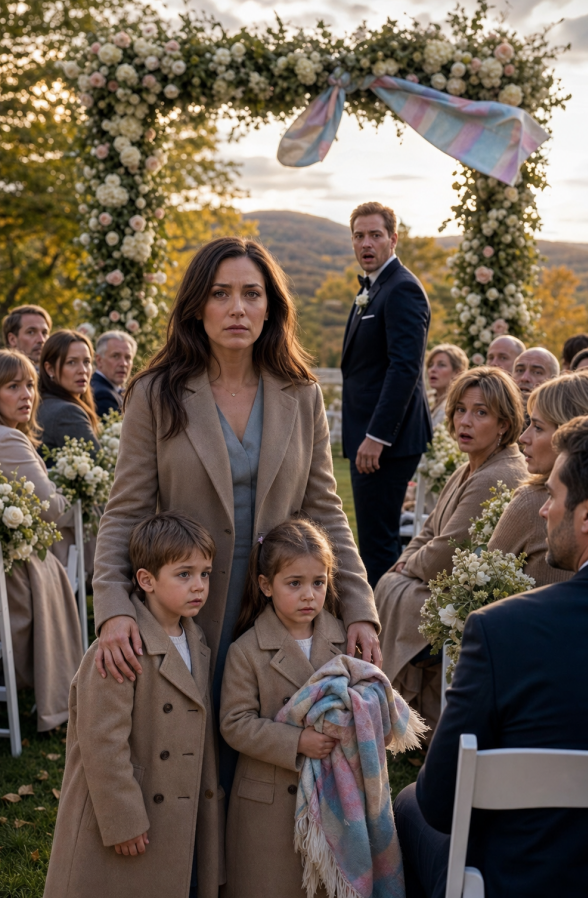
So I came early. I tied a strip of that blanket into the flowers of the arch. Then I sat in the back with my children and I waited.
When Nathan saw the fabric, he went pale. When he saw us, he stopped breathing. And when I stood and walked my twins up that aisle, the whole garden turned to watch a woman they’d been told was barren carry two children with their father’s exact eyes toward the altar.
I didn’t scream. I didn’t ruin anything with noise. I stopped a few feet from him, and in the silence I said, “You told everyone I couldn’t. I want you to meet the reason you were lied to.”
My son looked up at the tall man staring at him and said, “Are these your flowers?”
Nathan’s mother sat down hard in her white chair. His new bride looked at him, then at the children, then at his face, and understood something no one had told her. And Nathan — Nathan looked at two four-year-olds who were unmistakably his, and I watched three years of a story he’d chosen to believe collapse under the weight of two small pairs of shoes.
I did not stay for the wedding. I never intended to. I said what I came to say, I let the guests see what they’d helped bury, and I walked my children back down the aisle and out into the afternoon.
He’s called since. Lawyers have called. There will be tests, and there will be a reckoning about a letter and a golf course, and I’ll see that through for my children’s sake, because they deserve the truth in writing even if I can’t fix the past.
But the part that healed me wasn’t the reckoning. It was the walk. It was carrying the proof of my own body up an aisle full of people who’d been so sure of my failure, and refusing, finally, to be quiet about it.
They called me the wife who couldn’t give him children. My children were holding my hands when the whole story fell apart.