The account numbers were the easy part. Anyone can memorize numbers. The hard part had been sitting in that ballroom for two hours, letting Vivian Crestley wave her hand at me and call me stupid, and not moving until the room was full enough.
We had needed the room full. That was the whole point. Eleven months of work — subpoenas that went nowhere, shell companies that dissolved the moment we touched them, a whistleblower inside her foundation who was one bad night away from disappearing — all of it came down to getting Vivian Crestley to say something true, on tape, in front of witnesses who couldn’t later be paid to forget.
So I let her humiliate me. I let the whole table laugh. And when I set the tray down and started reciting, I wasn’t performing for her. I was performing for the three hundred donors who would each, later, swear under oath that they’d heard her.
I gave the first number in English. Cayman National, the account her “children’s hospital fund” routed through. Her smile stayed, but it stopped reaching her eyes.
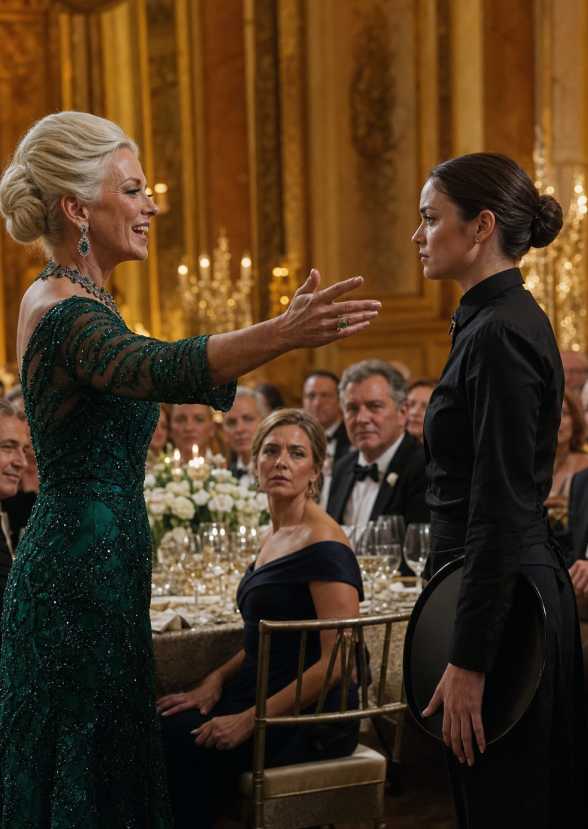
I gave the second in the banker’s own language, the one they’d used on the calls we’d been recording, the little Liechtenstein private bank that had no reason to know an American caterer. Her glass came down on the table too hard.
By the third — Singapore, the account where the money finally stopped moving and started belonging to her — the platinum-haired heiress had gone the color of the tablecloth, and every donor within twenty feet had turned to watch the slow girl who suddenly wasn’t slow.
“Who told you that,” she said. Quiet. Dangerous. “Who are you.”
I reached up and unclipped the wire from under my collar and set it on the table beside her untouched dessert, still recording, the little red light steady.
“Special Agent Dana Whitmore,” I said. “And I didn’t need anyone to tell me. I’ve been listening to you for eleven months.”
I have thought a hundred times about what happened in her face then. It wasn’t fear, not at first. It was recalculation — the specific horror of a person who has spent her whole life being the smartest one in every room realizing she got the math wrong in the one room that counted.
She tried the things people like her always try. She laughed and said it was a misunderstanding. She looked for her lawyer, who was already being walked toward the coat check by two of my colleagues who’d come dressed as guests. She reached for her phone, and a woman she’d assumed was a donor’s wife gently took it from her hand.
The donors did what I needed them to do. They pulled back. Chairs scraped. The champagne tower kept its little lights on over a table that had, thirty seconds earlier, been the center of the party and was now a crime scene with catering.
Vivian stood up. I’ll give her that much — she stood, spine straight, chin up, the way you’d expect a woman with that much money to stand. “You have no idea,” she said, “what you’ve just done to yourself.”
“I have every idea,” I said. “I know exactly who you’ll call. I know exactly who they’ll tell you to call after that. And I know that every one of them is going to hear the same tape you just heard, in your own voice, with your own account numbers, in front of your own guests.”
The whistleblower — the accountant who’d found the first thread and pulled it at enormous risk to himself — was watching from a service corridor where I’d stashed him for his own safety. When they finally led Vivian Crestley out through the kitchen, past the sinks and the stacked chairs and all the invisible people who make a gala run, he stepped out where she could see him.
She stopped. She understood, then, who the “slow” one had actually been.
The case took another year to close. The children’s hospital that never existed had, on paper, received nineteen million dollars in donations. Every cent of it is being clawed back into a fund that pays for real pediatric care now — actual sick kids, actual hospitals, the thing she’d used as a costume. I made sure of that part personally.
People ask me if it was worth it, standing there in a cheap uniform letting a rich woman call me stupid in front of three hundred people. Whether my pride could take it.
Here’s the truth. My pride was never in the room. I left it at the door with my coat, because I knew what she didn’t — that being underestimated is not an insult when you’re the one holding the recorder.
She thought I was too slow to teach.
I was just waiting for her to finish talking.