The initials inside the ring were T.J.D. I read them in the parking-lot sunlight with my hands shaking, and they were exactly the letters I’d watched a jeweler engrave the week before our wedding. Thomas James Danvers. My husband. The man in the closed casket.
Except the man attached to the ring was standing in front of me very much alive, and he’d stopped pretending to be a stranger the second I read them out loud.
“Rachel,” he said. Quiet. Tired. Like a man setting down something heavy. “You weren’t supposed to be here.”
I have replayed the next few minutes more times than I can count. Lily was still holding my sleeve. He looked at her — at his own daughter, taller than the last time he’d seen her, wearing a fun-run ribbon — and something moved across his face that I refuse to call love, because love doesn’t do what he did.
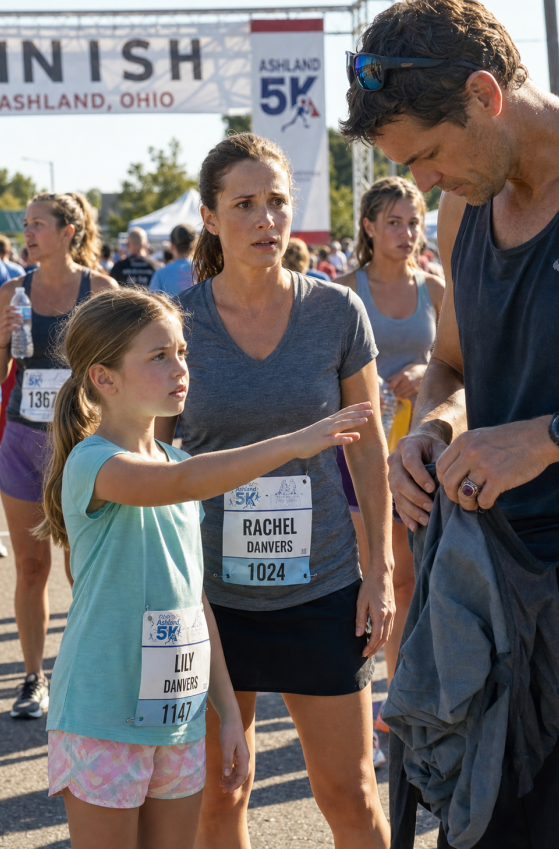
He didn’t have a good explanation. He had a true one, which is different and worse.
He hadn’t fallen. There’d been no accident on that mountain. Two years ago Thomas had been drowning in a kind of trouble I never saw — money he’d borrowed from people who don’t use courts, a business partnership that had turned into a debt with his name and only his name on it. He’d done the math the way cowards do, and decided the family was worth more with him dead than alive. The life-insurance payout. The clean slate. A “hiking accident” in a remote place, a body never truly recovered, a grieving widow who would cash a check and never dig.
He’d staged it with the help of a man he’d paid — the same man, I would learn, who signed the death certificate. A crooked contact at a small county office who backdated a document and looked the other way for a cut. Thomas took the insurance money, wired most of it to the people he owed, and vanished into a new state with a new name and just enough left to start over.
He never once thought his eleven-year-old would recognize a class ring he’d been too sentimental to leave behind.
I didn’t scream at him in that parking lot. I think that surprised him. I was calm the way you get calm when the floor drops out and you realize you have to be the one still standing for your kid. I told him to stay where he was. I told him if he ran, I would spend every dollar and every day I had left making sure he was found. And then I took a photo — of him, of the ring on his hand, of the car he’d driven — and I called the number of the detective who’d handled the “accident.”
Here is the part nobody warns you about. When a dead man turns out to be alive, the grief doesn’t reverse. It just complicates. I had already buried him. I had already learned to sleep in the middle of the bed. I had already answered Lily’s questions about heaven with the gentlest lies I could build. And now I had to walk it all back, not because he’d been miraculously found, but because he’d chosen this, chosen it over us, and let us mourn him to make the lie airtight.
The investigation moved faster than I expected, because insurance fraud that size leaves a paper trail and the company that paid out was very, very motivated to get its money back. The high school confirmed the ring — their engraving records, the year, the initials, a match with no reasonable doubt. The county clerk who’d signed the certificate folded almost immediately when the fraud unit came knocking; he had done it more than once, for more than one person, and Thomas was just the thread that unraveled the whole sweater.
Thomas was arrested three weeks later. Insurance fraud, filing a false death record, the debts themselves. I sat in the courtroom exactly once, long enough for him to see that I came, and then I didn’t go back. I didn’t need to watch it. I’d already watched the only part that mattered, in a parking lot, when he looked at his daughter and chose his own skin first — again.
People ask me if I hate him. I don’t have the energy for hate. What I feel is closer to a strange, cold gratitude toward my own kid. Lily saw a ring on a stranger’s hand and told the truth, the way she always does, even when the truth is impossible. If she’d stayed quiet — if I’d gotten us to the car thirty seconds sooner — he’d still be dead to us, and we’d be living inside a lie he built on purpose.
We had to grieve him twice, in a way. Once as a man who died, and once as a man who never deserved the grief. The second time was harder and cleaner. Lily doesn’t ask about heaven anymore. She asked me one night, careful and quiet, whether it was her fault for pointing.
I told her the truth. I told her she didn’t unbury anyone. She just refused to look away, and that’s the bravest thing a person can do. The class ring didn’t lie. Neither did she. Everything that fell apart that day was already broken — she was just the one honest enough to say it out loud.