The faded photograph trembled in my manicured hands. The glossy paper was worn soft at the edges, the black-and-white image slightly blurred by time and tears. But the face of the baby in my arms was unmistakable. And the handwriting on the back was Sarah’s.
The sounds of the garden party—the clinking of crystal, the polite laughter, the rustle of silk—faded into a dull, distant roar. The only thing I could hear was the frantic, hammering rhythm of my own heart.
“Richard, what is the meaning of this?” Eleanor’s voice cut through the haze. She stood up, her beige silk gown sweeping across the pristine white tablecloth. She glared at the boy with pure, unmasked disgust. “Give that to him, child, and get out of here before I have you arrested for trespassing.”
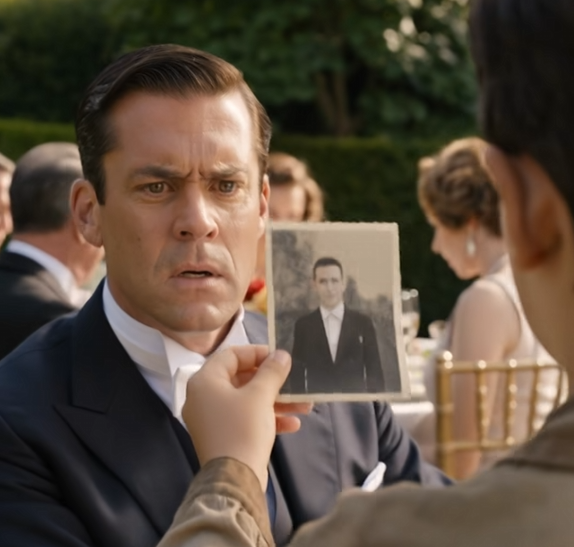
The boy didn’t look at her. He kept his dark, sorrowful eyes locked on me. “My name is Leo,” he said. His voice was small, raspy, but it carried across the silent lawn. “My mom’s name was Sarah. She died last winter. She told me to find you. She said you were the man who wrote the song.”
Was. The word hit me like a physical blow to the chest. Sarah died.
I looked up at Eleanor. The color had completely drained from her face. Her hands were gripping the edge of the table, her knuckles white. She wasn’t looking at the boy. She was looking at me, her eyes wide with a sudden, terrifying panic.
“Richard, he’s lying,” Eleanor said, her voice shaking. “It’s a scam. Some orphan trying to extort the Sterling name. Security!”
“You knew,” I whispered. The realization bloomed in my mind, cold and sharp. “Eleanor, you knew.”
Fifteen years ago, my family had given me an ultimatum: marry Eleanor and inherit the empire, or stay with Sarah and be cut off with nothing. I had chosen the empire. I had paid Sarah off. Or so I thought. Eleanor had always been the one to handle the “loose ends.”
“I did it for us!” Eleanor hissed, leaning in close, her voice dropping to a venomous whisper. “She was going to ruin you, Richard! She was going to drag you back into poverty. I paid her to leave. I thought she took the money and disappeared!”
“You paid her to disappear,” I said, my voice rising, echoing across the lawn. “But you didn’t pay her enough to survive, did you? You let my son grow up in the streets while we drank champagne in this garden.”
The guests were staring now. The flashbulbs from the society photographers in the bushes started popping, capturing the exact moment the Sterling empire began to crack.
“Richard, stop,” Eleanor pleaded, her perfect facade crumbling into dust. “Think about the company. Think about the board. If you acknowledge this… this bastard, they will strip you of everything.”
I looked at the photograph. I looked at Leo. He was shivering slightly in the cool evening breeze, his bare feet dirty, his clothes torn. He had nothing. And I had everything. And it was all built on the grave of the woman I loved and the childhood of the son I abandoned.
I stood up. I knocked my heavy gold chair backward. It hit the grass with a loud thud.
“Keep the company, Eleanor,” I said. My voice was steady, colder than I had ever spoken to her. “Keep the estate. Keep the lies.”
I stepped around the table. I didn’t look back at my wife, or the shocked guests, or the flashing cameras. I walked right up to Leo. I knelt down on the damp grass, ruining my tailored tuxedo trousers, and opened my arms.
“Leo,” I choked out, tears finally spilling over my lashes. “I’m so sorry. I’m your dad. I’m so sorry I’m late.”
The boy hesitated for a fraction of a second. Then, he dropped the wooden flute. He stepped forward and buried his face in my chest. I held him tight, feeling his small, fragile frame against mine, smelling the dust and the rain and the faint scent of the wildflowers he must have slept in.
The wooden flute lay on the white tablecloth, catching the golden light of the setting sun, as I carried my son away from the life I had built, and toward the life I should have lived.