The taste of the blueberry and sweet cream hit my tongue, and the bustling noise of Old Town Square completely vanished.
The pastry was warm. The crust shattered perfectly, giving way to the thick, tart filling. It wasn’t just a flavor. It was a sensory key turning in a rusted lock. A memory, sharp and blinding, flooded my brain. A warm kitchen. The smell of yeast. A woman humming a low, vibrating tune.
I choked. I coughed, covering my mouth with my hand, tears instantly springing to my eyes. Clara was suddenly beside me, her hand on my back, her voice tight with panic. “Elias? Elias, breathe. What is it?”
The old woman didn’t move. She kept her hand hovering near my face. Her fingers were trembling violently now.
“The almond extract,” I gasped, my voice cracking. “You use almond extract. Not vanilla.”
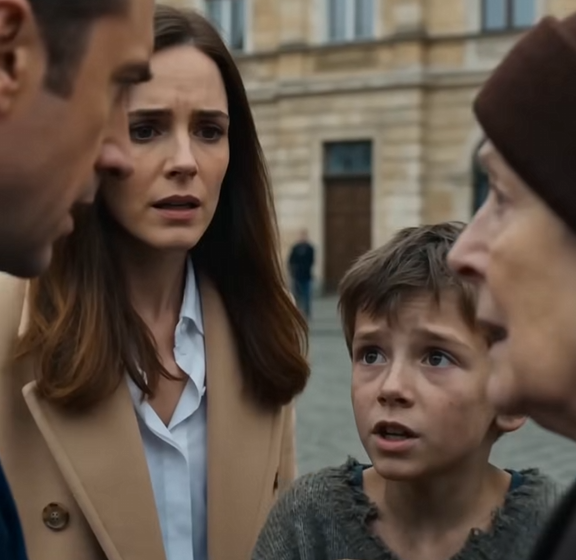
A single tear broke free from the corner of her eye, cutting a clean track through the flour dusted on her cheek. She nodded. Just once. A slow, heavy movement.
“My name is Magda,” she said. Her English was heavily accented, thick and rough. “And you are my Elias.”
The little boy in the gray sweater stepped closer. He didn’t look terrified anymore. He looked relieved. He lowered the polaroid and reached into his pocket. He pulled out a small, crudely carved wooden horse. The paint was chipped, the wood worn smooth by decades of handling.
He held it out to me.
I took it. My thumb traced the familiar notch in the horse’s ear. I had this horse. I had it in my dreams every single night for thirty years. The social workers told me it was a comfort object I brought with me to the orphanage in Boston. They told me my birth mother left it.
“Who gave you this?” I asked the boy. My voice was barely a whisper.
“My mother,” the boy said. His voice was small, clear. “Before she died. She said to give it to the man who comes back for the blueberry cake.”
Clara stepped back. I could feel her confusion, her shock radiating off her. “Elias, what is he talking about? Who is this woman?”
I looked at Magda. The truth was sitting right there in the deep, sorrowful lines of her face. “She’s my mother,” I said. The words felt heavy, solid. “And this boy is my nephew.”
Magda let out a ragged breath. She looked down at the boy. “His name is Leo. He is my daughter’s son. My daughter, Jana.”
The story spilled out of her in broken, jagged sentences. Thirty-two years ago, she was a young baker. She fell in love with a man from a wealthy, powerful family in the city. When she got pregnant, his family intervened. They didn’t just take the baby. They took her freedom. They paid off the local authorities. They told her the baby died in the hospital. They told her if she ever spoke, they would destroy her.
But she knew. A mother knows.
She kept the cart. She stayed in this exact square. She baked the pastries with the almond extract, hoping, praying, that one day the boy would walk by and remember the taste.
“They took you to America,” Magda said, her voice hardening, the grief turning into a cold, sharp anger. “To the man who bought you. To secure the shipping contracts.”
I felt the blood drain from my face. The Manhattan law firm. The senior partner who had taken me in, who had paid for my education, who had groomed me to take over his practice. He wasn’t just a benefactor. He was the buyer.
The man who taught me how to tie a tie. The man who paid for my law degree. He didn’t save me. He purchased me. I was an asset on a balance sheet, a human bribe to secure a transatlantic shipping route. My entire life, my career, my identity—it was all built on a transaction.
I looked at Clara. She was staring at me, her eyes wide, processing the magnitude of the betrayal. She didn’t say anything. She just reached out and took my hand. Her grip was tight. Grounding.
I looked down at Leo. He was shivering in the cold wind. His gray sweater was frayed at the cuffs. He had been living on the streets, selling these pastries for a woman who was too old to stand, too proud to beg.
I reached into my coat pocket. I pulled out my wallet. I didn’t care about the cash. I pulled out my phone. I dialed my managing partner in New York.
“Elias?” the voice answered, crisp and demanding. “You’re supposed to be at the merger meeting in an hour.”
“I’m not coming back, Richard,” I said. My voice was steady. The shaking had stopped. “And I’m taking the firm’s Prague accounts with me. I’m starting my own practice.”
I hung up. I dropped the phone into the brown paper bag Leo was holding.
I knelt down on the cold cobblestones. The dampness seeped instantly through the knees of my tailored trousers. I didn’t care. I looked at Leo. I looked at Magda.
“Show me the kitchen,” I said.
Magda smiled. It was a broken, beautiful thing. She reached out and wiped a tear from my cheek with her flour-dusted thumb.
The wind howled through the square, scattering dry autumn leaves across the cobblestones, but the maroon cart stood firm.