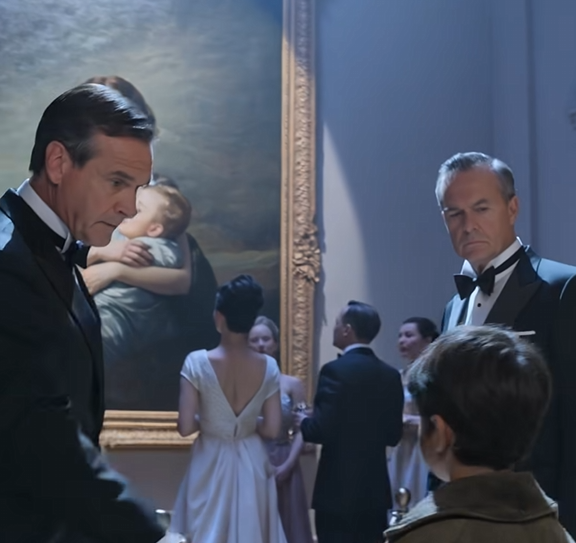
The curator’s hands shook as he read the note again under the soft gallery lights. The boy — no older than ten, with a dirty face and eyes that had seen too much — watched every movement.
“What does it say?” the boy asked.
The curator cleared his throat. “It says the painting was commissioned by Margaret Hale in 2014. She painted it herself from memory after her son was taken from a park in broad daylight. The boy was three years old. The police never found him. Margaret died two years later still searching. She left instructions that this message should only be found by someone who recognized the painting.”
He turned the photograph over. It showed a younger version of the same woman, smiling, holding a toddler with the same dark hair and serious eyes as the boy standing in front of him now.
“That’s my mom,” the boy said. His voice cracked on the last word. “She drew me the picture before she got sick. She said if anything ever happened to her I had to find this painting and look behind it. She said it would tell me who I really am.”
The head curator had arrived by then, along with two museum directors. They read the note in stunned silence. One of them recognized the name Margaret Hale — she had been a moderately famous portrait artist before she disappeared from the art world.
“We need to call the authorities,” someone said.
But the boy shook his head. “She said the people who took me might still be looking. She said the painting was the only safe place to leave the truth.”
The curator looked at the boy for a long moment. Then he made a decision. “We’re not calling anyone tonight. Not until we know he’s safe.”
They took the boy to a private office in the back of the museum. They gave him food and clean clothes from the gift shop. While he ate, the curator made phone calls to old contacts in the police department who had worked the cold case. By morning, DNA from the boy matched samples Margaret Hale had given years earlier.
The boy’s real name was Samuel Hale. He had been kidnapped by a woman who worked as his nanny. She had raised him as her own son in another state, moving often. When she died last year, he had been left with nothing but the drawing and his mother’s final instructions.
Three weeks later, at a small private ceremony in the same gallery, the painting was rehung with a new plaque. It now read: “Portrait of Margaret and Samuel Hale, 2014. Reunited.”
Samuel stood in front of it wearing a new coat the museum staff had bought him. He held the yellowed note in one hand and the old photograph in the other. For the first time since his mother died, he did not feel completely alone in the world.
The message hidden behind the painting had done exactly what Margaret Hale had hoped it would do. It had brought her son home.