For decades, the famous Nike swoosh stood for something universally inspiring, transcending politics, geography, and cultural divides. Whether you were an aspiring high school point guard in Ohio or a marathon runner in Oregon, the message was simple, rugged, and profoundly American: Just Do It. That legendary ethos built the greatest athletic empire in modern history, capturing the imagination of everyday consumers who simply wanted elite performance gear.
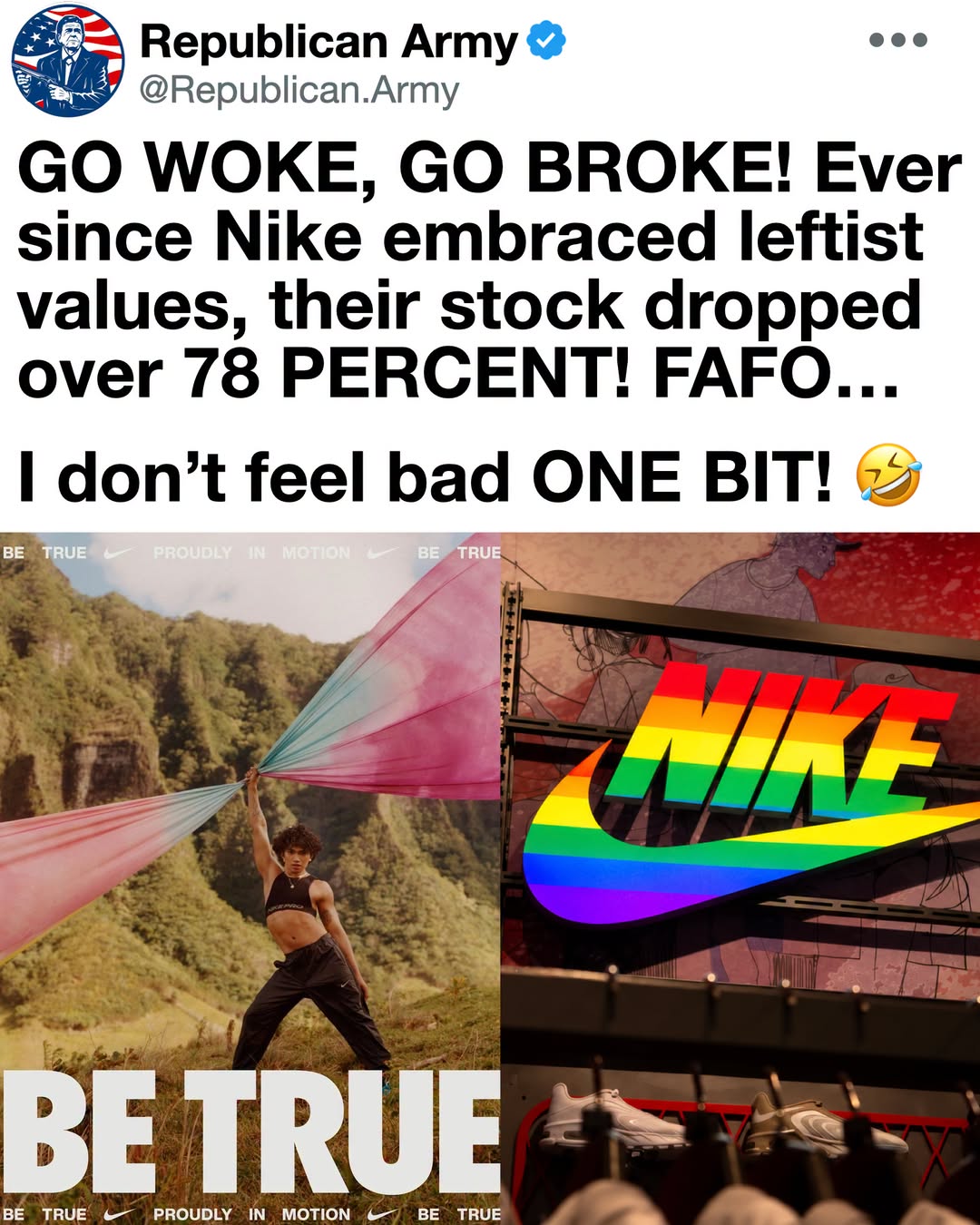
Yet over the past several years, the corporate suites in Beaverton, Oregon, decided that athletic excellence was no longer enough. The boardroom engineered a dramatic shift, transforming a beloved heritage brand into a megaphone for contested social and political messaging. Today, the bill for that ideological pivot has finally come due, and the market’s verdict is nothing short of brutal.
Wall Street does not operate on boardroom talking points or congratulatory applause from coastal media elites. It operates on cold, hard reality, and that reality has seen Nike shed tens of billions of dollars in market valuation. The steep and prolonged drop in Nike’s stock value is one of the clearest signals yet that consumers are sick and tired of being lectured by multi-billion-dollar conglomerates.
When an iconic American enterprise abandons its core mission to chase trendy social posturing, the consequences are swift, measurable, and devastating. Everyday Americans across the heartland who once proudly wore Nike shoes to work, to the gym, and on the field have simply walked away. They did not sign up to finance political advocacy every time they purchased a pair of running sneakers.
The fundamental premise of corporate capitalism is straightforward: companies exist to design outstanding products, serve their customers with excellence, and generate returns for shareholders. When a business loses sight of that foundational duty, it invites self-inflicted disaster. Nike chose to wade directly into the most divisive cultural battles in the country, seemingly indifferent to the millions of loyal buyers it alienated in the process.
The fallout has been undeniable across every major financial metric, sending shockwaves through the entire retail sector. Investors have watched in disbelief as the company experienced historic single-day stock plunges, wiping out years of hard-won financial gains. What was once seen as an untouchable market titan suddenly found itself scrambling to justify cratering sales in its most vital North American markets.
Retail analysts point out that heavy-handed corporate moralizing almost always backfires because it fundamentally misunderstands the consumer mindset. People do not buy sneakers to affirm an activist manifesto; they buy them for comfort, style, performance, and durability. By placing controversial political stances at the center of its brand identity, Nike effectively fractured its customer base down partisan lines.
The arrogance of assuming that loyal customers would stick around regardless of how alienated they felt proved to be a fatal miscalculation. Everyday families living on tight budgets began actively seeking out alternatives that focused purely on product quality rather than social preaching. In a hyper-competitive global marketplace, consumer loyalty is earned through value, not commanded through corporate arrogance.
That consumer revolt opened the floodgates for hungrier, focused competitors who were more than happy to claim Nike’s lost market share. Agile upstarts like Hoka and On Running, alongside battle-tested veterans like Brooks and New Balance, surged forward with relentless focus on technical innovation and athletic performance. While Nike’s executive suites were busy curating progressive PR narratives, their rivals were busy building better running shoes.
As specialty running shops and regional retailers began giving prime shelf space to these rising competitors, Nike’s direct-to-consumer strategy began unraveling at the seams. Customers walked into sporting goods stores looking for functional athletic gear and walked out with competitor brands, leaving Nike boxes gathering dust in distribution warehouses. The loss of shelf dominance in grassroots retail was the direct result of a leadership team that had lost touch with the ground floor of American sports.
A Self-Inflicted Crisis of Corporate Priorities
The internal turbulence caused by this strategic failure eventually triggered seismic changes at the very top of the company’s corporate hierarchy. Former chief executive John Donahoe, who oversaw the company’s aggressive push into direct-to-consumer digital channels and ideological branding, was abruptly pushed aside. The board was forced to bring veteran executive Elliott Hill out of retirement in a desperate attempt to stabilize the sinking ship.
 Courtroom Wink Sparks Viral Outrage: Vanity Fair Drops Reporter Over Lindsay Clancy Murder Trial Antics
 Florida man installed bedroom cameras to catch a coin thief — and caught wife Malia Nummerdor allegedly having sex with family dog
 Lakeland dad Isaac Kinsey dropped two babies into alligator swamp while fleeing crash: cops
The market does not care about executive virtue-signaling; it cares about operational discipline, product excellence, and customer trust.
The appointment of a legacy insider was a tacit admission that the modern strategy had failed on almost every measurable front. Decades of institutional knowledge had been cast aside in favor of a corporate culture that prioritized activist approval over genuine athletic innovation. Now, the company faces the excruciatingly slow task of rebuilding burned bridges with retail partners and disaffected consumers alike.
Inside the corporate headquarters, morale plummeted as thousands of corporate employees were hit with waves of layoffs and cost-cutting initiatives. It remains one of the bitter ironies of modern corporate governance that everyday workers almost always bear the brunt of disastrous executive decisions. While top executives collected massive compensation packages for steering the brand into cultural turbulence, rank-and-file employees paid the price with their livelihoods.
The financial community has been vocal in demanding a total return to operational fundamentals and product-driven marketing. Major Wall Street investment banks systematically downgraded Nike’s stock rating throughout the slump, warning that brand equity is far easier to destroy than to rebuild. Analysts noted that once a brand loses its universal appeal, regaining the trust of skeptical consumers requires years of relentless discipline and humility.
This crisis is not happening in a vacuum; it is part of a much wider awakening across the entire American business landscape. From legacy beer brands to massive entertainment conglomerates, companies that traded widespread appeal for polarizing social experiments have consistently suffered catastrophic financial backlash. The message from the American consumer is ringing out with absolute, undeniable clarity.
Consumers possess ultimate power in a free-market economy, exercising their democratic voice with every single dollar they choose to spend or withhold. When a company decides to lecture the very public that built its fortune, those citizens will gladly take their business elsewhere. The notion that ordinary Americans are obligated to subsidize corporate political advocacy has been decisively shattered by the cold reality of market economics.
The sheer speed with which Nike lost its untouchable aura should serve as a stark case study in business schools for decades to come. It demonstrates that no matter how massive your balance sheet or how historic your brand legacy, you are never too big to fail if you actively alienate your base. Respect for the consumer is the non-negotiable bedrock of enduring commercial success.
For millions of working-class citizens, sports have always served as a great national unifier, a sanctuary away from the non-stop friction of everyday politics. When sportswear companies intrude upon that sacred space with divisive messaging, they destroy the very magic that made sports culturally vital in the first place. Fans want to celebrate teamwork, resilience, and human achievement, not participate in an endless ideological struggle.
The road back for Nike will require far more than a simple executive shakeup or a clever new public relations campaign. It will require a profound, institutional commitment to abandon ideological posturing entirely and get back to the core mission that started in Phil Knight’s trunk. The company must prove that it respects the values, intelligence, and diverse perspectives of all its customers across the nation.
True corporate leadership requires the courage to resist trendy cultural pressures and focus relentlessly on serving the broad American public. The brands that maintain that steadfast focus consistently outperform the ones that blow with every passing ideological wind. In the end, the ultimate verdict is not delivered by board committees or social media echo chambers, but by ordinary citizens standing at the retail register.
The unfolding saga at Nike stands as an enduring monument to market accountability and the raw power of the everyday American consumer. Companies that honor their primary obligation to build great products and reward their shareholders will thrive and endure for generations. Those that choose to prioritize contested political agendas over genuine customer respect will continue to learn the exact same painful, expensive lesson.
No Comments yet!