Under the cover of dense maritime fog and midnight darkness, the southern border of Europe has transformed into a high-stakes frontline. Hundreds, and at times thousands, of young men gather on the rocky ridges overlooking Ceuta, waiting for the signal to launch mass charges against the fortified perimeter.
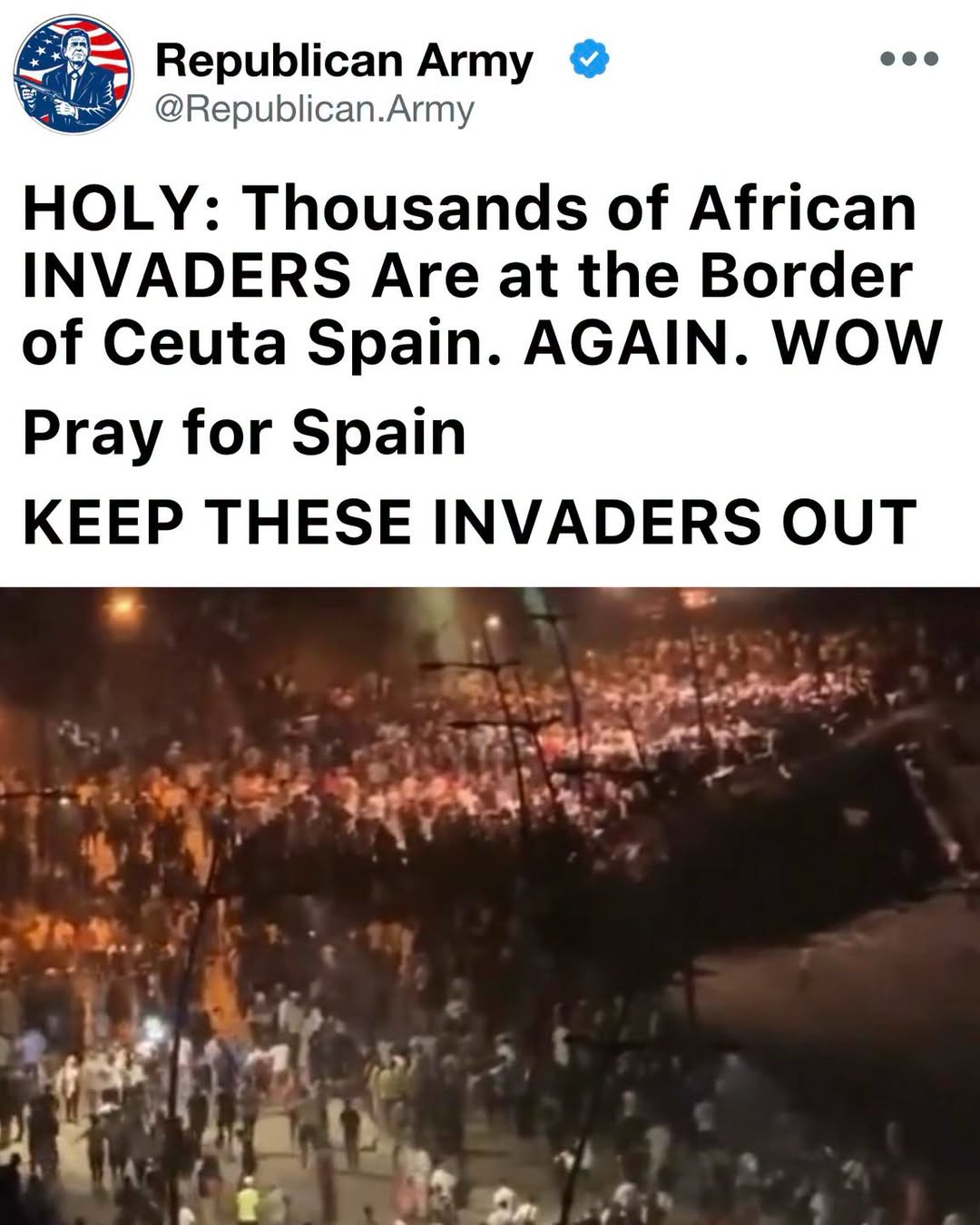
The scenes unfolding along the razor-wire fences and the rocky breakwaters of Tarajal are raw, chaotic, and unrelenting. This is not a distant geopolitical abstraction; it is an active, nightly assault on the sovereign territory of Spain that tests the breaking point of law enforcement.
Guardia Civil officers and national police units find themselves vastly outnumbered along critical stretches of the double-layered security barrier. Flashlights cut through the thick sea mist as patrol sirens wail, warning that another coordinated breach attempt is underway.
For the residents of Ceuta, an autonomous Spanish city nestled on the north coast of Africa, the tension has reached an absolute fever pitch. Life in the shadow of the border fence has become a cycle of sirens, emergency mobilizations, and an overwhelming sense that their home is under permanent siege.
Spain is now facing a profound test of national sovereignty and civilizational resolve that can no longer be ignored or downplayed by distant bureaucrats in Madrid or Brussels. Open borders, weak political messaging, and hesitant enforcement have created a catastrophic magnet for illegal mass migration.
The geography of Ceuta makes it uniquely vulnerable, serving alongside its sister enclave of Melilla as the only direct land borders between the European Union and the African continent. Spanning just under seven square miles, the city is fortified by modern infrared cameras, motion sensors, and high-tensile steel fences.
Yet advanced surveillance technology means very little when thousands of determined individuals move simultaneously toward the border in coordinated waves. Using mobile messaging networks, migrant groups organize synchronized rushes designed to overwhelm Spanish and Moroccan border guards at multiple points at once.
Those who do not attempt to storm the perimeter fences take to the freezing waters of the Mediterranean, swimming around the breakwaters in pitch-black conditions. Emergency rescue craft and patrol boats race back and forth across the waves, pulling exhausted swimmers from the churning surf before they hit the beaches.
Frontline officers describe an atmosphere of sheer exhaustion and extreme physical peril as they attempt to hold the line with limited manpower and restrictive rules of engagement. Riot shields, tear gas canisters, and non-lethal deterrents are often all that stand between order and total border collapse.
The sheer scale of these nightly mobilizations proves that the southern frontier is facing systematic, calculated pressure rather than isolated, spontaneous movements. Human trafficking networks operate with brazen impunity on the other side of the border, exploiting every sign of political weakness to push their lucrative human cargo forward.
A Frontier Pushed Beyond Its Breaking Point
The strain on Ceuta’s local infrastructure, public safety apparatus, and emergency social services has reached catastrophic levels. The city’s temporary migrant holding centers (CETI) are perpetually pushed beyond their intended operational capacities, creating volatile conditions within the city itself.
Hospitals, paramedic crews, and social workers are stretched to the brink as local resources are diverted away from municipal needs to manage the relentless influx. Every breach attempt drains local budgets, exhausts police personnel, and deepens the anxiety of citizens who feel abandoned by their national government.
 Monroe Woman Facing Compulsory School Attendance Counts and Active Warrants Following Traffic Stop
 Chilling motive suspected after Marine Isaac Ruiz indicted for attempted murder of paralyzed North Carolina woman
 Missouri senior Jewel Braziel, 74, charged with murdering his girlfriend after an all-night fight, refused dispatchers’ CPR instructions.
Local business owners, families, and neighborhood leaders speak of an escalating climate of insecurity that threatens the very fabric of their historic community. They watch their streets change in real time while national leaders issue vague platitudes about humanitarian management rather than enforcing the rule of law.
“A nation without secure borders ceases to be a sovereign nation. We are watching the southern gate of Europe being forced wide open while the authorities pretend everything is under control.”
The narrative that these mass rushes can be managed with soft diplomacy and open-ended processing has failed entirely on the ground. When enforcement is perceived as weak or hesitant, it acts as a direct invitation for even larger, more aggressive crowds to test the perimeter.
Law enforcement unions across Spain have repeatedly sounded the alarm, demanding immediate reinforcements, heavier defensive equipment, and unequivocal legal backing for border agents. Officers on the frontline should not have to second-guess their duty to protect the border out of fear of political blowback or legal persecution.
The geopolitical reality surrounding Ceuta is further complicated by diplomatic maneuvering across the border, where migration is frequently weaponized as leverage. When diplomatic relations fluctuate, border enforcement suddenly softens on the perimeter, unleashing waves of migrants directly toward Spanish soil.
Spain cannot allow its national security and border integrity to remain hostage to external diplomatic games or foreign political calculations. A sovereign nation must possess the independent capacity and the political will to seal its borders against unauthorized entry, regardless of outside pressure.
Across the European continent, citizens are waking up to the reality that unchecked mass migration threatens the safety, economic stability, and cultural identity of local communities. The chaotic scenes in Ceuta are not an isolated anomaly, but a preview of what happens when border enforcement collapses entirely.
Public anger is rapidly mounting as ordinary taxpayers see their safety compromised while millions in public funds are spent managing an endless border crisis. People are demanding real solutions: fortified physical barriers, rapid deportations, and an uncompromising enforcement of sovereign immigration laws.
The Moral Duty of National Defense
True compassion does not consist of surrendering sovereign borders to human traffickers and chaotic mob rushes. Permitting mass illegal entry only enriches ruthless criminal cartels, endangers human lives at sea, and destabilizes the communities that are forced to absorb the impact.
Spain must defend its territory with total, unwavering resolve, sending an unmistakable message across the Mediterranean that its borders are closed to illegal crossings. Every illegal entry must be met with immediate expulsion, eliminating the incentive that drives thousands of young men to risk their lives at the fence.
The brave men and women of the Guardia Civil and the National Police are fighting an uphill battle every single night to hold Europe’s southern line. They deserve the full solidarity, resources, and institutional protection of the Spanish state as they stand in the breach against overwhelming odds.
We must pray for the people of Spain, particularly the beleaguered citizens of Ceuta and Melilla, as they navigate this existential challenge. Their courage and resilience in the face of relentless pressure should serve as a wake-up call to the entire Western world.
History will judge this moment by whether Spain chooses sovereign strength or managed decline. The southern border cannot hold on willpower alone; it requires ironclad political determination, strong laws, and uncompromising enforcement before the frontier is permanently lost to chaos.
No Comments yet!