A chilling new precedent has just been set on the public sidewalks of New Jersey, and every American who values basic constitutional freedoms should be paying close attention. In an extraordinary display of government overreach, the state has moved to criminalize the simple, peaceful act of praying outside abortion facilities. What was once considered the bedrock of American liberty is now being treated as an offense worthy of state intervention.
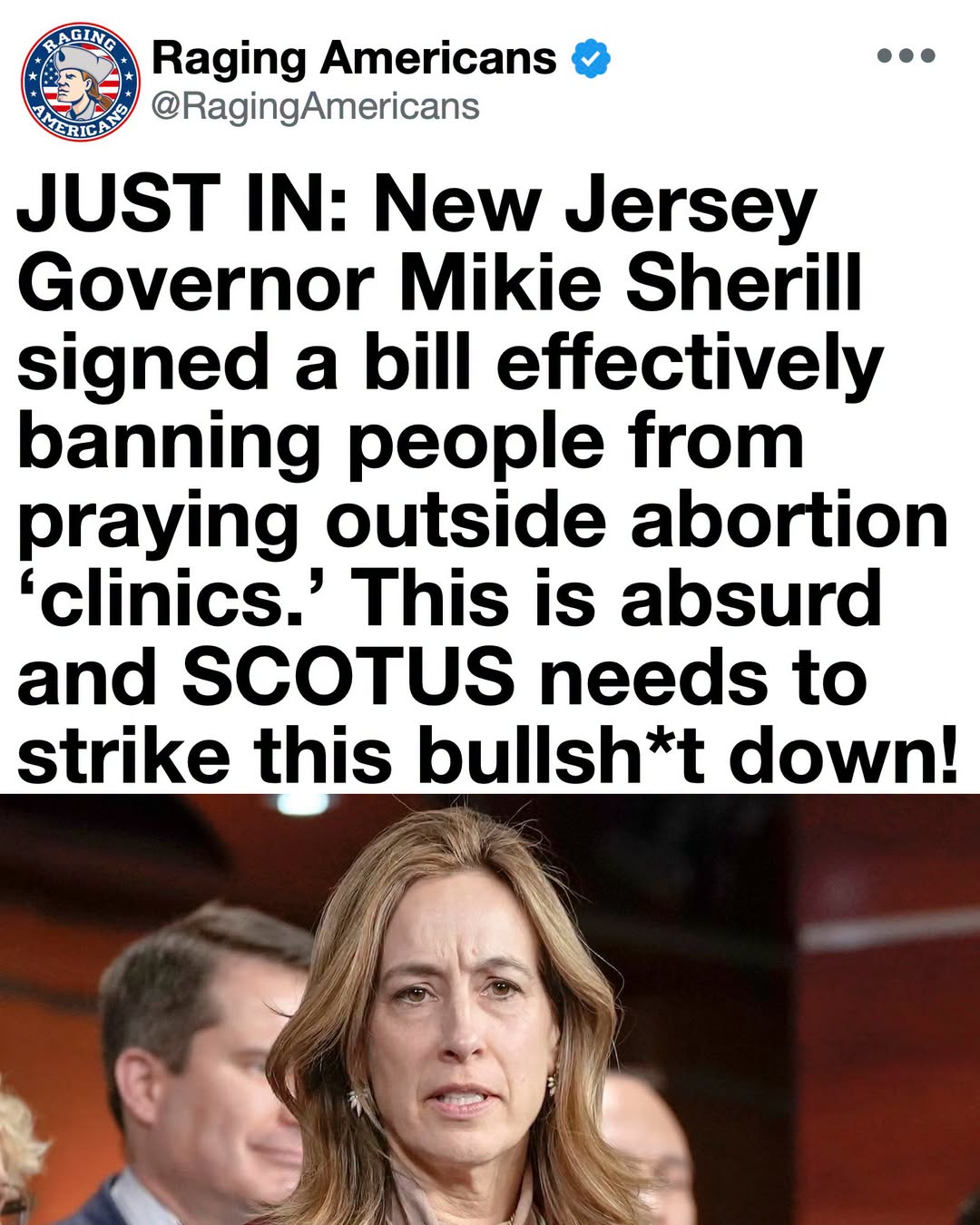
Governor Mikie Sherrill recently signed a bill that effectively turns public walkways into speech-free zones, specifically targeting individuals who dare to kneel or speak a quiet prayer. By signing this legislation, the administration has sent an unmistakable message that peaceful religious expression is no longer welcome in the public square. This is not about maintaining order or ensuring public safety; it is a direct strike against First Amendment freedoms.
For generations, public sidewalks have stood as the ultimate forum for assembly, free expression, and peaceful witness. They are the spaces where citizens from all walks of life have traditionally gathered to voice their deepest convictions without needing government permission. Under this new measure, however, those same sidewalks are being cordoned off and placed under ideological surveillance.
The notion that someone offering a quiet prayer or standing in silent reflection represents a danger is as absurd as it is alarming. When a state begins classifying quiet contemplation as a threat, it is no longer governing in good faith. It is using the heavy hand of the law to suppress voices it simply does not want to hear.
This is not neutral regulation, nor does it apply evenly across the board. It is blatant viewpoint discrimination carefully crafted to target one side of the most deeply contested moral issue in the nation. By singling out pro-life advocates, the state has abandoned any pretense of impartiality and chosen to weaponize policy against a specific belief.
Free speech and the free exercise of religion do not conveniently stop at the property line of a government-favored industry. Citizens do not surrender their fundamental rights simply because they step onto a sidewalk near a facility that political leaders wish to shield from moral scrutiny. The Constitution was specifically designed to protect citizens from this exact brand of targeted suppression.
Under this law, the right to offer gentle counsel, peaceful witness, or silent prayer is being actively criminalized. Ordinary people who feel a personal, moral, or religious calling to stand quietly on public property now face legal jeopardy. That reality should alarm anyone who understands the foundational principles upon which this nation was built.
When the government decides that certain forms of peaceful speech are unacceptable, it creates a dangerous and slippery slope. If authorities can ban quiet prayers outside one specific type of facility today, they can ban any form of peaceful dissent outside any building tomorrow. The principle at stake extends far beyond any single issue or location.
Laws like this reveal an unmistakable priority: silencing dissent rather than protecting legitimate public safety. If the true goal were community peace, the law would address disruptive or unlawful behavior regardless of the message being expressed. Instead, it exclusively targets those offering peaceful moral witness while leaving other forms of public activity untouched.
This deliberate double standard exposes the ideological motivation behind the measure. When a law specifically isolates one perspective for prohibition, it ceases to be a legitimate exercise of state authority. It becomes an unconstitutional tool designed to enforce ideological conformity in public spaces.
The Dangerous Illusion of Buffer Zones
The concept of using buffer zones to sanitize public areas of disfavored speech is an affront to the First Amendment. Labeling an entire public zone as off-limits to religious expression under the guise of administrative regulation does not make it constitutional. The courts have a long-standing responsibility to see through these semantic games and protect core civil liberties.
 Memphis mother charged after allegedly abandoning four young children in uncooled home — returning an hour later holding a beer
 Arlington worker José Mejía Hernández, hospitalized with brain bleeding after immigration arrest, was blocked from MRI by ankle monitor
 Outrage Erupts After Illegal Immigrant Assaults NYPD, Walks Free Without Bail, and Mocks Cameras
Judicial precedent has repeatedly affirmed that public sidewalks occupy a special status in American law. They are traditional public forums where the government’s power to restrict speech is strictly limited. By attempting to bypass these protections, state officials are directly challenging settled constitutional norms.
The idea that a person whispering a prayer constitutes an unlawful act is an insult to the intelligence of the American public. Prayer is an inherently peaceful exercise of personal faith, conscience, and devotion. To treat it as an act of hostility or harassment requires a total distortion of reality.
When the state claims the authority to dictate which thoughts and prayers are permitted on public land, it assumes a power it was never granted. The First Amendment exists precisely to prevent politicians from serving as arbiters of acceptable religious practice. No governor and no legislature has the right to rewrite that foundational rule.
Observers have rightly pointed out that this legislation represents a direct escalation in the ongoing effort to marginalize faith in the public square. By pushing religious expression out of public view, the state is attempting to redefine religious freedom as something that must remain locked behind closed doors. That narrow interpretation is completely foreign to the American tradition.
Constitutional rights do not exist at the mercy of shifting political tides or legislative majorities. They are inherent protections meant to shield individuals from government overreach, especially when their views challenge prevailing political orthodoxies. When those protections are weakened for one group, they are weakened for everyone.
The overreach embodied in this legislation cannot be allowed to stand unchallenged. The American legal system relies on the courts to strike down measures that punish protected speech under false pretenses. If judicial institutions fail to invalidate such obvious violations, the First Amendment will be reduced to a hollow promise.
Citizens who care about the future of religious liberty and free speech must make their voices heard against this unprecedented overstep. Tolerating the criminalization of prayer sets a precedent that will inevitably be used to silence other fundamental rights in the future. The erosion of constitutional protections always begins with the targeted silencing of a specific group.
A Definitive Line Has Been Crossed
The state has crossed a bright constitutional line by presuming to regulate the private prayers of peaceful citizens standing on public ground. There is no middle ground when it comes to basic First Amendment freedoms. Either the public square is open to all peaceful voices, or it becomes a curated zone controlled entirely by state decree.
Americans who still value the First Amendment must reject any government that arrogates to itself the power to decide which prayers are legal and which are forbidden. The right to peacefully practice one’s faith in public without fear of arrest is not a privilege granted by politicians. It is an unalienable right that must be fiercely defended against every form of state encroachment.
By enacting this measure, New Jersey officials have chosen to prioritize ideological enforcement over the fundamental liberties of their citizens. The contrast could not be clearer: on one side stands the fundamental right to peaceful religious expression, and on the other stands a state apparatus determined to silence dissent. This is a defining moment for constitutional freedom.
The legal fight against this law is not merely about one statute in one state; it is about defending the very essence of American liberty. When peaceful witness is outlawed and sidewalks are turned into speech-free zones, freedom itself is on trial. The line has been drawn, the boundary has been violated, and the defense of our core rights must now begin in earnest.
No Comments yet!