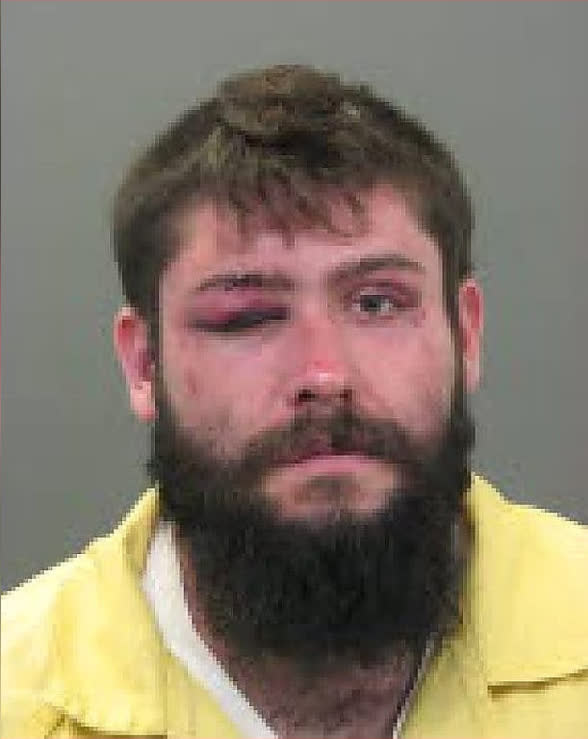
When a mugshot captures a suspect sporting fresh stitches and a badly swollen eye, the immediate assumption is often that the arrest itself turned violent. In the case of twenty-four-year-old Joseph Franklin Neff, however, the blood was already pouring before police ever arrived. It was a freezing February night in Feasterville, Pennsylvania, that quickly unraveled into an all-out, four-officer hallway brawl.
The chaos kicked off just before one in the morning on February 11, 2013, inside the Croftwood Apartment Complex. A late-night knock on an apartment door is rarely a comforting sound, but an unsuspecting resident opened up anyway. Standing on the threshold was Neff, an uninvited stranger whose presence immediately set off alarm bells throughout the small apartment.
According to initial reports, the resident quickly noticed that the twenty-four-year-old was grossly out of it and acting completely detached from reality. Sensing immediate danger, the tenant ordered Neff to turn around and leave the apartment immediately. But simple verbal requests meant nothing to a man who was already slipping into an unpredictable, drug-fueled state of agitation.
Instead of walking away, Neff turned aggressively hostile, kicking at the apartment door and lunging directly at the resident who had tried to eject him. Faced with an aggressive intruder charging forward, the resident reacted in pure self-defense, landing a solid punch squarely to Neff’s face. The heavy blow tore open the skin around Neff’s right eye, leaving him bleeding profusely.
After forcing the bleeding intruder out into the corridor, the resident slammed the door, hoping the nightmare was finally over. But Neff did not leave the Croftwood complex to seek medical care for his gushing eye wound. Instead, he vanished down the hallway, only to turn up outside a completely different apartment within the very same residential building.
Terrified residents inside the second apartment dialed 911 in a panic, reporting that a bloodied, agitated man was lurking outside their door armed with a knife. That chilling report immediately elevated the call to high priority, sending patrol cruisers racing toward the complex. Authorities later determined the weapon was merely a butter knife, though investigators never managed to recover it.
Officer Christian Tracy and Corporal Raymond Young were the first to arrive on scene, stepping into a tense and volatile apartment hallway. They found Neff standing there bleeding, drenched in sweat, and completely incapable of answering basic questions. He appeared utterly lost in a profound chemical haze, showing signs of severe disorientation while blood continued to drip down his face.
Hoping to defuse the escalating crisis without violence, the officers issued clear verbal commands, ordering the bleeding suspect to get down onto the floor. Neff complied briefly, lowering himself toward the ground just long enough to give the impression that he was submitting. But that brief moment of obedience was merely the calm before an explosive, violent surge.
Without the slightest warning, Neff suddenly scrambled back to his feet and lunged violently toward Corporal Young, punching the officer directly in the face. The sudden physical strike threw the narrow corridor into utter chaos. Neff began swinging wildly with both fists, charging forward aggressively and attempting to tackle both officers onto the hard hallway floor.
An Unstoppable Force in the Hallway
With Corporal Young under direct physical assault, Officer Tracy instantly drew his department-issued taser and fired the probes directly into Neff. Under normal circumstances, the sudden electrical charge completely immobilizes a combative subject by locking up the muscular system. Yet against Neff, the taser discharge failed to halt his forward aggression, barely slowing down his furious assault.
Seeing the taser fail, Corporal Young went hands-on, engaging in a desperate physical struggle to wrestle the thrashing twenty-four-year-old down. The cramped apartment hallway offered almost no room to maneuver, turning the arrest into an exhausting, close-quarters grappling match. Neff continued to kick, thrash, and throw wild punches, displaying an alarming level of raw physical power.
As the violent struggle intensified on the floor, Officer Tracy escalated his tactical response by deploying his baton against the combative suspect. He delivered multiple direct strikes in an urgent attempt to gain compliance and protect his fellow officer. Yet even hard baton impacts seemed utterly useless against the frenzied young man, failing to register any noticeable pain response.
In his sworn affidavit following the arrest, Officer Tracy documented the chilling reality of that physical encounter, writing plainly that the strikes appeared to have no effect. The suspect was completely detached from normal physiological pain limits, driven by a surge of adrenaline and potent illicit stimulants. When standard pain compliance tools completely fail, responding officers find themselves in an extraordinarily hazardous position.
 Brooklyn Street Shooter Busted After Stray Bullet Wounds Beloved Service Dog In Sickening Sidewalk Attack
 Eight Months Pregnant and Charged With Murder: The Harrowing Case of Keshia Golden and the Lethal Fight for Survival
 Utah Teen Claimed He Slept Through the Slaying of His Mother and Little Brother—Until Investigators Found the Evidence
It ultimately required a second taser deployment—this time aimed directly into Neff’s back—along with the arrival of two additional backup officers to finally end the brawl. With four officers now physically wrestling him down, they finally managed to overpower his resistance and secure the handcuffs. Subduing a single, bloodied suspect had pushed the responding officers to their absolute physical limits.
Once the scene was secured, emergency medical personnel arrived to extract the embedded taser darts from Neff’s back and evaluate the battered officers. Given the heavy bleeding from his facial wound, Neff was transported directly to St. Mary’s Hospital under police escort. Emergency room doctors cleaned his injuries and administered multiple stitches to close the gaping wound above his right eye.
Following his medical release, Neff was formally booked and hit with a severe slate of criminal charges reflecting the night’s extreme violence. Prosecutors charged him with aggravated assault, drug possession, simple assault, resisting arrest, and disorderly conduct. A judge subsequently set his bail at $150,000, ensuring that the combative twenty-four-year-old would remain held in custody pending further legal proceedings.
The Amnesia, The Aftermath, and The Black Hole of Justice
The bizarre nature of the case took another dramatic turn once the intense chemical high finally wore off and Neff sobered up in custody. He admitted to an officer that he had consumed a dangerous combination of cocaine and methamphetamine prior to wandering the apartment complex. Yet when asked about the violent hallway brawl, Neff claimed he had no memory of anything that happened.
Instead of maintaining the hostility he had displayed in the hallway, Neff appeared genuinely confused and bewildered by the charges against him. In a striking moment of apparent remorse, he even asked the arresting officers whether any of them had been hurt during the struggle. The stark contrast between the wild hallway fighter and the soft-spoken prisoner was both jarring and deeply unsettling.
That dramatic behavioral shift highlights the terrifying reality of drug-induced delirium and the extreme unpredictability of mixing methamphetamine with cocaine. When potent stimulants flood the brain, normal inhibitions and rational thought processes completely vanish, replaced by intense paranoia and explosive aggression. The residents and responding officers faced a terrifying, life-threatening encounter, regardless of whether Neff remembered throwing a single punch.
Observers often debate how much of Neff’s unstoppable resistance was driven by the illicit chemicals versus an underlying capacity for raw personal violence. Fighting through two separate taser deployments and absorbing baton strikes without flinching requires an extraordinary shutdown of normal human pain receptors. Many have pointed out that severe stimulant intoxication frequently produces this exact type of superhuman physical resistance during police encounters.
Yet, despite the dramatic nature of the Feasterville arrest and the high bail amount, the case seemingly vanished into thin air afterward. A thorough search of available court records reveals no public record of a guilty plea, a scheduled criminal trial, or an official sentencing order. It is as though the entire legal proceeding quietly dissolved behind closed administrative doors.
Critics and legal observers frequently point out that cases involving severe substance abuse often take unexpected detours away from public view. Without accessible records, it remains entirely unclear whether Neff entered a specialized drug diversion program, accepted a confidential plea agreement, or had his charges quietly downgraded. The justice system often resolves complex addiction-driven cases far away from public scrutiny and media attention.
For the officers involved, Corporal Raymond Young and Officer Christian Tracy, the terrifying memories of that narrow Feasterville hallway cannot be so easily erased. Law enforcement officers face immense danger whenever they confront an agitated suspect in a confined space where non-lethal weapons repeatedly fail. Surviving an assault against an opponent who feels no pain is a harrowing testament to the perils of modern frontline policing.
The Croftwood residents who were forced to defend their homes also endured a traumatic ordeal that shattered their sense of late-night security. Being confronted at one in the morning by an aggressive, disoriented stranger kicking at your door is an absolute nightmare scenario. The resident who threw the punch acted out of sheer necessity, defending his home against an unpredictable intruder.
The story of Joseph Franklin Neff serves as a chilling case study in how quickly illicit narcotics can transform an ordinary night into chaos. In a matter of minutes, a twenty-four-year-old managed to terrorize innocent neighbors, violently assault two police officers, and end up bloodied in a hospital bed. His swollen booking photo remains a stark visual reminder of the sheer devastation wrought by cocaine and methamphetamine.
Whether Neff ever achieved long-term sobriety or simply slipped through the cracks of a massive judicial system remains an unanswered question. What is certain is that the events of February 11, 2013, left an indelible mark on everyone who crossed his path in that Feasterville hallway. Until official updates finally emerge, his case remains a haunting symbol of violence, chemical amnesia, and unresolved justice.
No Comments yet!