A wave of sheer terror tore through East Oakland on Monday night, leaving one dead and four injured in what police call a random rampage. For thirty minutes, a knife-wielding assailant struck across multiple locations, turning public spaces into bloody crime scenes. Yet, even as the community reels, police have sparked intense debate by adamantly refusing to name the suspect.
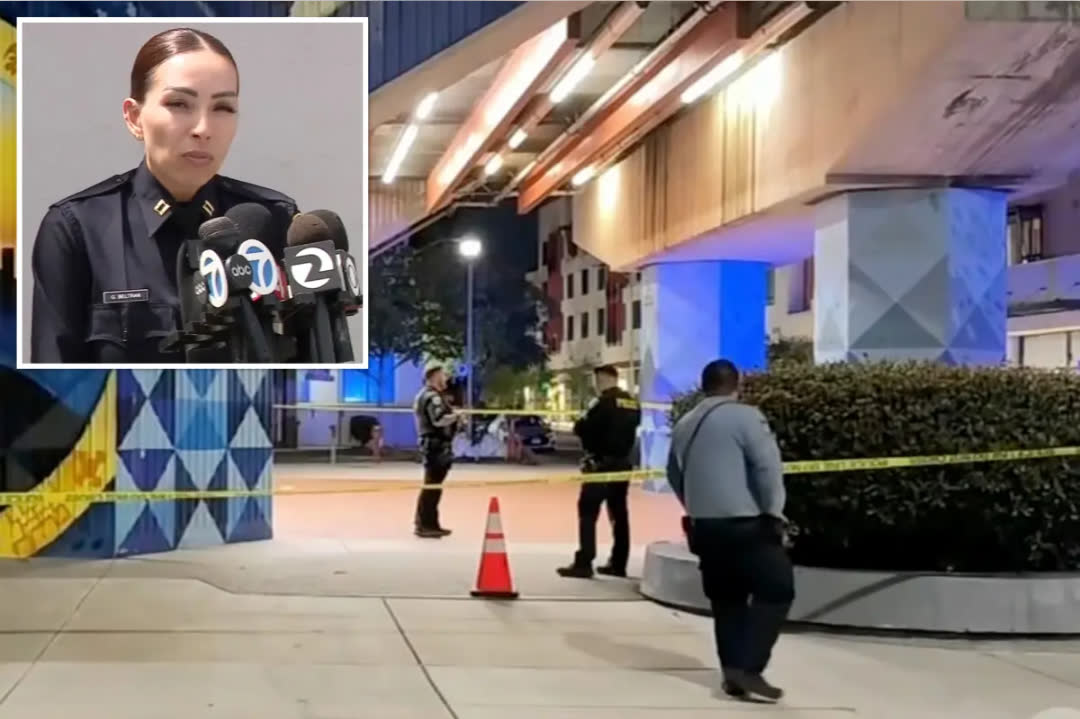
The sudden explosion of violence has sent shockwaves through the California city, exposing the fragile boundary between routine life and sudden horror. Residents walking through their neighborhoods or commuting home found themselves directly in the path of a fast-moving attacker. What makes the tragedy even more disturbing is the complete absence of motive, leaving locals with profound unease.
During a press conference on Tuesday afternoon, Oakland police addressed a frightened public, but the answers offered were chillingly sparse. While confirming that five individuals were targeted across a half-hour window, investigators repeatedly declined to identify the person in custody. They revealed only that the victims included three men and two women, aged between 30 and 50.
The human toll became clear as medical updates emerged from local hospitals treating the wounded survivors. One male victim succumbed to fatal injuries in the park where the violence began, while another remained in critical condition Tuesday. The remaining three victims were listed as stable, bearing physical and emotional scars from the terrifying encounter.
Perhaps the most terrifying admission from law enforcement was the sheer arbitrariness of the spree. Detectives stated plainly that, based on evidence gathered so far, they believe every attack was carried out at random. There was no argument, no prior altercation, and no established dispute to explain why these five individuals were singled out for bloodshed.
Investigators cautioned that it remains too early to determine whether the victims had any connection to one another. However, prevailing evidence points toward an attacker who struck blindly against anyone crossing his path on Monday evening. That grim assessment has left residents wondering how anyone could have protected themselves against an unprovoked, sudden assault.
Compounding public anxiety is the departmental decision to keep the suspect’s identity secret, despite having him safely locked in jail. In high-profile mass attacks, communities expect transparency regarding who was arrested, their criminal history, and their background. The refusal to release basic identifying details has fueled widespread frustration across the Bay Area as residents demand answers.
What police did reveal paints a grim picture of the complex crises colliding on the pavement of East Oakland. Authorities confirmed that the captured suspect is homeless, living without permanent shelter in the city. Furthermore, officials disclosed that at least two victims attacked during the rampage were also experiencing homelessness when the violence unfolded.
That stark reality underscores the extreme vulnerability of those living without four walls to shield them from street violence. Many note that unhoused individuals are disproportionately exposed to sudden danger, lacking basic physical security when night falls. The fact that the violence played out in public parks and transit corridors highlights how exposed vulnerable populations remain.
Law enforcement leaders did not mince words when categorizing the severity of Monday night’s multi-scene onslaught. Detectives acknowledged that they have not encountered attacks of this magnitude in recent years, highlighting how extraordinary the incident was. The sheer speed and geographic spread of the violence pushed municipal resources to the limit as emergency calls poured in.
A Rapid Trail Of Blood Across East Oakland
The nightmare began shortly before 7:30 p.m. on Monday, when sirens shattered the evening calm around Cesar Chavez Park. Officers were initially dispatched under the impression that they were responding to an active shooting. But when squad cars arrived at the scene, officers were greeted not by gunfire, but by a horrifying spectacle of knife violence.
Inside the park, police discovered a man suffering from severe stab wounds that required immediate medical intervention. First responders scrambled to perform lifesaving measures on the grass, attempting to stabilize the victim as precious minutes ticked away. Despite their frantic efforts to keep him alive, the man’s injuries proved fatal, and he died right at the scene.
Before investigators could secure the perimeter at Cesar Chavez Park or comprehend the scope of the incident, violence shifted blocks away. Police were quickly summoned to a second scene near 38th Avenue and San Leandro Street. There, officers encountered another injured victim who had been stabbed, making it obvious that an active, dangerous threat was loose in the community.
The terrifying rampage continued to widen across East Oakland with breathtaking speed, moving dangerously close to public transportation hubs. Commuters were placed on high alert when Bay Area Rapid Transit officers alerted Oakland police to yet another stabbing. That third violent encounter occurred near the Fruitvale BART station, a bustling focal point for daily travelers.
The realization that transit infrastructure was now entangled in the spree heightened the urgency to track down the assailant before more lives were claimed. Observers note that an attacker moving through transit corridors poses an immense challenge for responding units, given heavy foot traffic. East Oakland was plunged into thirty minutes of pure suspense as officers fanned out.
The bloodshed did not stop at the transit station, as emergency personnel were directed to yet another location to treat casualties. Two additional victims were discovered wounded near 39th Avenue and International Boulevard, bringing total casualties to five. In minutes, four distinct geographic locations had been transformed into taped-off crime scenes, stretching the capacity of local emergency responders.
Looking at the map of attacks, detectives realized that the entire rampage unfolded across four separate locations in roughly thirty minutes. The sheer velocity of the suspect’s movement suggested a relentless drive to inflict harm, even if targets were picked at random. It was the kind of rapid-fire urban nightmare that every major metropolitan police department dreads containing.
As dusk settled over the city, the atmosphere on the streets was described as fraught with panic, confusion, and fear. Pedestrians and business owners had little way of knowing where the phantom attacker might strike next. Without the immediate intervention of alert bystanders, the toll of this violent sweep across East Oakland could have climbed significantly higher.
In the midst of the escalating crisis, the courage of ordinary community members broke the momentum of the deadly spree. Rather than retreating into silence, several observant residents stepped forward, keeping eyes on the suspect and actively directing responding officers toward his location. Their quick thinking provided patrol units with the critical intelligence needed to corner the assailant.
Oakland Police spokesman Beere publicly commended the local neighborhood for stepping up during those critical, chaotic minutes. Addressing reporters at the Tuesday briefing, Beere expressed profound gratitude for the community’s willingness to work hand-in-hand with law enforcement to neutralize the threat. Without that civilian cooperation, locating a mobile attacker in a dense urban area would have been vastly harder.
The Foot Pursuit And The Lingering Questions
Guided by the community’s precise directions, officers converged on the suspect near the 1500 block of 39th Avenue shortly before 8:00 p.m. What followed was a tense foot pursuit as the armed individual attempted to evade the closing perimeter. With sirens wailing and officers closing the distance, the half-hour reign of terror across East Oakland reached its dramatic climax.
Cornering the suspect, officers drew their weapons and issued stern verbal commands ordering the individual to drop the knife he was holding. In a situation that could have easily escalated into lethal gunfire, the suspect complied with directives and surrendered. Police took him into custody without further violence, recovering the weapon believed to have been used in all five attacks.
The recovery of the blade brought immediate relief to officers on the ground and frightened residents watching from nearby windows. Taking an armed mass stabbing suspect into custody without discharging a firearm was a rare tactical outcome in an otherwise violent evening. Yet, the physical capture of the suspect was only the beginning of a much longer, more complicated investigative journey.
Reflecting on the sheer speed and devastation of the rampage, spokesman Beere offered a sobering assessment of the close call the city survived. The police spokesman candidly noted that the outcome could have been “a lot worse” had officers not apprehended the suspect when they did. Had the rampage lasted even slightly longer, more innocent bystanders could have fallen victim.
Now, detectives face the grueling task of reconstructing the suspect’s movements prior to 7:30 p.m. to understand what triggered the explosion of violence. Investigators are reviewing surveillance feeds, interviewing witnesses, and examining physical evidence from all four crime scenes. They are working to establish whether any subtle interactions preceded the attacks, or if the tragedy was truly an act of unadulterated madness.
Meanwhile, the department’s continued refusal to release the suspect’s name remains a major sticking point for a community demanding accountability and answers. Critics argue that transparency is vital in the wake of mass violence, especially when public safety has been compromised. Keeping the suspect anonymous fuels speculation and leaves the public wondering what details authorities might still be withholding.
As East Oakland mourns the life lost at Cesar Chavez Park and prays for the recovery of the critically injured victim, profound questions linger. The city has been reminded of how quickly ordinary public spaces can be transformed into scenes of horror by a single individual with a knife. Until law enforcement provides full transparency, the community must grapple with the chilling reality of unprovoked terror.
No Comments yet!