People underestimate me for a living, and I’ve mostly made my peace with it. I’m a woman in my late fifties from a county most people couldn’t find on a map. I wear practical clothes. I talk slow because I think slow — on purpose, because thinking slow is how you avoid saying something fast that you can’t take back. Men like Trent Mercer take one look at me and file me under “harmless local,” and I have learned to let them, because a person who thinks you’re harmless will tell you absolutely everything.
Let me explain the land, because the land is the whole story.
My great-grandfather put together a stretch of ground in this county over a lifetime of farming and stubbornness. Before he died, he did something unusually forward-thinking for his time: he put the bulk of it into a family trust, so that no single descendant could sell it off in a weak moment or lose it in a bad marriage or a bad year. The trust holds the land. A director makes decisions on the trust’s behalf, bound by rules my great-grandfather wrote to keep the land in the family and out of the hands of exactly the kind of man who showed up in our county last spring.
When my father passed, the directorship came to me. It’s not glamorous. It’s mostly property taxes and fence-line disputes and telling the occasional hopeful buyer no. But it means that on the specific parcel everyone was suddenly so interested in — a flat, road-adjacent stretch at the edge of town, perfect for a developer’s dreams — nothing happens, legally, without my signature. Nothing.
So you can imagine my interest when Trent Mercer rolled into town and started telling people he’d “secured the site” for a major shopping center. I hadn’t secured anything to him. I’d never met the man. And yet here were the renderings in the local paper, here was the buzz, here were the promises of jobs, and here was a man acting like the ground was already his.
That’s where I found it. An “option agreement,” recorded as an exhibit to Mercer’s financing paperwork, purporting to give his company the right to purchase the land from the trust. It had the trust’s name on it, a legal description of the parcel, and on the signature line the name Ruth Callahan, Director — with a signature above it.
I have signed my name approximately ten thousand times in my life. I know my own hand. That was not my signature. It was a decent forgery, but it was wrong in the way a forgery is always wrong to the one person who’s signed that name ten thousand times. And most damning of all, it was dated to a week I could account for down to the hour — the week I’d spent at my sister’s bedside two states away after her surgery, nowhere near any office, any notary, or any Trent Mercer. He had forged my signature to manufacture a right to my family’s land, and he was days from using it to raise millions.
So I found out when and where the investor unveiling was. It was at a hotel two towns over, invitation-only, the afternoon he planned to close his financing. I am, technically, a member of the community he was courting, and I know how to get into a room. I put on my plain blazer, I brought a slim folder, and I sat in the back like a naive small-town woman out of her depth.
I asked my one quiet question about title. I let him laugh at me. I let the room chuckle. I needed them charmed and comfortable and entirely on his side, because the higher he stood, the farther the fall would carry.
Then, when he moved toward the signing — actual pens, actual paper, the crisis clock down to its last minutes — I stood up and asked if I might address one small point of “small-town naivety” before everyone committed their money.
He couldn’t say no without looking afraid. So he waved me up, grinning, ready to make me the afternoon’s entertainment.
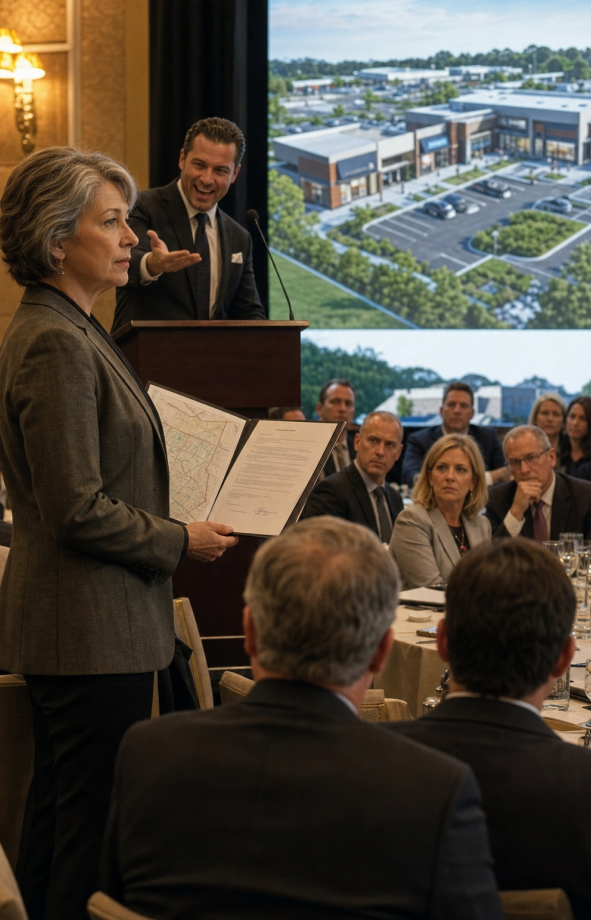
I opened my folder. I laid out the county parcel map and I explained, slowly, because I do everything slowly, that the land his center was drawn upon sat inside a family trust. I explained that the trust had exactly one director authorized to option or sell that land. And then I told them my name, and I watched the word “director” land on a few faces at the money tables that had done their homework and suddenly went pale.
Mercer recovered fast. He said of course, the option agreement, all properly executed, and he had his assistant put the document up on the screen — the very forgery, blown up ten feet tall for the whole room.
Which was exactly where I wanted it.
I said, “That’s my name. That is not my signature.” And I laid my driver’s license, three years of trust filings, and a notarized document next to a printout of his “agreement,” and I invited any investor in the room to compare the signatures themselves. Then I said the thing that turned skepticism into cold silence: I told them the date on his agreement, and I told them where I had verifiably been that entire week — at a hospital two states away, with records and witnesses and a sister who’d be glad to confirm it — and that I could not possibly have signed anything in this county on that day.
A forged signature is bad. A forged signature that the signer can prove was physically impossible to have made is fatal.
The room turned on him in the space of about ninety seconds. Money is loyal only to itself. The moment those investors understood that the foundational document of the deal was forged — that the land wasn’t secured, that the man at the podium had committed what looked an awful lot like fraud — they didn’t want to be near it. Phones came out. A man I later learned was the lead investor stood up, buttoned his jacket, and said, “We’re done here,” and the rest followed him out like a tide going back to sea.
The deal died on that ballroom floor.
I was ready. I was ready the whole time.
He just mistook ready for naive, right up until the moment I showed the room whose ground he’d been standing on.
Comments are closed.