The phone was already ringing against my ear when Grant folded his arms and told me, in that patient tone he used on waiters, that I was making a scene on my own porch.
He didn’t know yet that it wasn’t my porch to make a scene on. It never had been.
“Nell,” he said, “put the phone down. Be reasonable. The house needs someone who’s actually here to run it, and you’ve been gone a year.”
A year. He said it like an accusation, like I’d taken a sabbatical in the Maldives instead of sleeping upright in a hospice chair, holding my mother’s hand while the machines counted down. Behind him, through the wavy old glass, Simone lifted my grandmother’s Meissen shepherdess off the mantel, turned it over to read the mark, and set it back facing the wrong way. She caught my eye through the window and gave me a small, pitying smile, the kind you give a stranger who’s parked in your spot.
The line connected.
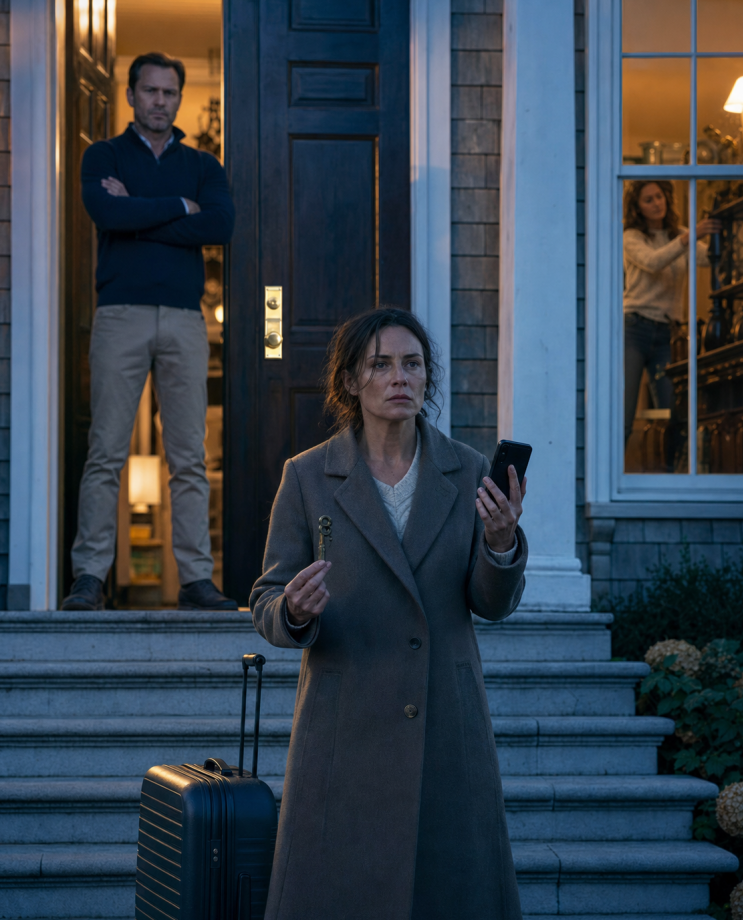
“Marcus,” I said. “It’s Eleanor Prescott. I need you to pull the Prescott Family Trust file. Yes. Now, if you can.”
Grant’s jaw did something complicated. Marcus Ferro had been my grandmother’s estate attorney for thirty years, and he was mine now, though Grant had never bothered to learn that. Grant handled his own money, loudly, at dinner parties. He’d never once asked how the Newport house actually worked, because in his head it was simply ours the way a view is yours if you like it enough.
“Marcus, I’m standing on the front steps of the Bellevue Avenue house and my key doesn’t fit the lock. Can you confirm for me, out loud, who holds title?”
I put him on speaker. I wanted Grant to hear it in a lawyer’s flat, unbothered voice.
“Title is held by the Prescott Family Trust,” Marcus said, tinny and clear in the dusk. “You are the sole trustee and director, Eleanor. Your grandmother named you before she passed. Grant is not a beneficiary. He was never added. Nobody can be added without your signature, and you’ve never signed anything.”
The porch got very quiet. Somewhere down the hill a foghorn moaned.
“Who’s the current occupant of record?” I asked.
“You are. Only you. Any other resident is there at the trustee’s discretion. Yours.”
I lowered the phone. I looked at my husband, and I watched the arithmetic finally start running behind his eyes.
“The renovations,” I said. “The parlor you gutted. The kitchen you told me you were ‘finally handling.’ The locks you changed. You did all that to a house you don’t own, Grant. You spent a year decorating a building that legally belongs to a trust I control.”
“We’re married,” he said, but it came out thin. “Marital property—”
“It was my grandmother’s before we married. It’s in trust. You’d know that if you’d ever read anything that wasn’t about yourself.” I turned the useless key over in my hand, the worn brass warm from my grip, the little scratch I’d made on it at sixteen still there. “You changed the lock on my house so I couldn’t come home from burying my mother. Sit with that.”
Simone had come to the doorway now, drying her hands on a dish towel that had monogrammed corners — my grandmother’s initials, EP, the same as mine. She’d been using our linens. “Grant?” she said, uncertain for the first time. “What’s happening?”
“What’s happening,” I said, “is that you’re both trespassing. As of right now. I have a lawyer on the phone who will put that in writing tonight.”
I didn’t yell. That surprised me most. A year of hospice teaches you that the loudest thing in any room is a quiet person who has finally stopped negotiating.
Grant tried, of course. He tried charm, then logic, then the version of hurt he thought looked like love. He said we could talk about this, that I was exhausted, that I wasn’t thinking clearly. Simone slipped past him at some point and stood on the lawn with her arms crossed, no longer rearranging anything, just watching her whole soft future evaporate off the grass.
I let the police non-emergency line and Marcus handle the choreography of who left when. It took a locksmith ninety minutes to core the deadbolt Grant had installed and hand me a new key that actually turned. I paid him from the trust account, the way my grandmother would have, and he called me Mrs. Prescott, and I didn’t correct the Mrs.
When I finally stepped inside, the house smelled wrong — someone else’s candle, someone else’s coffee. The shepherdess was still facing backward. I turned her around so she looked out at the water, the way Gran had kept her, and I stood in the gutted parlor in my travel-creased coat and let myself shake for exactly one minute.
Then I stopped.
Grant filed for divorce three weeks later, I think hoping a judge would see the grand house and split it down the middle. His attorney learned about the trust in the first meeting and, I’m told, stopped taking his calls shortly after. There was nothing to divide. He’d built a life on my absence, on ground he never stood a chance of owning, and when I came home the whole thing simply had nowhere left to stand.
I kept the old key. It doesn’t fit anything now. I keep it on the mantel, next to the shepherdess, facing the sea.
Comments are closed.