He held the note out like it might catch fire in his fingers.
Same cream stationery. Same soft, furred fold. Same careful looping hand — except the hand had never been mine, no matter how many times he’d read it as if it were.
I didn’t take it. I couldn’t, because Lily was still wrapped around my leg in her pink puffer coat, her auburn head pressed to my hip, and my whole body had gone to the single task of holding her up.
“Where did you get that,” Daniel said. His voice had lost the polish. The man who’d stepped over my carry-on ten minutes ago, who’d lectured a gate agent about his time, was gone. What was left was gray and unsteady, a person standing on ice he could feel cracking.
“I didn’t get it anywhere,” I said. “I got the other one. The one that said you didn’t want her.”
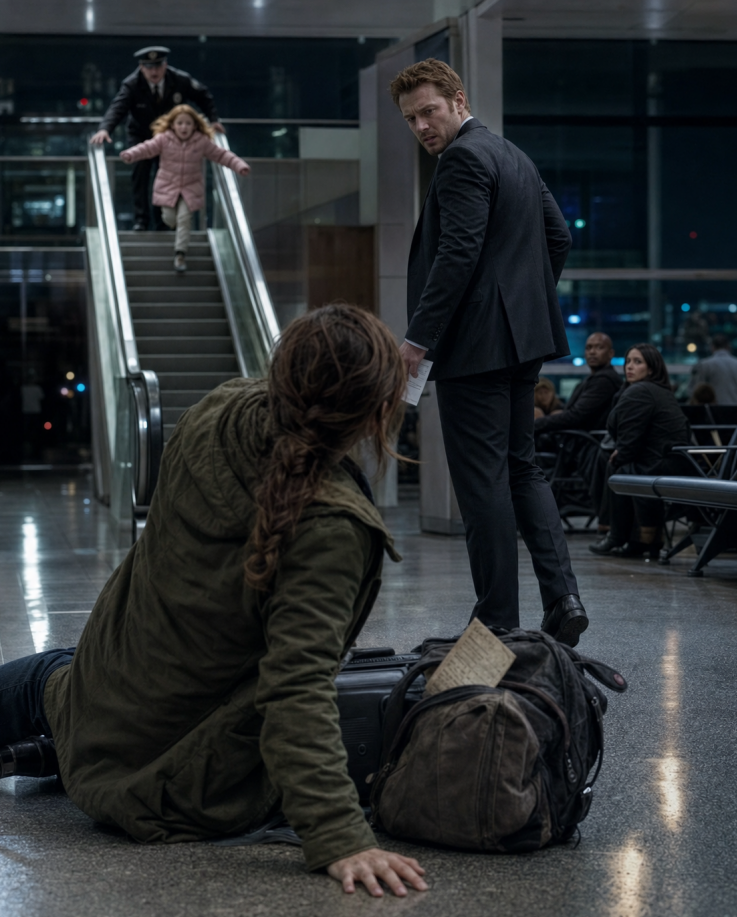
His eyes went to Lily. Really went to her, the way you look at something you’ve been told a hundred times doesn’t exist. Her chin, which was his chin. The exact impossible red of her hair. The little furrow between her brows that I’d spent six years telling myself she got from me.
“Mommy, is that man crying,” Lily whispered, too loud, the way six-year-olds whisper.
The chauffeur hovered a few feet off, unsure whether to reclaim the child he’d been driving or back away from whatever this was. Around us the late gate had gone quiet. A woman with a neck pillow had stopped scrolling. Even the agent had frozen mid-scan, a boarding pass suspended in the air.
“Six years ago,” Daniel said slowly, “you left a note on my kitchen counter. You said you’d met someone. You said the baby wasn’t a life you wanted with me. You said not to look for you.” He swallowed. “I looked anyway. For eight months. And then I stopped, because a man came to my office with a signed statement, and my mother sat me down and told me to protect myself.”
The word landed in my chest like a stone dropped down a well. His mother.
“I never wrote you a note,” I said. My voice came out thin. “I woke up in that apartment and you were gone. There was a note in your handwriting on my pillow saying the pregnancy was a mistake, that your family would ruin me in court if I ever came near you, that you’d already left the state.” I pressed my hand flat against Lily’s back to keep it from shaking. “I believed it, Daniel. I believed it because it was in your hand. I’ve kept it in a shoebox for six years so I’d never let myself hope.”
He looked down at the paper in his fingers like it had changed shape.
“This isn’t your handwriting,” he said. It wasn’t a question. He’d heard it and understood it in the same breath. “And that one wasn’t mine.”
We stood there, two people who had each spent six years memorizing a forgery of the other’s cruelty, and I watched the whole architecture of his anger come down at once. Not slowly. All at once, the way a building comes down when the right supports are pulled.
“My mother,” he said, “hired someone to write both.”
I didn’t have to answer. He wasn’t asking me. He was saying it out loud to see if it could stand up, and it could. It explained the statement, the man at his office, the way his mother had steered him out of the country on a “fresh start” the very week I’d been discharged from the hospital with a newborn and no forwarding address for the father.
It explained the six years.
Lily, bored of the crying man, tugged my sleeve and announced she needed the bathroom, and the ordinary smallness of that — a kid needing a toilet in the middle of the ground shifting under two adults — was the thing that finally broke me. I laughed, and it came out wet.
Daniel crouched. Slowly, the way you approach something that might bolt. He was at her eye level now, in his tailored suit on the filthy carpet of Gate B47.
“Hi,” he said to her. Just that.
“Hi,” Lily said. “Are you sad?”
“A little,” he said. “But not about you.”
She considered this with the grave attention six-year-olds give to important questions, then held out the crumpled boarding-pass stub she’d been carrying as a toy. “You can have my ticket,” she offered. “It’s not real but it works.”
He took it like it was made of glass.
The gate agent quietly reprinted our seats. I don’t know who authorized it — later I’d learn Daniel had, that the man who’d sneered about who belonged up front had put his own daughter and a stranger he’d wronged into the two seats beside his — but the red-eye we’d all been waiting for didn’t feel like the point anymore.
We didn’t fix it at the gate. I want to be honest about that, because the movies make you think a reveal is the ending, and it isn’t. It’s the first true thing after a long lie, and true things are heavy.
There were lawyers, after. There was a conversation with his mother that I wasn’t in the room for and never asked about, though Daniel came out of it looking older and lighter at once. There was a paternity test he insisted on taking, not because he doubted, he said, but because Lily deserved a father who could never be told again that she wasn’t his.
And there was a night, months later, when he sat on the floor of my apartment assembling a dollhouse two sizes too big for the room, and Lily fell asleep against his shoulder mid-sentence, and he looked up at me with the note — my note, the fake one — in his hand.
“Can I burn this,” he asked.
“Both of them,” I said.
We did it in the kitchen sink, two yellowed lies curling into ash, and the smoke set off the alarm, and Lily woke up laughing, and for the first time in six years the sound in my chest wasn’t grief pretending to be strength. It was just relief, finally allowed to breathe.
Comments are closed.