The note was four sentences long, written in a careful hand on a page torn from a child’s practice tablet, and it took me nine years off my feet.
I need to back up. When I was thirty-five I worked nights at a different plant, two cities over, before I moved up to managing the floor here in Toledo. Nights were their own world — a skeleton crew, the machines louder because there was nothing else to hear, the same forty people passing the same hours in the dark. There was a woman on that crew named Tessa. Quick hands, quicker mouth, the kind of person who made a brutal shift survivable. We were together, quietly, the way people are when they work opposite the rest of the world. And then one winter I took the day-shift promotion here, and she didn’t come with me, and we let the distance do what distance does. No fight. No goodbye that felt like a goodbye. Just two people who stopped calling.
I never knew she was pregnant. That’s the whole hinge of it. She never told me, and I never asked, and I built a settled, ordinary life on the assumption that chapter had simply closed.
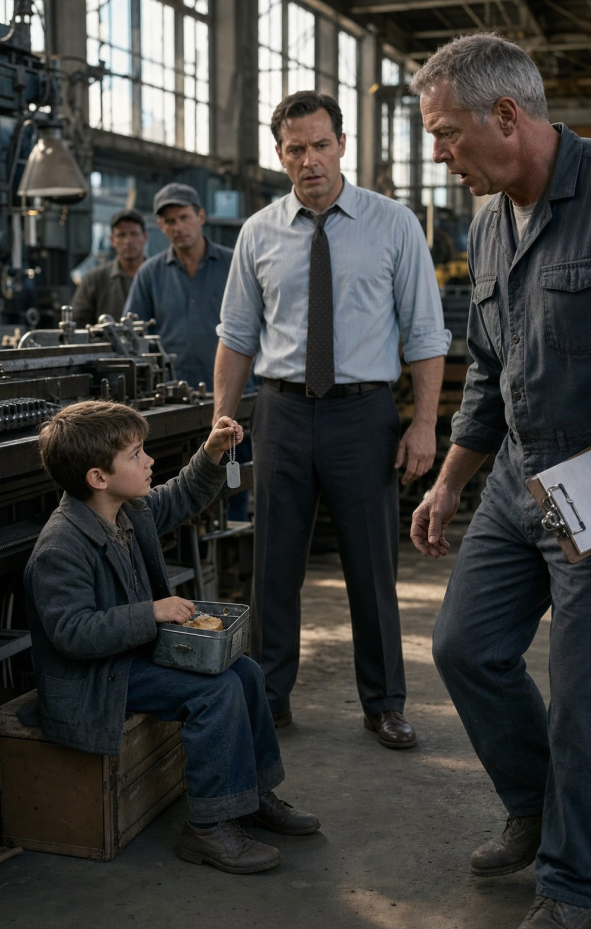
So when I came around the crate stacks on a Tuesday afternoon and found a seven-year-old boy sitting on an overturned bin, eating a sandwich, wearing my dog tag around his neck, the floor genuinely tilted under me. I got down on one knee. I asked him his name and he said Micah, and I asked where his mother was, and instead of answering he held up the tag in his fist like it explained everything.
It did, eventually.
The note was in his lunchbox, folded into a tight square the way you fold something you’ve read a hundred times. It was Tessa’s handwriting. She wrote that she’d gotten sick — her heart, something she’d known about and worked straight through anyway, because a single mother on an hourly wage doesn’t get to stop. She wrote that she’d worked my old night shift right up until the week she collapsed, because it was the only schedule that let her be home when Micah woke up. She wrote that she’d never asked me for anything because she was proud and because she was scared and because by the time she wasn’t either of those things anymore, too much time had passed to know how to start.
And she wrote the last sentence plainly, no softening: His name is Micah. He’s yours. If you’re reading this, I’ve run out of time to bring him myself, so I’m sending him to the one name I know he can trust.
A neighbor had driven him. A tired, kind woman who’d promised Tessa she’d get the boy to the plant with my name on it, and who had talked her way past a distracted gate guard and pointed Micah toward the floor because she didn’t know the protocols and just wanted the errand done. Tessa was in a hospital across town. She was alive — that Tuesday she was still alive — but she was out of road, and she knew it, and she had spent what she had left making sure her son wouldn’t be.
I want to tell you I handled it with grace. I didn’t. I read that note twice on the floor with the conveyors still running and my throat closing, and then I told my second to take the line, and I put Micah in my truck and drove to the hospital with a strange boy who was somehow entirely mine.
Tessa was thin and gray and furious at herself for waiting, and she cried when she saw me, and she said the thing I’ll carry the rest of my life: “I didn’t want him to have to earn a father. I wanted him to have one already there.” I told her he did. I told her he’d had one the second I read his name, and I meant it in a way I didn’t fully understand yet but would learn to.
She had eleven more days. I spent every one of them at that hospital learning my son in front of his mother, so she could see it happen, so she could go knowing the handoff had landed. Micah has her laugh and, God help me, my stubborn cowlick. He has her way of going quiet and watchful when a room gets tense. He is, in every way that the paperwork later confirmed and my heart already had, my boy.
He lives with me now. His room is down the hall. He keeps the dog tag in a small wooden box on his dresser, next to a photo of his mother, and once in a while I catch him holding it the way he held it that day on the plant floor — like an answer to a question he was too young to have to ask.
People ask if I’m angry that she never told me. I was, for about a day. Then I understood that Tessa spent seven years carrying alone what she could have shared, and that the last thing she did on this earth was hand it to me anyway, trusting a name stamped on a piece of steel to be enough.
It was enough. It’s the most enough I’ve ever been.
Comments are closed.