I did not move to help him, and I don’t know why. Maybe some part of me understood that if I touched that notepad, I would take from him the one thing this house had spent a year stealing — the choice to speak for himself.
So I waited. I watched Adrian Thornton drag his hand across the blanket, watched the muscles in his forearm shake with an effort that made my own jaw clench in sympathy, and watched him fumble the fallen pen up from the rug where it had landed. It took him a long time. Minutes that felt like hours in that dim, gold-papered room. When he finally pinned the notepad against his knee and began to write, the letters came out crooked and enormous, a child’s hand forced through a grown man’s ruin.
The first word was HEAR.
Then, slower: I HEAR EVERYTHING.
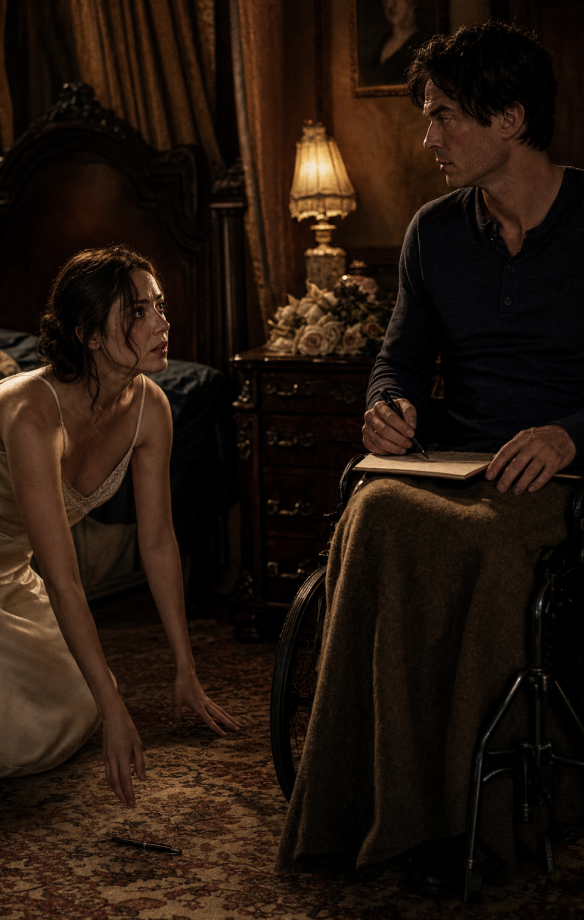
I put my hand over my mouth. He kept going, resting between strokes, breathing like the writing cost him something I couldn’t see. NOT SAFE, he wrote. THEN, beneath it, in letters that pressed so hard the pen tore the paper: JASON.
I have replayed that night a hundred times since, and I still remember the exact temperature of the fear that went through me. Not fear of him. Fear for both of us.
It came out over the following days, in fragments, in that shaky handwriting and in the slow blink he used for yes. Adrian had not been “absent” for a year. He had been aware for most of it — trapped in a body that had betrayed him after the accident, yes, but present, listening, learning. And somewhere in those long silent months he had made a terrible discovery: it was easier, and far safer, to let them believe he was gone. Because the moment his cousin Jason and the family lawyer believed Adrian could understand what was being said around his bed, the conversations changed. They stopped talking about his recovery. They started talking about his estate.
He had heard all of it. The doctor who was paid to keep his notes vague. The “care schedule” that kept him dulled and drowsy whenever visitors came, so no one would catch the awareness behind his eyes. He wrote the word for it once and then scratched it out, ashamed, and I understood that he had spent a year being managed rather than healed. I won’t pretend I understood the medicine of it. I understood the shape of it, the way you understand a locked door without seeing the key — someone had decided a silent Adrian was worth more than a living one.
And I was part of the plan. That was the sentence that undid me. He wrote it out fully, the longest thing he’d written yet, resting three times to finish it: THE MARRIAGE MAKES THE TRUST VEST. THEN THEY HAVE YOU DECLARED UNFIT. THEN JASON RUNS BOTH OF US.
I sat down hard on the floor beside his chair. Of course. I had been so busy feeling like a signature that I hadn’t asked why they needed the signature to be a person at all. A wife made the estate whole on the deadline. A wife who could then be quietly labeled unstable, unfit, a gold-digger who married a dying man for his money — she could be pushed out, controlled, erased. And Jason, who “handled everything,” would go right on handling it, now with the whole Thornton fortune vested and no inconvenient heir awake to object. The lawyer had drafted it all like a grocery list. I was the ink, and Adrian was the paper, and neither of us was ever meant to read what was written on us.
“How long,” I finally asked, “have you been letting them think you’re gone?”
He wrote a number. I won’t say it here. It was long enough to break my heart and long enough, I realized, to make him the most patient person I had ever met. He had been waiting. Watching Jason overreach, watching the lawyer get sloppy, gathering the small proofs a careful man gathers when he has nothing but time and a notepad. He had simply never had anyone on the inside he could trust.
Until they married him to a stranger who talked to him like he was still a man.
“I told you I’d rather be poor and free,” I said. My voice was steadier than I felt. “I meant it. But I didn’t know you were in here. That changes the math.”
His mouth moved. It wasn’t quite a smile — a year of stillness doesn’t give a face back all at once — but it was close, and it was the first real thing I’d seen in that entire mausoleum of a house. He wrote one word.
PARTNERS?
I looked at the fallen pen, at the torn notepad, at the man everyone had written off, and at the trust deadline sitting six days away like a cliff edge. I thought about how they’d underestimated us both — the disposable wife and the vegetable heir, the two people at the very bottom of the Thornton ledger.
That, it turned out, was their mistake.
“Partners,” I said, and I picked the pen up off the rug and set it back in his hand. “But we do this quietly. We let them keep thinking you can’t hear and I can’t count. And we don’t miss.”
Over the next days we built it the way you build anything in a house full of listeners — slowly, in whispers, in the margins of a notepad I learned to burn page by page. He knew where the doctor’s real records were. He knew which of Jason’s promises to the lawyer had been made on paper. And I, the temporary signature, had something none of them expected: I could walk through that house freely, because no one bothers to watch the ink.
I still don’t know how it ends. I’m writing this the night before the deadline, and my husband — I’ve started to mean that word — is asleep for real, resting, because tomorrow he’s going to need his hands.
But for the first time since they put that pen in mine, I’m not signing what someone else wrote.
We are.
Comments are closed.