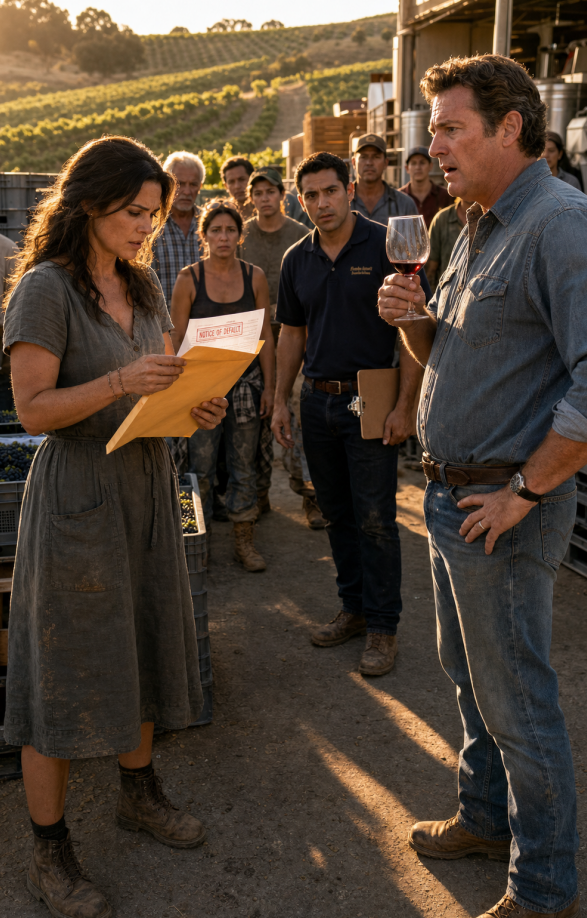
I set the notice down on the nearest barrel, face up, so the red stamp was still visible, and I let the quiet do some of the work for me.
“Grant,” I said. “You should sit down for this part.”
He didn’t sit. He gave the crowd a small, sad smile, the one he’d been perfecting for months, the one that said poor Elena, in over her head. “I think we’ve all seen enough,” he said. “Maybe this isn’t the night.”
“It’s exactly the night,” I said. “You picked it.”
I need to back up, because the story the family believed was simple and wrong. When my grandmother — Nonna Rosa, who planted the oldest block herself in 1974 — got sick, everyone assumed the vineyard would pass the usual way, run by consensus, which in practice meant run by Grant, who talked the loudest and had married the eldest daughter. But three years before she died, quietly, with a lawyer none of them knew, Nonna put the land into a trust. And she named exactly one trustee to control it.
Me.
Not because I was blood — I wasn’t. Because I was the one who drove her to chemo and sat in the vines with her afterward, and because she’d watched Grant for thirty years and decided she didn’t trust him with a hundred years of her family’s work. “You’ll be the wall between them and their worst ideas,” she told me once. I thought she was being dramatic. She wasn’t.
I never announced it. The trust ran quietly. I signed the checks, I approved the contracts, and the family assumed I’d simply grabbed power when Nonna weakened. I let them think it because correcting them meant a fight I didn’t have the stomach for. So when the harvest account started draining in the spring, they blamed the outsider holding the pen. They didn’t know the pen was legally mine — and that every real transaction had to pass through me.
Which was the whole problem with the loan.
“The notice says I’m the guarantor,” I told the party, picking the page back up. “A harvest loan. Ninety thousand dollars, taken out in April, secured against the estate, drawn down almost immediately and never repaid.” I looked around at them. “Did any of you see ninety thousand dollars come into this vineyard in April? Did the tractors get fixed? Did we hire the crew we couldn’t afford? No. The money went out. Somebody took it out.”
“You took it out,” Grant said. “Your name’s on it. You just read it yourself.”
“My name’s on it,” I agreed. “The bank believes I signed the consent. There’s a signature on file. I’ve seen the copy.” I let a beat pass. “I never signed it.”
That landed differently than the toast. My sister’s head came up.
“The trust that owns this land,” I said, “requires the trustee’s signature on any loan against it. That’s me. Only me. When the bank flagged the default, I asked for the origination file. I sat with it for a week before tonight because I wanted to be sure before I said a word.” I pulled the folded photocopy out of my jacket — I’d brought it, because some part of me had known Grant wouldn’t be able to resist a stage. “This is the consent form. This is the signature they think is mine.”
I held it up next to the real thing — my actual signature, right there on the notice I’d just signed for the courier, on the barrel in front of everyone.
They weren’t the same. They weren’t even close. The forged one had the flourish on the R that Grant always used in emails, not the plain block letters I’ve written since I was nine. Whoever made it had copied the idea of my signature from the outside, from guessing. Not from my hand.
“The consent was filed by the estate’s own email account,” I said. “The one three people have the password to. The application listed a callback number for verification.” I read it off the page. Grant’s phone, sitting on the table beside his empty glass, lit up and buzzed when I dialed it in front of them. It kept buzzing while nobody moved.
I have never watched a room turn so fast. It wasn’t loud. That’s the part I remember — how quiet betrayal is when it finally lands on the right person. My father-in-law set his glass down very carefully. My sister said Grant’s name once, like a question, and then didn’t say anything else.
“You were going to drain the account before the season closed,” I said, and I wasn’t angry the way I’d expected to be. I was tired. “And when the default hit, the outsider was already holding the blame. It was clean. I’d have looked exactly as reckless as you’d been telling everyone I was.”
Grant tried, for about ten seconds, the way people do. Said the bank made an error. Said I was confused. Said this wasn’t the place. But a forged signature doesn’t argue back, and a phone that answers to your name when a stranger dials it doesn’t either.
Here’s the mixed part, the part I didn’t expect. Being exonerated in front of fifty people didn’t feel like winning. Grant is my sister’s husband. He’s the father of my niece, who was asleep in the farmhouse while her dad’s number lit up on a table. Watching my sister realize what she’d married — that was worse than any humiliation he’d handed me on the crush pad.
The aftermath was slower than the moment. Once the bank had the origination file and a forensic look at the signature, it unwound my liability; the fraud became a matter between Grant and the institution he’d deceived, and the family agreed, quietly, not to press a criminal case for my niece’s sake — a decision I had a vote in, as trustee, and chose. Grant moved out by November. My sister and I are rebuilding something careful and real, one hard conversation at a time.
The vineyard made it through the season. I finally told the family the truth about the trust, and Nonna’s reasons, and for the first time in eight months nobody called me a tourist.
I kept the notice with the red stamp in a drawer in the tasting room. Sometimes I set it next to my real signature, to remember the difference between the name someone forges for you and the one you actually sign — and how the second one was the only thing that saved me.
Comments are closed.