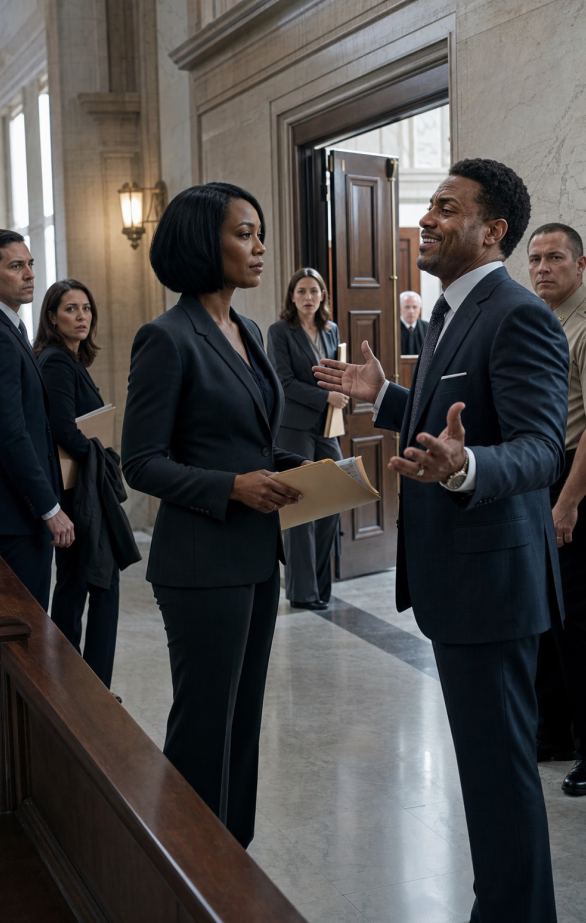
I opened the folder in the marble hallway, and I watched my husband’s face do something I’d waited three years to see.
Dominic had just told me, smiling, that the company was all his. That I’d signed it away. That I’d walk out of divorce court with nothing. And on every piece of paper his lawyers had ever produced, he was right.
That was the trap. I’d helped build it without knowing.
Let me go back.
Dominic and I started the business together nine years ago. It was my idea — a logistics company, unglamorous and enormously profitable if you ran it right, and I knew how to run it right. He was the face. The charmer. The one who took the meetings and shook the hands and let everyone assume he was the brains. I ran operations, hiring, the actual machine that made the money. That suited us both for a while. He liked the spotlight. I liked the work.
To get the company off the ground, we took a founding loan. A big one, secured against everything we had. I remember the week we set it up — I was traveling constantly, opening our first real warehouse, and Dominic handled the paperwork at the bank because I simply wasn’t in town. I trusted him. He was my husband and my partner. Signing a stack of documents I didn’t personally witness felt like nothing at the time.
That loan, and my supposed signature on it, became the cornerstone of everything. Over the years, as the company grew, Dominic quietly restructured the ownership — always with a reason, always with a lawyer explaining why it was “cleaner” this way for taxes, for liability, for the next round of financing. Each time, I signed where I was told. Each time, a little more of my stake moved to him. I was busy running a company. I let my husband handle the ownership of the thing I was running. I have had a long time to be angry at myself for that.
By the time our marriage fell apart, the paper said Dominic owned it all. The prenup he’d insisted on “just for the banks” said I left with what I brought in, which was nominally nothing. The bylaws made him sole controlling member. He’d spent years building a legal fortress, and I was standing outside it.
His lawyers were smug. His offer was insulting — a number that wouldn’t have covered a year of the work I’d put in. And Dominic himself couldn’t resist gloating in that hallway, because for men like him the money isn’t even the best part. The best part is watching you understand you’ve lost.
What he didn’t know was that eight months earlier, when I first saw the shape of what he was doing, I’d pulled every original document the bank still had on file. And I’d taken the founding loan — the very first one, the cornerstone — to a forensic document examiner. A specialist. The kind who testifies in court about ink and pressure and the mechanics of a human hand.
Her report was in the folder in my hands.
My signature on that founding loan was forged. Not traced from a real one — fabricated. The examiner was categorical: the person who signed my name on that document was not me, and the characteristics matched, in her professional opinion, samples of Dominic’s own writing.
He’d forged my name at the very beginning, probably to speed things along while I was traveling, probably telling himself it was harmless because we were married and it was our company anyway.
But it wasn’t harmless. Because that forged signature was the foundation the entire ownership structure was built on. If the founding loan was fraudulent, every “clean” transfer that followed rested on fraud. The fortress he’d built to keep me out had a forged brick at the very bottom, and I was holding the proof.
I handed the folder to the judge through the open courtroom door. I watched Dominic’s lawyer read the first page and go pale. I watched Dominic himself realize, slowly, that the sentence he’d just gloated — “you signed it away” — was about to become the thing that destroyed him, because if I never signed the first document, the whole chain of my “signing away” was in question, and worse, he was now facing an allegation of fraud in front of a family-court judge.
The case did not resolve that afternoon. These things never do. But the ground shifted completely. His leverage evaporated. The company’s ownership went into dispute, then into a settlement that gave me back far more than the insulting number he’d offered — because a man facing a forgery finding will suddenly find enormous flexibility.
I did have a one-way ticket in my bag that day. London. My old firm had offered me a role running their North American logistics division, and I’d said yes weeks before, because I wasn’t going to wait on a courtroom to start my life over. My daughter and I flew out that summer. She’s in school there now. She likes the rain, which is more than I can say for either of us about our old life.
Dominic kept a smaller, wounded version of the company. He also kept a fraud allegation on his record and a reputation, in our small industry, as a man whose signatures you might want to check.
People ask me if I regret trusting him with the paperwork all those years. I did, for a while. Then I realized the trust wasn’t the mistake. The mistake was his — he’s the one who forged a name. I just made sure the first lie he ever told about me became the last word in the story.
He said I’d signed it all away.
I never signed the first page. And that made all the difference.
Comments are closed.