The major — his name was Doyle, and I will never forget it — actually smirked when my coat fell open.
For half a second he did not process what he was seeing. He was so deep into the pleasure of putting the clipboard woman in her place that his eyes slid over the silver eagle at my collar the way your eyes slide over a word you are not expecting to read. Then his brain caught up to his eyes, and I watched the blood leave his face from the top down, like someone pulling a shade.
Behind him, General Aldous did not hesitate. Fifty-eight years old, thirty-some of them in uniform, and the man snapped to attention so fast it was practically a reflex older than thought. “Colonel Sable,” he said. “Ma’am. We weren’t briefed you’d arrived.”
“No,” I said. “You weren’t.”
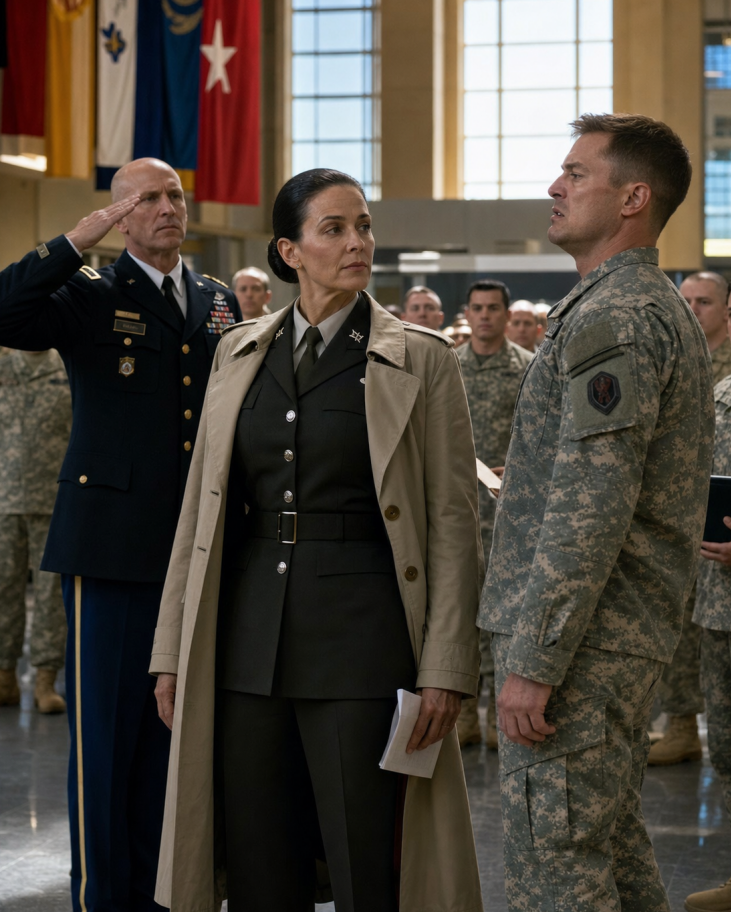
I had planned it that way. I want to be honest about that, because people like to imagine these moments as accidents, as if I stumbled into my own humiliation and got lucky with the timing. I didn’t. When I get a new command, I walk the installation first as a nobody. A civilian contractor, an event coordinator, a woman with a clipboard and no rank anyone can see. Because you cannot learn how a unit actually treats people by watching how it treats a colonel. Everyone is decent to a colonel. I wanted to see how Fort Halloran treated someone it believed had no power at all.
Now I knew.
I had spent the morning being told to fetch coffee, being talked over, being asked if I was “sure I was in the right building, sweetheart.” I had watched a young enlisted airman — a kid, maybe nineteen — quietly bring me a chair and a bottle of water when no one told him to, and I had watched Major Doyle build his little kingdom out of everyone he thought was beneath him. I had a very clear picture of who my officers were when they thought God wasn’t watching.
I did not scream at Doyle. That is not how it works, and it is not what it deserved. I let the silence do it. I let him stand there at attention in front of the assembled staff he had spent all morning performing for, and I let every single one of them watch him realize that the woman he had dressed down for standing in “officers’ space” was the officer who now owned the space, the building, the base, and his career.
Then I said, quietly, “Major, my office. Fifteen hundred. Bring your morning with you.” And I turned to the airman who had brought me the chair, and I said, loud enough for the room, “Airman, thank you. I won’t forget it.” And I watched Doyle understand that the currency of this base had just changed hands, and that he had been caught holding all the wrong coins.
At fifteen hundred, Doyle stood in my office and did the thing men like Doyle always do, which is explain. He hadn’t known. If he’d known, he would never have. He hoped I understood it wasn’t personal.
That, I told him, was exactly the problem. It wasn’t personal. He would have been perfectly respectful to a colonel and perfectly contemptuous to a clipboard, and the difference between those two behaviors was the whole measure of the man. I told him I didn’t need officers who were respectful upward. I needed officers who were decent in every direction, especially the directions that couldn’t hurt them.
I did not end his career that afternoon. That surprises people. But I am not in the business of collecting scalps; I am in the business of running a functional command. What I did was put it in writing, put him on notice, and give him one year to show me he could be the same man to a private that he was to a general. Some men rise to that. Some men resent it until it sinks them. I have watched both. Doyle, to his credit and my mild surprise, is trying.
The airman with the chair is being mentored for officer candidacy. Quietly. On merit. I mention that because the story people love is the one where the arrogant man gets destroyed, and that’s the small half of it. The real half is the kid who was kind to a stranger with a clipboard, and who never once suspected it would be the making of him.
That’s why I walk my bases as a nobody. Not to catch the cruel ones, though I do. To find the decent ones, who are decent when it costs them, when no one who matters is supposed to be watching.
Someone is always watching. That morning, it was me.
Comments are closed.