The two men in dress blues did not come inside right away. Ethan turned and said something to them low, and they stayed by the door like they had been ordered to, which, I would learn, they had.
He crossed the room to me instead. He moved carefully, the way you move around a spooked animal, and when he was close enough that I could smell him — soap and airplane and something faintly medicinal — he stopped and held out one hand, palm up, and waited. He didn’t grab me. He let me decide.
I put my hand in his. It was warm. It was calloused in places it had never been calloused before. It was real.
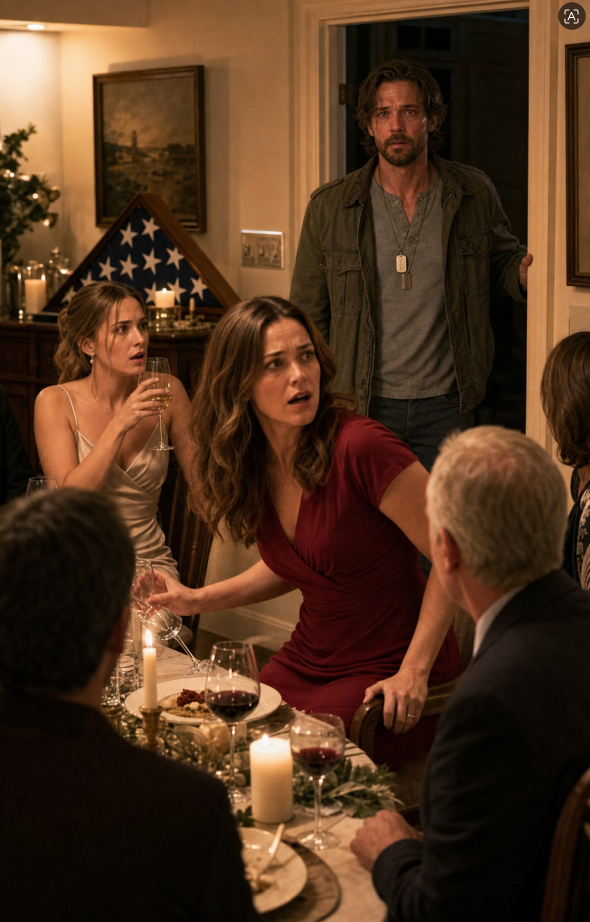
And then my knees went, and he caught me, and for a long time neither of us said anything intelligible into the shoulder of the other while my entire family stood frozen around a cooling dinner.
It was the older of the two officers, a lieutenant colonel named Briggs, who finally sat my family down and explained what he was permitted to explain, which was not everything, and never would be.
Ethan’s reconnaissance team had gone out on an operation that “did not go as briefed.” That was the phrase Briggs used, and he used it more than once. There had been an ambush. Two of Ethan’s team were killed. Ethan and one other Marine were taken. Because of the nature of the mission and the people who had taken them, and because there was an active effort to recover a source whose life depended on the enemy believing certain men were dead, the decision was made — far above Ethan’s head, far above mine — to list him as killed in action.
They gave me a flag over a casket that did not have my husband in it. They let me grieve. They let me sell his truck and give away his coats and learn to sleep in the center of the bed. And they did it, Briggs said, because a living prisoner is a bargaining chip, and a dead man is not, and there were other lives braided into that lie that I was never going to be allowed to know the shape of.
I understand it now. I even understand why. But understanding a thing and forgiving it are two different rooms, and I have spent the two years since walking back and forth between them.
Ethan was held for fourteen months. He was recovered in an operation he will not describe and I have stopped asking about. He spent the better part of a year after that in medical facilities and debriefings, being slowly, bureaucratically, brought back from the dead — because you cannot simply un-kill a Marine. There are records. There is a headstone. There is a widow who has moved on with the small, hard-won furniture of her grief.
The reason he walked into my sister’s dinner instead of calling first was that he had only been cleared to contact me that afternoon, and he was terrified — his word — that if he called, I would think it was a cruel prank, or that I had finally lost my mind, and he would lose the one chance to let me see his face and know.
Here is the part I did not put in the first telling, because it still takes the wind out of me.
For two years my family had gently, lovingly, insisted that I “hadn’t let him go.” My mother worried I still wore my ring. My sister thought I talked about him in the present tense too often. There had been a soft, constant pressure to accept that he was gone, to date, to move forward, and underneath all of it a quiet suggestion that my inability to fully believe in his death was a kind of sickness.
It wasn’t sickness. Some animal part of me had been right the entire time. He was alive, on the other side of the world, and I had been made to feel broken for failing to bury a feeling that turned out to be true.
We are not the same people who kissed goodbye at that airport. He has bad nights. I have a startle response to doors opening that I am working on. We went to the graveside together, the two of us, and stood over the stone with his name on it, and he read his own death date out loud in a flat voice and then we drove home and did not talk for an hour.
But he is here. He drinks his coffee too hot. He folds the memorial flag differently than the honor guard did and it drives me quietly insane and I would not trade it for anything.
My sister postponed the engagement party. She said it didn’t feel right to celebrate one homecoming while we were all still catching our breath from another. Then she looked at Ethan across the kitchen and said, “Actually, no. We’re celebrating both. Sit down. You’re not going anywhere,” and for the first time in two years the whole family laughed at the same time.
He is not going anywhere. I keep the flag on the sideboard anyway. Some things you earn the right to keep, even after they come back to you alive.
Comments are closed.