The sheriff’s truck rolled to a stop in the dust behind me. Two doors. A deputy I’d known since high school stepped out, settled his hat, and took in the scene: me at the gate with a duffel and a folder, a new padlock, Bo on the far side going pale, a woman by the barn who’d started backing toward the house.
“Afternoon, Delia,” the deputy said. “You said on the phone there’d be a lockout situation. This it?”
“This is it,” I said.
Bo found his voice. “Now hold on. Hold on. This is my property. My name’s on everything. She’s the one who’s been gone four months, she doesn’t get to just—”
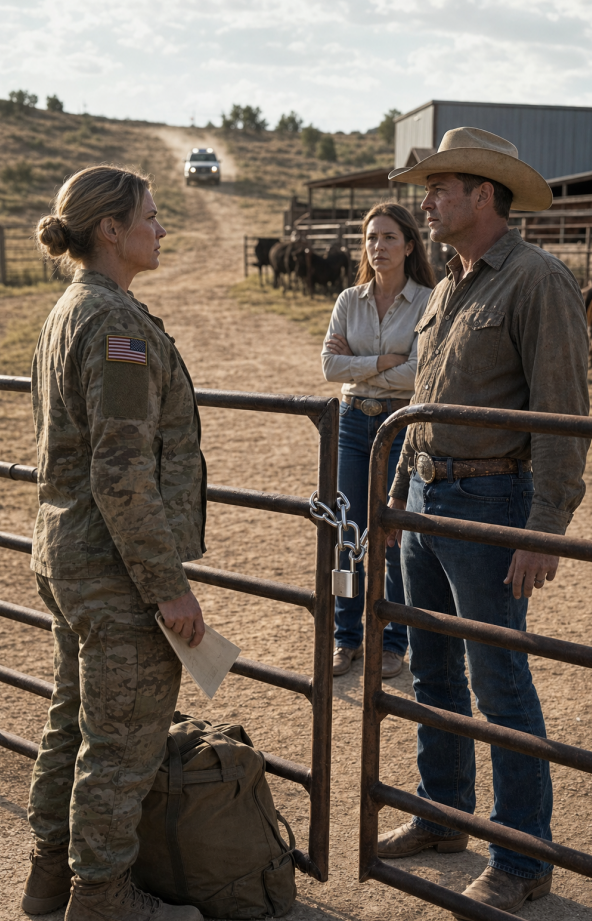
“Bo,” I said, “I’m going to ask you one more time, so the deputy hears your answer. Whose name is on the deed to this ranch?”
He didn’t answer, because he’d realized, in the way you realize you’ve stepped off a ledge, that he didn’t actually know. He’d assumed. Eleven years of marriage, and he’d assumed the way men like Bo assume, that the land a woman brought to a marriage becomes his the moment he starts driving the tractor.
I handed the deed through the gap in the gate to the deputy. He read it. He read it twice, the way people do.
“This says the property’s held in the Hartman Family Trust,” he said. “And that the sole trustee, the only person with authority over it, is Captain Delia Hartman.” He looked up. “That’s you.”
“That’s me. My father set it up before he died. He’d met Bo. He was a careful man.” I looked at my husband. “The ranch was never yours, Bo. Not one acre, not one fence post. You’ve been living in a house I let you live in. And then, while I was pulling drowned families out of the water in another state, you changed the locks on it and told your girlfriend it was yours.”
The deputy folded the deed. “Sir, I’m going to need you to open that gate.”
What happened after that was quiet, which is how these things usually go once the paper’s on the table. There was no shouting. Bo unlocked his shiny new lock with hands that didn’t work quite right. The woman by the barn came out with a suitcase she’d apparently packed in a hurry, got in a car, and drove off without a word to him or to me. I never did learn her name.
Bo tried, one more time, at the very end, standing by his truck with a box of his things. He said we could talk about it. He said four months was a long time and he’d been lonely and it hadn’t meant anything and couldn’t we just start over.
“You changed the locks,” I said. “That’s the part I keep coming back to. Not that you were lonely. Not even that you found someone. You can survive a lot of things in a marriage. But you looked at my father’s land, and you looked at my absence, and your first move was to lock me out of my own home. You didn’t want a wife, Bo. You wanted the ranch. You just needed me gone to take it.”
He didn’t have anything to say to that. There wasn’t anything to say.
The deputy stayed until Bo’s truck was down the road and out of sight. Then he tipped his hat, told me it was good to have me home, and left me standing in my own yard in the last of the late-afternoon light.
I walked up to the house. My key didn’t work, of course, so I let myself in through the mudroom window the way I did when I was a girl and forgot my key, and I went straight through to the kitchen and made a pot of coffee in my own pot in my own kitchen, and I drank it on the back porch watching my cattle move across land that had been in my family for three generations.
I had a locksmith out the next morning. New locks, keyed to me. I kept the shiny padlock Bo had put on the gate. It sits on a nail in the barn now. Sometimes when I’m out there I look at it.
The divorce went through without a fight. There was nothing for him to fight over. He’d spent eleven years believing he was building an empire, and it turned out he was a guest the whole time, same as his girlfriend, same as the hired hands, and the only difference was that I’d loved him and let him stay.
People in town were kind about it, in the careful way of small places. A few of the older ranchers, men who’d known my father, made a point of stopping by, leaning on the new gate, telling me the place looked good. It does look good.
I’m back on deployment cycles now, but I’ve got a real manager running the operation, a woman whose name is on a real contract that I signed myself.
Turns out the trick isn’t never leaving. The trick is making sure that whoever you leave in charge remembers, every single day, exactly whose name is on the deed.
Comments are closed.