He asked me to describe her, and when I did, the man in the black SUV put his hand over his mouth like he’d seen a ghost. The name smeared across my wrist — Emma R., a little girl I’d fought for through a thirty-one-hour shift — was a name he had been searching for, quietly and desperately, for a very long time.
I didn’t understand yet. I was still half-asleep, mortified that I’d climbed into a stranger’s car, fumbling apologies. But he didn’t let me leave. He asked, very carefully, if the little girl was still at the hospital. If she was going to be all right.
I told him the truth, because I was too tired to do anything else. Emma was seven. She’d come in through the ER two nights earlier, no adult with her, brought by a neighbor who’d found her alone. She was sick — dangerously, the kind of sick that doesn’t wait — and she needed a treatment her chart said we couldn’t authorize without a legal guardian we couldn’t find. She’d been placed in the system as an emergency, no next of kin located, a hold on the care she needed while the paperwork chased its own tail. I’d written her name on my wrist because I couldn’t stop thinking about her going through it with no one in the waiting room.
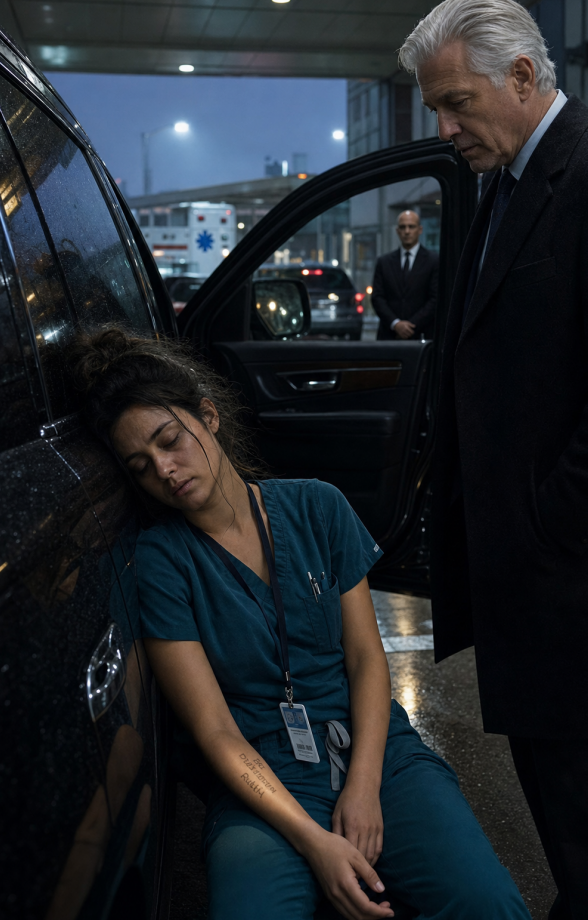
The man in the SUV was named David. That’s all I’ll call him here. And what he told me, in the idling car outside the hospital at four in the morning, unspooled a story I’m still not sure I fully believe except that I watched the end of it happen.
Seven years ago, David’s younger sister had a baby and then had a falling-out with their family so complete that she vanished from all of their lives. Money, old wounds, a father’s ultimatum — the kind of rupture that swallows people whole. David had spent years and a genuinely staggering amount of resources trying to find her, and her child, with almost nothing to go on. His sister had cut every thread. He didn’t even know if the baby had been a boy or a girl.
He knew the child’s name would be Emma. His sister had told their mother that much, once, in the only phone call she ever made after she left — that if it was a girl, she’d be Emma, after their grandmother.
His sister had died eight months earlier. He’d learned it too late, through a records search, in another state. And the child — Emma — had disappeared into a foster system that had no idea she had an uncle tearing the world apart to find her.
He’d been sitting outside that hospital that night, he told me, because it was the county’s pediatric receiving center, and he’d taken to parking near places children in crisis are brought, running down every lead his investigators surfaced, chasing the ghost of a girl who might not even exist. And a nurse he’d never met had fallen asleep in his car with that exact name written on her skin.
I want to be careful here, because the coincidence is the part that sounds invented. But this is a city of millions with a handful of pediatric ERs, and a man who has spent years haunting them, and an overworked nurse who happened to scrawl the one name that could stop his heart. Sometimes the world is smaller and stranger than we let ourselves believe.
By six that morning we were both back inside the hospital. David brought lawyers — the fast, expensive kind who exist for exactly this. There was DNA, because there had to be; you don’t hand a child to a stranger on the strength of a name and a story. It took two days. Emma’s cells and David’s told the truth the paperwork couldn’t: he was her uncle. Her closest living blood relative. The guardian the system had been unable to find because no one had known to look for him.
The treatment Emma needed — the one stalled behind a missing signature — was authorized the moment his guardianship was recognized. She got it. She is, as I write this, going to be okay. That sentence took a long time to become true, and I don’t say it lightly.
I’ve thought a lot about the chain of small things. If the gate agent hadn’t sent my rideshare to the wrong door. If David’s car hadn’t been idling in that exact spot. If I’d wiped the ink off my wrist before I left the floor, the way I usually do. If I’d been a little less exhausted and noticed I was in the wrong vehicle before I fell asleep. Any one of those, and Emma is still waiting behind a signature no one could provide.
David tried to give me money. A lot of it. I understand why — it’s the language he speaks, and gratitude that large has to go somewhere. I told him no. I told him the truth, which is that I didn’t do anything except write a little girl’s name on my arm because I didn’t want to forget her. That’s not heroism. That’s just the job, on a night when the job broke my heart a little.
He didn’t push. But he did something I didn’t expect. The hospital’s pediatric unit — the one that had to put a hold on a dying child because the system couldn’t find her family fast enough — has a new fund now. It exists to bridge exactly that gap, to get emergency care to unaccompanied kids while the paperwork catches up. It’s named after his grandmother. Emma.
I still work the floor. I still write names on my wrist when a shift gets loud and frightening and I’m scared I’ll lose track of someone who has no one else keeping track of them.
But now, sometimes, when I catch myself doing it, I think about a man in an idling car who couldn’t look away from a name written in smeared ink — and I remember that the small, tired, invisible things we do for the people in front of us are sometimes the exact thing someone else has been searching the whole world to find.
Comments are closed.