The ultrasound in her coat pocket is the thing I’ll never stop seeing, even now, even after everything.
I need to tell you who I was that night, because I’ve spent a long time since trying to become someone else.
I was an ER charge nurse, six years in, good at my job and hard around the edges the way you get when you’ve watched too much come through those doors. That night was chaos — a multi-car pileup on the interstate had filled every bay, and we were triaging in the hallways. And in the middle of it, a woman collapsed in the waiting room. Just went down, out cold, no obvious trauma, no ID that anyone could find fast.
And the man who’d been standing near her — well-dressed, impatient, already annoyed at the wait — stepped back like she was contagious. When a tech asked if he was with her, if he knew her, he said the thing I will hear for the rest of my life.
“Some woman fainting isn’t my concern. I’m here for my own appointment.”
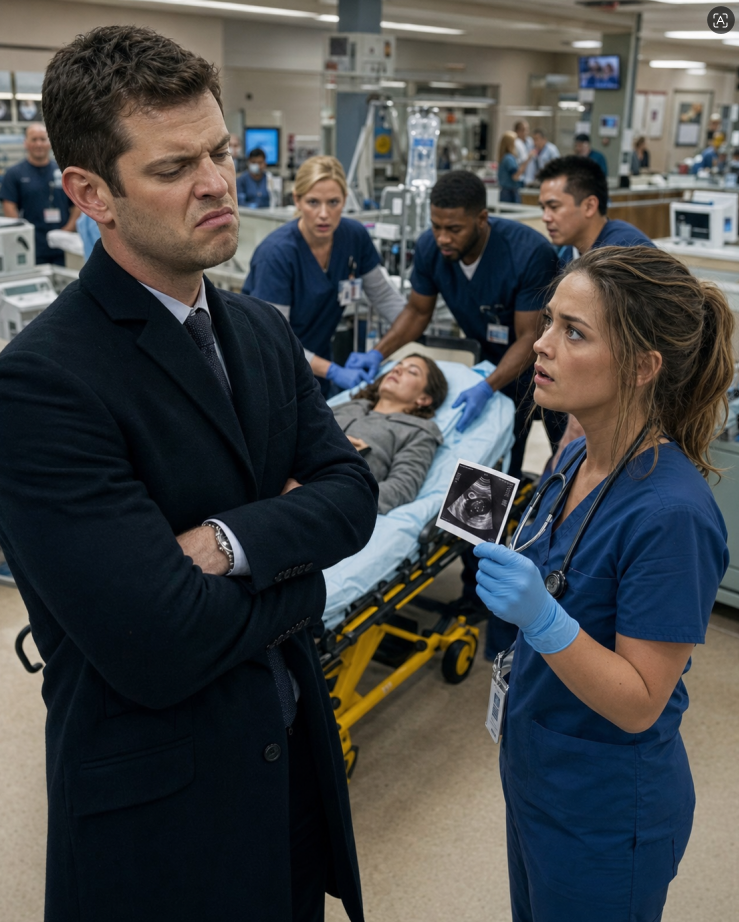
I didn’t have time to be disgusted with him. I had a patient on the floor. We got her onto a gurney, into a bay, and started working her up. No wallet. No phone we could unlock. Just a winter coat that we cut partway to get a line in, and in the inside pocket, folded carefully, an ultrasound printout.
She was pregnant. Early, but pregnant. And the ultrasound had a name written across the top in a nurse’s handwriting — the referring information, the responsible party, the name the patient had given at whatever clinic had done the scan.
It was his name. The man in the waiting room. The one who’d just said she wasn’t his concern.
I checked it twice. Then I walked out to the waiting room, ultrasound in a clear bag in my hand, and I asked him to confirm his name. He did, irritably. And I watched his face as I held up the printout and told him, quietly, professionally, that the woman he’d just disowned in front of a full waiting room was carrying a pregnancy with his name on the paperwork, and that she was now unconscious in my ER, and did he want to reconsider his answer.
I have never seen a man’s face do what his did.
Here is what came out over the next several hours, because I was the one who ended up sitting with both of them.
Her name was Maria. She and the man — I’ll call him Grant — had been together, quietly, for the better part of a year. He was a married man, it turned out, or nearly divorced depending on which of his stories you believed, and he’d been keeping Maria a secret from a life he wasn’t willing to disrupt. When she’d told him she was pregnant, he’d panicked and gone cold, told her he “needed time,” and stopped answering her calls. She’d come to the ER that night not by coincidence — she’d found out he had an appointment, and she’d come to try, one last time, to make him look at her. And then her blood pressure had bottomed out from a condition the pregnancy had triggered, and she’d collapsed at the feet of the man she’d come to find.
He hadn’t recognized her at first, he claimed, because she’d been facing away and he “wasn’t expecting her.” Maybe that’s true. But he’d said what he said, and a waiting room full of people had heard him, and now there was an ultrasound with his name on it and a woman who might have died on my floor.
Maria was going to be okay. We stabilized her, admitted her, treated the underlying condition. The baby, too, held on. And Grant — I’ll give him this one thing — did not leave. He sat in that ER for the rest of the night, and somewhere in those hours something in him broke open, the way it sometimes does when a person is finally cornered by a truth they can’t outrun.
I don’t know if he became a good man. That’s not the kind of thing you can see from an ER. But I know that when Maria woke up, he was there, holding her hand, and that he was crying, and that he told her — in front of me, because I refused to leave my patient alone with him until I was sure of him — that he was sorry, that he’d been a coward, that he wanted to do right by her and the baby. I know he signed the paperwork acknowledging paternity before the sun came up, not because anyone made him, but because I put it in front of him and asked if he still thought this wasn’t his concern.
He didn’t say much. He just took the pen.
Maria found me a year later. She came back to the ER — not as a patient this time, but carrying a baby girl in a car seat, to say thank you to the nurse who’d held up a piece of paper and refused to let a man walk away from his own life. Grant, she told me, was in it. Imperfectly, still learning, but in it. The wife-or-ex situation had resolved in the direction of the truth. He was the baby’s father in every way that counted now, and he’d told Maria more than once that the worst thing he ever said was said in my waiting room, and the best thing that ever happened to him was that a nurse made him hear it.
I don’t take credit for saving anybody’s soul. I saved a life that night — Maria’s, medically, that’s my job. What happened after was theirs.
But I’ll tell you what I learned, standing in that waiting room with an ultrasound in my hand. You find out who people are in the exact moment they think there’s nothing at stake for them. Grant thought a fainting stranger cost him nothing, so he showed me exactly who he was. And then the universe wrote his own name across the one thing he’d tried to walk away from, and gave him a second chance to answer the question differently.
He answered it differently. Not everyone does. But I’ve kept doing this job all these years partly to be there in those moments — the ones where a person still has time to become someone better than the worst thing they just said out loud.
Comments are closed.