The rain had been falling for three days when Boone’s truck came up my flooded lane, headlights swinging wild through the sheeting water.
I’d delivered babies in this county for twenty years. I’d delivered them in barns, in the beds of pickups, once on the floor of the feed store during an ice storm. But I had never been called to the Boone place, because men like Cyrus Boone didn’t call the country doctor. They had people. They had money. They had a name that made grown men step off the sidewalk.
So when he pounded on my door at two in the morning, soaked to the bone and shaking, and said his wife was losing the baby and the bridge to the hospital was gone, I knew two things at once. That I was going. And that if it went wrong, I would be the last person who ever saw the inside of a Boone house.
He drove. I held my bag on my knees and watched the water rise over the road in the headlights.
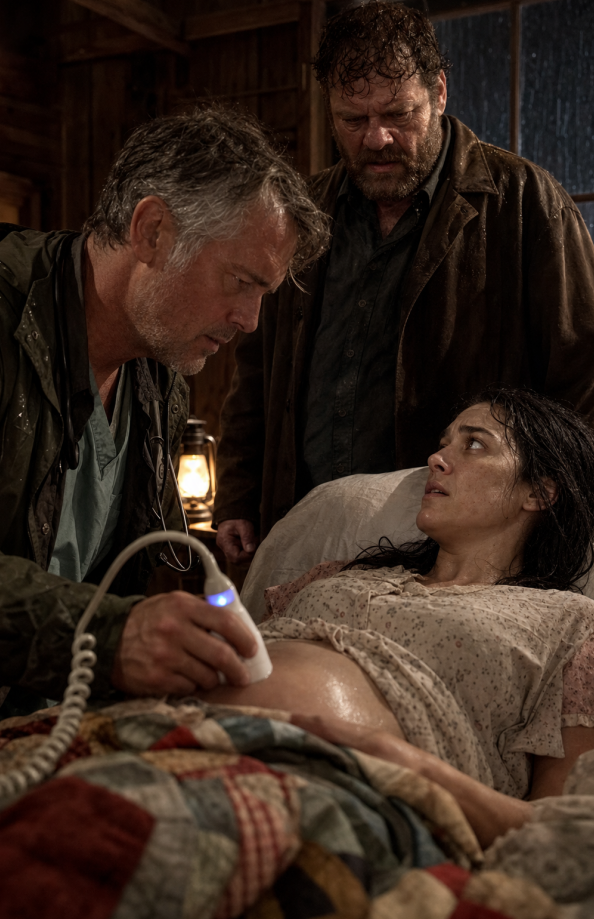
Cora Boone was twenty-nine and looked younger, pale and frightened in a big bed under a quilt her grandmother probably made. The room was lit by a hurricane lantern because the power had been out since midnight. She was cramping, bleeding lightly, terrified. And Boone stood at the foot of the bed with his fists at his sides like a man guarding a door, watching me the way you watch a stranger near your truck.
“Fix it,” he said. It wasn’t a request.
I’ve learned not to argue with fear when it wears a hard face. I washed my hands in the basin they brought me, I knelt by the bed, and I talked to Cora in the low steady voice I’ve used a thousand times, the one that says we are going to get through the next ten minutes and then the ten after that.
Then I took out the Doppler.
It’s a small thing, a handheld monitor, and in a room that quiet it sounds like the whole world. I moved it slow across her belly, listening for the heartbeat we were all afraid was already gone.
I found it. Faint, too slow, struggling. And Cora started to cry, because she thought that thready little rhythm was the sound of her baby dying.
But I didn’t move the wand away. Because underneath that first sound, off to the side, I’d caught something else. A shadow of a beat. A second rhythm, faster, stronger, hiding behind the first.
I moved the wand two inches and pressed.
There it was. Loud and certain and furious to live.
“There are two,” I said. My own voice surprised me. “Cora. There are two babies in here. And this one—” I held the wand still “—this one is strong.”
Here is what I understood in that lantern-lit room, and what Boone didn’t understand until later.
Cyrus Boone had one heir. A grown son from his first marriage, a hard young man who’d been running the Boone holdings-in-waiting for a decade, certain that when the old man died it would all come to him. The whole county assumed the same. Cora was the second wife, the young wife, and the child she carried had been treated by the family lawyers as a complication, not an heir.
But the Boone land, the leases, the trust the old man’s father had set up — all of it was written the old way, divided by blood among all surviving children, per stirpes, share and share alike.
One baby would have changed the son’s inheritance. Two babies, twins, one of them a boy as we’d learn in the spring, changed everything. The grown son’s certain empire had just been cut, in the space of one heartbeat found under another, into pieces he never agreed to.
I didn’t know all of that in the moment. I just knew I had two heartbeats and one exhausted mother and a storm outside, and a long night ahead of stabilizing her until the water dropped enough to move her.
Boone knew, though. I watched it cross his face.
He’d come in that room ready to lose the one child, braced for it, a hard man expecting the worst because the worst was familiar. And instead the country doctor he’d threatened had just told him there were two, and that the family arithmetic he’d lived by his whole life had quietly rewritten itself in the dark.
He sat down. The big man just folded into the chair by the bed and put his face in his hands, and I honestly couldn’t have told you, watching him, whether it was joy or fear or the collision of both.
We got Cora through the night. By dawn the bleeding had stopped and both heartbeats were steady, and when the water dropped that afternoon we moved her to the county hospital, where the twins held on and eventually thrived.
Boone never threatened me again. He didn’t thank me either, not in words. But a week later a truck came up my lane and two men spent a day rebuilding the culvert that had washed out, and every winter after that my woodshed was mysteriously, fully stocked before the first freeze. That’s how a man like Boone says the thing he can’t say.
The grown son found out about the twins a month later. What happened between him and his father over the reshuffled inheritance is a longer story, and not a gentle one — there were lawyers, and there was a night the son came to the house that Cora still won’t talk about.
But the boy is real. He’s six now. He has his mother’s eyes and a laugh you can hear across a field, and every so often when I’m in town Cora finds me and turns him toward me and says, “This is the doctor who heard you.”
He doesn’t understand yet. Someday I’ll tell him what I heard that night — a second heart, hiding, insisting, in a room where everyone had already decided he wasn’t there.
Comments are closed.