I set the tray down. Not slammed — set. And I straightened up, and I opened the slim leather folder I’d been carrying under my arm all evening, the one Bram had assumed was a room-service check.
“Mr. Sable,” I said, “before your guests decide whether to fund this slate, they should probably know it’s being financed twice.”
The laughter died in a way that laughter dies when the person everyone was laughing at turns out to have the floor.
I’d been on that lot for three weeks. Coffee, water, the quiet refilling of glasses in rooms where powerful people forget the staff can hear. It’s astonishing what men like Bram Sable say in front of a woman they’ve decided is furniture. I’d heard him take a call about a wire that had to clear before the “other investors” found out. I’d watched him close a laptop a little too fast whenever I approached. And I’d already known, because it was my job to know, exactly what I was looking at.
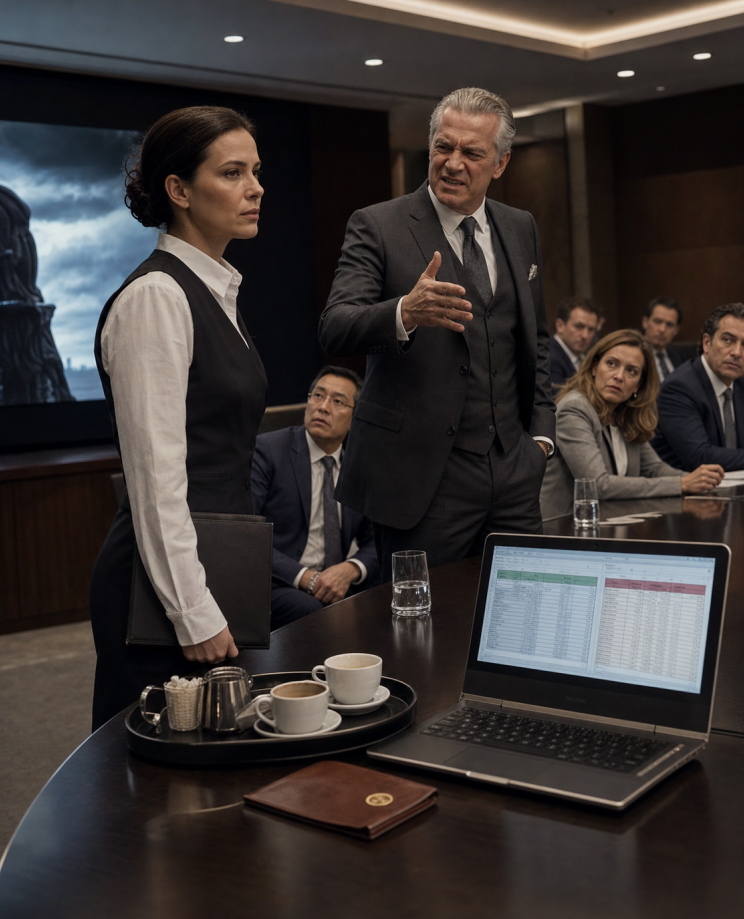
I’m a forensic auditor. His own investors — the ones seated around that table, the ones whose money he was toasting — had quietly retained my firm six weeks earlier, because the numbers he’d been sending them had the particular smell that numbers get when there are two sets of them. The coffee cart was my cover. You learn more with a tray in your hands than you ever will with a subpoena; people perform for auditors and they ignore servers.
So when Bram pointed at me and told the room I couldn’t follow a spreadsheet, he was, in a sense, correct about the fiction I’d been maintaining. He just had the wrong woman.
I turned the laptop on the table toward the guests — the same laptop he’d been closing too fast — and pulled up the two budget documents side by side. One was the version he’d shown these investors: lean, promising, a slate of films built for a specific return. The other was the version he’d shown a completely different set of financiers overseas — same films, same production, pledged again as collateral, the money committed twice against assets that could only pay out once.
Double-booked financing. The oldest trick and still the one that ruins the most people, because it works right up until two rooms full of investors compare notes. Tonight was the comparing.
Two of the guests at that table were his foreign investors, and I could see one of them leaning toward the other, not fully following the rapid English. So I switched to Spanish, and I walked them through it line by line in their own language — the pledged assets, the duplicated collateral, the wire that was supposed to clear before anyone cross-referenced — so that nothing Bram could later claim was a “misunderstanding” would have anywhere to hide. I watched the older of the two go pale, then very, very calm, which is the more dangerous of the two reactions.
Then I opened my credential wallet and set it on the table beside the abandoned coffee tray.
Bram Sable looked at it. He looked at me. And I watched the sneer he’d worn all night — the one that had gotten the whole table to laugh at the coffee girl — collapse into the specific expression of a man doing arithmetic he doesn’t like: how much I’d served, how many calls I’d poured coffee through, how many closed-laptop moments I’d been standing three feet away for.
“You’ve been here three weeks,” he said. It wasn’t a question.
“Twenty-two days,” I said. “You take it black. You should probably sit down.”
He didn’t sit down. Men like that never sit down when you suggest it; it’s the last small refusal available to them. But it didn’t matter, because the room had already turned, and a room of investors who’ve just watched their money get pledged out from under them twice does not un-turn.
The consequence isn’t a movie. It’s slow and it’s paperwork and it’s the kind of thing that ends with regulators and clawback provisions and a slate of films that will now be made, if at all, by somebody else. Bram’s investors pulled out that night — the domestic ones in English, the foreign ones in the Spanish I’d made sure they fully understood. The double-booked financing became a matter for the people whose job it is to care about double-booked financing. My firm delivered the report we’d been retained to deliver, now considerably more complete than it would have been from behind a desk.
My name isn’t on any org chart Bram Sable would recognize. He never learned it; to him I was the coffee girl right up until the credential wallet hit the table. But my name was already on the report his investors had been reading, quietly, under that very table, while he told them I was too dim to follow a spreadsheet.
I followed it just fine. I followed it all the way to the second set of books he thought no one would ever read.
Comments are closed.