I read the lab report three times before the words stopped rearranging themselves.
It wasn’t my ex-wife’s file. It was mine. A fertility workup, dated the spring everything fell apart, ordered by the same clinic I’d later sued her over. The numbers on the page said, in clinical language that left no room for a man’s pride, that the problem in my first marriage had never been her.
It had been me.
The whole time. Every cruel thing I said. Every friend I let believe she was “the one who couldn’t.” The divorce I framed as her failure. I’d built an entire second life on a lie I told myself so I wouldn’t have to read a page exactly like this one.
“Where did you get this,” I said to the girl. My voice had no floor under it.
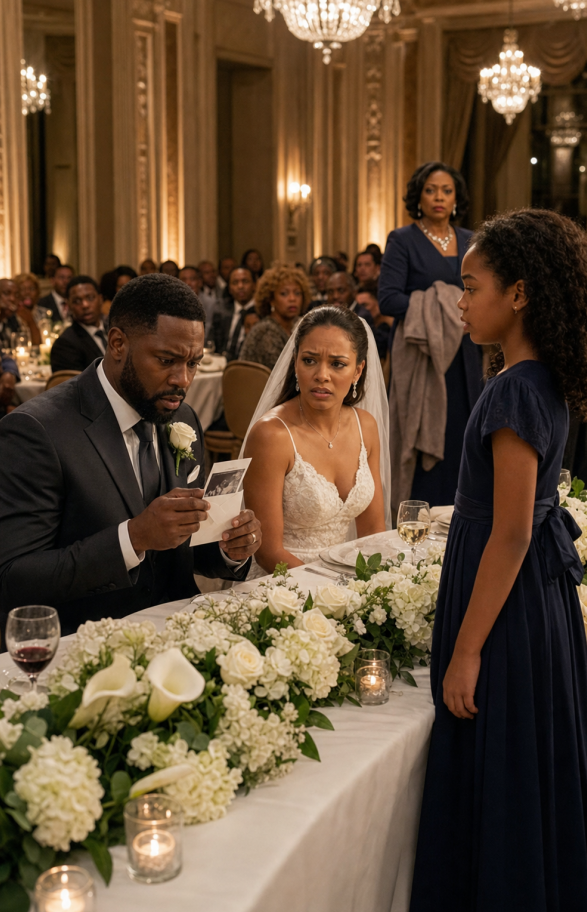
“My mom kept it,” she said. “She kept everything. She said someday you’d want to know the truth more than you’d want to be right.” She lifted her chin — that stubborn chin I couldn’t place, because it was my mother’s. “I’m fifteen. My birthday’s in December. You can do the math.”
I could do the math.
After the divorce, my ex-wife hadn’t been barren and hadn’t been lying. She’d been quietly, cautiously pregnant — with the help of a donor and a doctor and a plan, because she’d wanted a child so badly and had spent years being told by me that she was the reason she couldn’t have one. She left. She raised our daughter in another state. She never asked me for a dollar, because asking would have meant telling me where they were, and she had decided I hadn’t earned the answer.
She was right.
The ballroom was very quiet. My fiancée still had her hand on my sleeve. Two hundred guests were pretending not to watch and watching completely.
“Is it true?” my fiancée asked. Not accusing. Just — needing to know who she was about to marry.
“Yes,” I said. Because I was done building lives on the other answer.
I did not marry anyone that night.
I spent the next year doing the only thing left that mattered. Not grand gestures — my daughter made it very clear she didn’t want grand gestures, and she was right about that too. Small things. Showing up when I said I would. Listening more than I talked. Learning that she liked terrible action movies and hated when people apologized with excuses attached.
Her mother and I did not get back together. Some bridges you burn all the way to the water, and the honest thing is to accept it rather than expect the fire to un-happen. But we learned to be two adults in a hallway at a school play, which my ex-wife told me, dryly, was more than she’d expected from me and about what she’d hoped.
There were harder consequences too, the kind that don’t fit in a warm ending. My fiancée and I tried, for a few weeks, to pretend the party hadn’t happened. It had. She told me, gently, that she couldn’t build a marriage on top of a man who’d spent eight years punishing an innocent woman rather than face a piece of paper. She wasn’t cruel about it. She was just right, and I’d finally run out of the habit of arguing with people who were right.
Word got around, the way it does. A few of the friends who’d nodded along when I called my first wife “broken” stopped returning my calls. I don’t blame them. I’d handed them a version of events that made me the wounded party, and they’d believed me because I was loud and certain and it was easier. Certainty had been my whole personality. It turned out to be the cheapest thing I owned.
I wrote my first wife a letter. Not an email — a letter, on paper, because some apologies need to cost you the effort. I didn’t ask for anything. I didn’t explain myself or soften it with the word “but.” I just told her she had been telling the truth, that I had known somewhere how to find out and had chosen not to, and that our daughter was the bravest fifteen-year-old I’d ever met and that was entirely her doing. She never wrote back. She didn’t have to. Three weeks later my daughter texted me a photo of the letter stuck to their refrigerator with a magnet, and one line underneath: “Mom cried. Good crying. Don’t get weird about it.”
The consequence I earned wasn’t a reunion. It was a Tuesday-night phone call, months later, when my daughter called me first — about nothing, about a movie — and hung up with a casual “bye, Dad” that knocked the wind out of me in my own kitchen.
I still have the lab report. I keep it in a drawer, not to punish myself, but because a man who spent years insisting on a comfortable lie should probably keep one true page where he can find it.
The girl at the head table hadn’t come to ruin my party.
She’d come to give me the one thing I’d been running from since the spring my first marriage ended: the truth, and a second chance to deserve it.
Comments are closed.