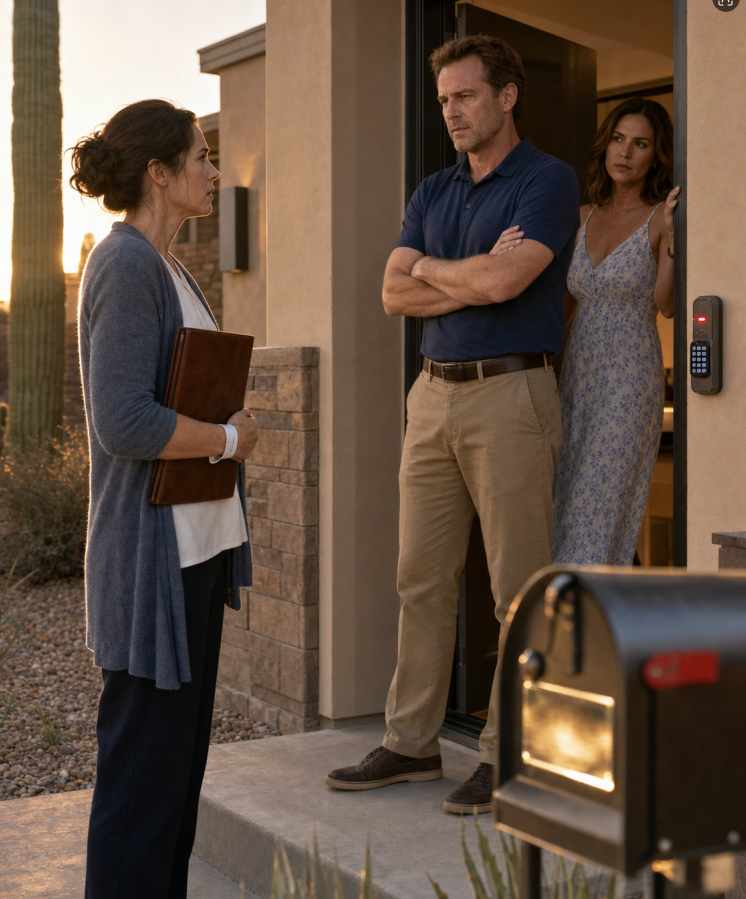
I opened the folder on my own front step, and I watched my husband’s face while I did it.
Derek’s arms came uncrossed. That was the first tell. A man who’s sure of himself keeps his arms crossed. A man who’s just realized he might have made a mistake lets them fall to his sides so his hands are ready for something.
“What is that,” he said. Not really a question.
“This is the trust deed,” I said. “For this house. Do you want to read it, or do you want me to tell you what it says?”
Behind him, Sherri’s hand slid off my doorframe.
Here’s the thing I need you to understand about the eleven days I spent in that hospital. I wasn’t there for something small. I’d been sick for a while — the kind of sick where you start doing math about the future, quietly, in the dark, without telling anyone. And in that hospital bed, between the tests and the needles, I’d had a lot of time to think about my marriage. About how, somewhere in the last few years, Derek had stopped looking at me and started looking through me. About how a man treats you when he’s decided, privately, that you’re already gone.
So I made some calls. From the hospital bed. Because I am, whatever else Derek thought I was, a woman who reads the documents.
This house was bought with money from my family. When we married, my father — who never trusted Derek, and told me so, and was right — put it into a family trust rather than into our names jointly. Derek signed those papers eleven years ago without reading them, because reading them would have required being curious about where the money came from, and Derek was only ever curious about where it went. The trust owns the house. And the trust has one directing trustee.
Me.
Not “us.” Not “the family.” When my father passed, the trusteeship came to me alone. Derek has no more legal claim to this house than Sherri does. Less, actually, because at least Sherri never signed anything promising to love me.
“You disabled my code,” I said. “While I was in the hospital. You want to explain that part?”
“Lauren—”
“Because from where I’m standing, you changed the locks on a house you don’t own, moved another woman into it, and put her name on my mailbox, all while I was being told whether I’d need surgery. I’d like to hear you explain that as anything other than what it is.”
Sherri spoke up then, from the hallway. “Derek said the house was his.”
I looked at her, and I felt, unexpectedly, a little sorry for her. “Derek says a lot of things,” I said. “He said them to me for eleven years.”
I reached past him — he actually stepped back, out of my doorway, on instinct — and I held my phone up to the keypad I’d had installed the week before my hospital stay, the one he’d never noticed because it looked just like the old one. The biometric lock I’d set up quietly, that recognized exactly one face. Mine.
The little light blinked green.
The deadbolt slid back with a sound I will remember for the rest of my life.
“I set that up before I left for the hospital,” I said. “In case I came home to exactly this. Turns out I know my husband better than he knows the paperwork he signs. The system recognizes me. It doesn’t recognize you. And as of this morning, when I called the trust’s attorney, it’s not supposed to.”
Derek’s whole face changed. The reasonable-man performance dropped, and underneath it was something small and scrambling. “You can’t just—”
“I can, though,” I said. “That’s the part you never checked. You spent eleven days assuming you held all the cards because you’d changed a lock and printed a nameplate. You never once asked whose name the deed was in. You assumed. Men like you always assume.”
I stepped inside my own house. Sherri was already gathering her things — she was quicker than Derek, quicker to understand which way the wind had turned. Derek stood on the step where I’d been standing a minute before, on the wrong side of his own front door now, and it was almost funny, the symmetry of it.
“You have until the end of the week,” I said. “The attorney will send the details. Take your things. Leave the nameplate — I’ll deal with it.”
“Lauren, please, we can talk—”
“Through the lawyers,” I said. “You told me that yourself, ten minutes ago. I’m just agreeing with you.”
I closed the door. Then I reached up and slid the new deadbolt home, the one only I could open, and I stood in the front hall of the house my father made sure would always be mine, and I listened to my own breathing, in and out, alive, in the quiet.
Later, I went out to the curb and peeled Sherri’s vinyl nameplate off the mailbox. Underneath, faded but still there, was my own name, where it had been the whole time.
Comments are closed.