The rancher’s name was Cole Danner, and the last time I had seen his face, he was standing on a porch telling me I would never see any of them again.
I need to explain how I ended up on that ranch at all, because nobody chooses a night like that. I’m a doctor in a small county where the nearest real hospital is ninety minutes on a good day. When the wildfires come, the roads close, and people who can’t or won’t go to an ER start calling the woman who’ll come to the door with a bag. I don’t ask a lot of questions. I’ve learned that the people who need a quiet doctor most are rarely the ones who can afford to have their business written down.
So when two men I didn’t know arrived at my clinic in the orange half-dark and said someone at the Danner place was “in a bad way” and it “couldn’t go on any record,” I understood exactly what kind of call it was. I got in the truck. I told myself it was the same as any other night. I told myself the name didn’t mean anything.
That was a lie, and I think I knew it even then.
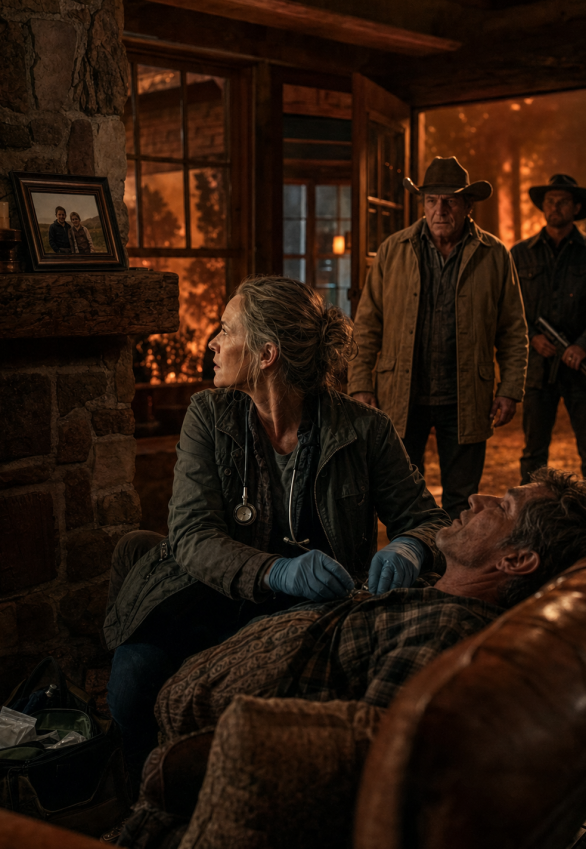
They drove me up switchback roads with the sky glowing the color of a struck match, past a gate and a long fence line, to a fortified ranch house with men posted at the corners who watched my hands more than my face. Inside, a young man was slipping in and out on a leather couch, pupils like pinpricks, breathing shallow. An overdose. The family wanted him alive and the night forgotten.
I went to work. That part I can do in my sleep — airway, breathing, the medication I carry precisely because of nights like this. I got his respirations back up. I got color into him. I knelt there on that stone floor with my bag open, counting his pulse, and for a while the only thing in the world was the work.
It was when his numbers steadied and I finally let myself breathe that I looked up.
There was a photograph on the mantel. Framed, a little faded, the kind of picture a family keeps for decades. And I knew the face in it the way you know your own name in the dark. It was the boy I loved when I was nineteen. The first one. The one whose family decided a girl like me was a problem to be removed, and removed me.
I must have made a sound, because that was when I noticed the man in the doorway.
He’d been standing there the whole time, watching me work, and now he was watching me see the photo. Older. Harder. But it was Cole. The brother. The one who’d stood on that porch all those years ago and made the family’s decision sound like weather — inevitable, impersonal, final.
For a long moment neither of us said anything. The fire glowed at the windows. The young man breathed. And two people who’d buried each other stood in a room and let the past come all the way up out of the ground.
“You saved him,” Cole said finally. Not a question.
“That’s the job,” I said.
Here’s the thing I understood in that silence, the thing that made my hands go cold in a way the medicine had nothing to do with. The boy on the couch had the same jaw as the photograph. The same brow. He wasn’t a stranger’s son. He was family — Cole’s son, or close enough that the resemblance told the whole story. The love they’d torn out of my life had gone on without me, married, had children, built this fortified place with its men at the corners and its secrets kept off any record.
And now I was the outsider who knew. The only one.
That is a dangerous thing to be, on a ranch like that, with men like those. I’ve thought a lot since about why they let me leave. I think it was Cole. I think, whatever he’d become, whatever business those corner-posted men were really guarding, the sight of me kneeling over his boy pulling him back from the edge did something the years hadn’t undone.
He walked me out himself. At the truck, under a sky raining ash, he stopped.
“He’d have wanted to know you were the one,” Cole said. “My brother.”
Past tense. That was how I learned the boy I’d loved was gone — had been gone for years. The photograph on the mantel wasn’t nostalgia. It was a memorial. The young man I’d just saved was the son he’d left behind, being raised by the same family that once decided who got to stay and who got sent away.
I didn’t cry until I was back on the switchback road with the gate shrinking behind me.
I never told anyone what I saw that night. Not because I’m afraid of the Danners, though maybe I should be. I keep it quiet because some secrets aren’t yours to spend. That boy is alive. He doesn’t know a country doctor once loved his father, or that the same doctor knelt on his family’s floor and breathed him back. He just knows he woke up.
Cole and I have never spoken since. But twice now, in bad fire seasons, an envelope of cash has shown up at my clinic with no name on it, enough to cover the patients who can’t pay. I know who it’s from. It’s the closest thing to an apology that family will ever make, and it’s paid for by guarding a life I’ll never fully understand.
People think being trusted to keep quiet is a small role. The silent witness. The one who asks nothing. But I’ve learned it’s the heaviest thing you can carry — because you’re the only one holding the truth, and you have to decide, alone, every day, to keep holding it.
I went up that mountain thinking I was just the doctor.
I came down carrying the whole buried history of the family that once threw me away.
Comments are closed.