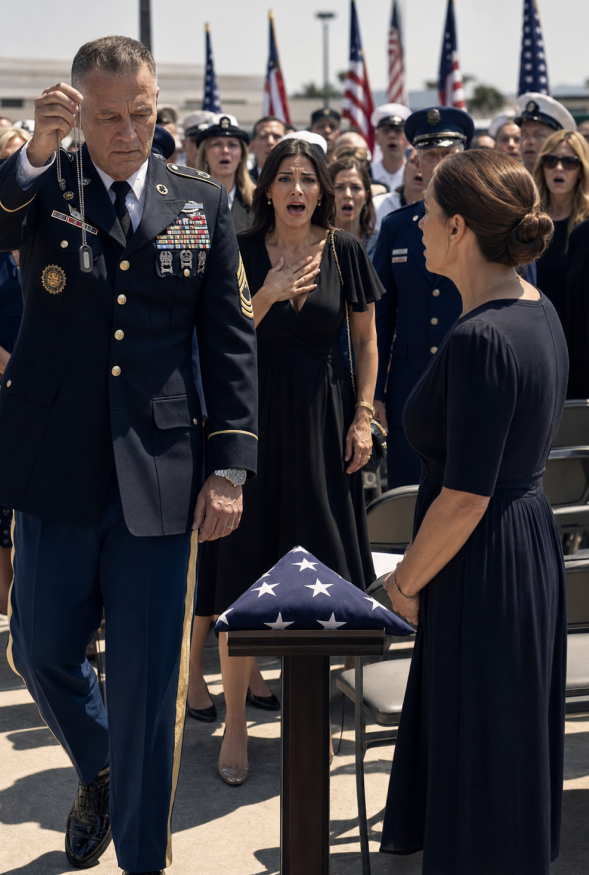
The sergeant major’s name was Waller, and when he took the dog tags out of Sylvia’s hands, he did it so gently that for a second I don’t think she understood what was happening.
Neither did I.
Let me tell you what it’s like to be called the delusional one for two years.
When the Army officers came to my door and told me my husband, Daniel, had died overseas, I already knew something was wrong. Not because of grief — grief came later, and it came sideways. It was wrong because the woman standing behind them, the woman in the tailored black coat introducing herself to my husband’s commanding officer as “Mrs. Mercer,” was someone I had never seen in my life.
I said, that’s my name. I’m Rachel Mercer. I’m his wife.
And she looked at me with such calm, practiced pity that three officers turned to comfort her instead of me.
That was the beginning. Over the next months, Sylvia did what people like Sylvia do — she got there first, she cried on cue, and she made my truth sound like a breakdown. She had documents. Not real ones, I’d learn later, but convincing ones. A marriage certificate. Photographs. She’d inserted herself into two years of Daniel’s deployments so smoothly that when I insisted I was his real wife, I was the one who sounded unhinged. His extended family, people I’d met only a handful of times because Daniel and I married quietly before he shipped out, sided with the woman who performed the part better.
They started calling me the delusional ex. The woman who couldn’t accept she’d been replaced.
So by the time the base memorial came, I almost didn’t go. I sat in the back in a plain dark dress because I couldn’t bear to fight for a seat at the front of my own husband’s service. I watched Sylvia accept the folded flag they should have handed me. I watched her clutch his dog tags to her chest and sob, and I watched hundreds of people believe her.
And then a sergeant major named Waller stopped the ceremony.
He didn’t announce anything dramatic. He simply walked to Sylvia, said something quiet, and lifted the tags from her hands. She resisted for half a second. He didn’t. Then he crossed that field — the longest walk I have ever watched anyone take — and he lowered the chain over my head, and he saluted me.
Here is the part that took my breath, that I’ve had to sit with for a long time since.
Daniel wasn’t dead.
The “death” had been constructed. Daniel worked closer to intelligence than I had ever been allowed to know, and when a source he was protecting was compromised, the fastest way to shield both the source and Daniel’s family was to bury Daniel on paper. The dog tags Sylvia had been clutching were reissued — cover-identity tags, part of the fiction. And Sylvia was not a grieving widow at all. She was the leak they were smoking out. She’d attached herself to Daniel’s deployments not out of love but to track him, and when the operation staged his death, she stepped into the role of widow to stay close to the flow of information and condolence briefings that came with it.
The Army let it run. They let her play the widow because a performing leak is a leak you can watch. And the record — the real one, the sealed one — named exactly one next of kin. Me. The woman everyone had spent two years dismissing.
Sergeant Major Waller had been read into enough of it to know who the tags belonged around. When the moment came to end the charade, he ended it the way soldiers end things: without a speech, with a salute.
I won’t pretend the field understood all of it that day. Most of them just saw a decorated senior NCO take a dead man’s tags from one woman and hang them on another, and go rigid with respect in front of the second one. That was enough to turn every head that had ever looked at me with pity. You could feel the story rearranging itself in real time across hundreds of faces.
Sylvia was quietly detained before the crowd fully dispersed. I didn’t see it happen. I was told later. By then I wasn’t watching her anymore.
Because six weeks after that memorial, in a room I’m still not allowed to describe, they brought Daniel back to me. Thinner. Older around the eyes. Alive. He held my face and said the first thing he’d been able to say in two years was sorry — sorry I’d carried the delusional-ex label so the fiction would hold, sorry he couldn’t warn me, sorry the cost of protecting a stranger’s life had been letting the world tell me I’d imagined my own marriage.
I’ve thought a lot about why it was the tags that undid it. Why that object. And I think it’s because a wedding can be faked and a certificate can be forged and a woman can cry on command — but the chain they hung around my neck came from the one institution that actually knew the truth and had simply been waiting for the right second to tell it.
They called me the delusional ex right up until those tags left her hands.
I don’t need them to apologize. Most of them never will; some still don’t know the classified half and think I got lucky. Let them.
I know what I held onto for two years when everyone told me to let go. And I know it came back.
Daniel’s home. The tags are in a drawer, not around my neck — I don’t need to wear the proof anymore. I lived it. That’s enough.
Comments are closed.