The phone was still recording when it happened. I want you to understand that. Every second of it lives on a memory card somewhere, and I have thought a hundred times about what it must look like played back.
Damien didn’t lower the camera when Lucy started running. That was the thing that told me who he’d become. A little girl in a light coat and red sneakers broke away from the town car at the far end of the platform, her nanny a step behind her, and my ex-husband kept filming, narrating for his followers in that smooth voice he’d built his second life on.
“And here’s the part where the sad ex tries to pretend—” he started.
Then Lucy reached me.
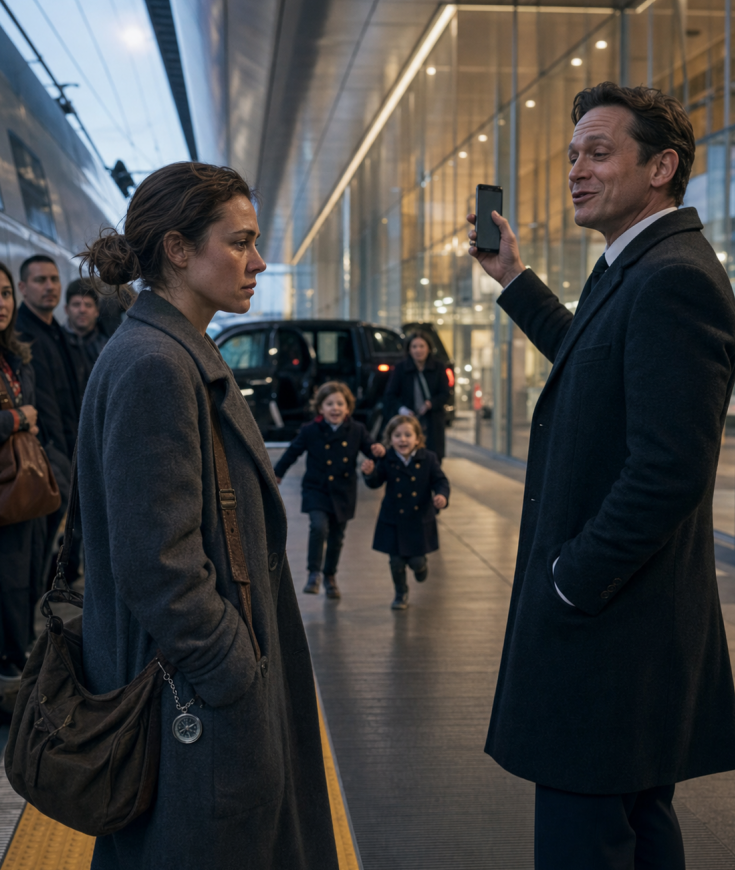
She hit my legs the way six-year-olds do, all arms and momentum, and she pressed her face into my coat and said “Mom” in that muffled, certain way, and I felt the silver half-heart locket at her collar knock against the one at mine.
Damien stopped talking.
I watched it happen behind his eyes. The math. The dates. A little girl who was exactly the age she would be if the pregnancy he’d accused me of inventing had been real. A locket that matched mine — the pair I’d bought the winter before he vanished, the winter he told a courtroom’s worth of lawyers he’d “died at sea” rather than answer a federal subpoena.
Because that’s what he did. He didn’t run to another woman. He didn’t lose his fortune. He walked onto a boat one gray morning, left a wallet and a shoe and a plausible current, and let the world grieve him. Let me grieve him. He reinvented himself two states away with capped teeth and a follower count while the investigation into his firm collapsed for lack of a defendant.
What he never knew — what I made very sure he never knew — was that I was eight weeks pregnant the day he “drowned.”
I didn’t hide her out of spite. I hid her because a man who would fake his own death to escape the law was not a man I would hand a daughter to. I raised her quietly. I let people believe I’d lost everything, because the alternative was letting Damien’s family, his lawyers, his new life, come looking for an heir.
I had a little help. Not the kind he’d assume. A woman I’d nursed through her final years left me more than anyone knew, and I’d spent it the way you spend a secret — carefully, invisibly, on a town car and a nanny and a good school and a locket to match my own.
“That’s not—” Damien said. The phone was shaking now. “Nora. Whose kid is that.”
I crouched down. I fixed the strap on Lucy’s sneaker. I did not answer him, because he did not deserve the answer, and because I had waited three years for the particular silence that was settling over that platform.
The commuters had stopped pretending not to watch. His livestream, I found out later, had four thousand people on it. Four thousand people watched the man who’d built a brand on my “downfall” go gray in the face as a little girl in red sneakers looked up at him with his own eyes.
“You told everyone I lost everything,” I said. I stood up. I took Lucy’s hand. “I let you. It was easier than telling them the truth. That the man who died at sea to dodge a subpoena left a pregnant woman he’d accused of betraying him — and that I decided you were exactly the kind of father a child is better off believing is dead.”
He lowered the phone at last.
“You can’t prove—” he started, and then he heard himself, and he stopped. Because the locket. Because her face. Because a man who fakes his own death has no legal standing to demand a paternity test on a platform full of witnesses, and he knew it before I did.
Here is the part the livestream caught that I’m almost glad exists: Lucy, who did not understand any of it, who only knew that a strange man had been pointing a phone at her mother and making her mother’s face go tight, tugged my sleeve and asked, loud and clear, “Mommy, is that man okay?”
And four thousand strangers heard my daughter pity the man who’d built his fame on my ruin.
He turned it off then. He put the phone in his pocket and he stood there, and for one moment I saw the person I’d married under all the capped teeth and expensive wool, and he looked lost.
“Go home, Damien,” I said. “Wherever that is now. You buried yourself to get away from us. You don’t get to dig back out because you saw something you wanted.”
We walked out through the turnstiles. The town car was warm. Lucy fell asleep before we hit the bridge, her locket rising and falling on her chest.
I never heard from him directly again. But three weeks later a very careful letter arrived from a very expensive attorney, asking about “the child.” I gave it to my own lawyer, along with a printout of a three-year-old Coast Guard report and a federal case number.
I never got a second letter.
The daughter he buried himself to escape is seven now. She has both halves of the heart — I gave her mine on her last birthday, told her it was so we’d always match. She doesn’t know the rest yet. Someday she’ll ask why she never had a father, and I’ll have to decide how much of the truth a person is owed about the day they were both grieved and hidden by the same lie.
For now, she sleeps with the locket on. And somewhere there’s a memory card with the exact second a man realized that the thing he threw away had grown into the one thing he could never take back.
Comments are closed.