My father did not raise his voice. He never has. Thirty-one years of command taught him that the quietest man in the room is usually the one everyone should be watching, and Trevor and Marlene had never once thought to watch him.
He held my forearm in the light, looked at the row of finger-shaped bruises they’d told me to keep covered, and then he folded my sleeve back down as gently as he’d lifted it. He did not want them displayed. He wanted them witnessed. There’s a difference, and he knew it.
Then he stood up.
“Trevor,” he said, in a voice so level it made the air go tight, “you’re going to sit down, and you’re going to keep your hands where I can see them, and you’re going to listen to me very carefully, because I am only going to explain your situation to you once.”
Trevor tried the routine one last time. “Ray, she bruises easily, the pregnancy—”
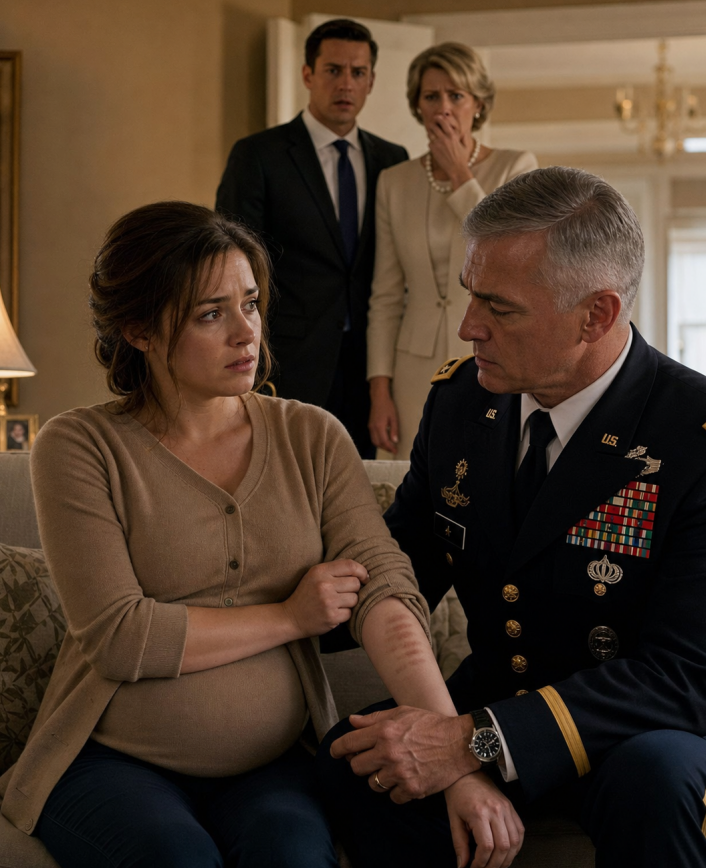
“Colonel,” my father said. “You’ll call me Colonel. You lost the right to my first name the moment you put your hands on my daughter.”
The word hands landed in that beige living room like a dropped plate. Marlene’s smile finally came all the way off. And I realized, sitting there, that this was the first time in seven months that someone had said out loud, in front of them, the thing they’d spent seven months teaching me to never say.
He didn’t shout. He laid it out like a briefing.
He told Trevor that he had spent the drive making two phone calls. One to a friend from his old unit who now practiced family law in the state, who would be taking my case at no charge and who already had a protective order half-drafted. One to a woman named Denise, a victim advocate my father had apparently known for twenty years, who was expecting my call that evening. He told Trevor there would be photographs of my arm taken tonight, dated and documented, by a professional, and that if a single new mark appeared on me or on my child after today, the documentation would already exist to bury him.
He told Marlene that he knew exactly what she’d done — that covering for a man who hurts a pregnant woman doesn’t make you a bystander, it makes you a participant, and that she should think very hard about which of those two things she wanted a court to call her.
Then he turned to me, and his whole face changed. The colonel went away and my dad came back.
“Hannah,” he said, and his voice finally, barely, moved. “I am so sorry it took me this long to hear it. That’s on me. You called and I heard something wrong in your voice and I told myself I was imagining it, because the alternative was unbearable. I will not make that mistake again as long as I live. You’re coming home with me tonight. You and the baby. Pack what you need. Leave the rest — it’s just things, and I’ll send someone for the things.”
I want to tell you I said something strong. I didn’t. I put my face in my hands and I cried the way you cry when a weight you’ve carried alone for seven months is finally lifted by someone else’s shoulder, and my father sat back down and put his arm around me and let me.
We left that evening. Trevor stood in the doorway saying my name in that soft, worried voice, performing concern for neighbors who weren’t watching, and my father simply put himself between us and did not move until I was in the car.
That was three weeks ago.
I’m at my father’s house now. The protective order is real and signed. The photographs exist. Denise sat with me for two hours the first night and told me something I’ve thought about every day since: that the cruelest part of what Trevor did wasn’t the bruises, it was convincing me that my own account of my own life couldn’t be trusted. That the isolation was the weapon and the marks were just the proof he got careless.
My daughter is due in six weeks. She is going to be born into a house where her mother is believed. My father has already, absurdly, bought a car seat and installed it wrong twice, and I have never loved him more than watching him swear at an instruction manual on the living room floor.
They spent seven months betting that no one would believe me. They never counted on the one man who raised me to know the difference between someone who’s unstable and someone who’s being made to look that way.
He heard it in a phone call. He drove two states. And he lifted one sleeve.