The dove on her wrist changed the arithmetic of the whole night.
Eighteen years earlier I had run a small women’s shelter two states inland, the kind that doesn’t put its address online. We moved people. We gave them new towns and new names and a bus ticket bought with cash. The rule was simple and absolute: once someone walked out our back door into a new life, I forgot they had ever existed. It was the only way to keep them safe from the men who came looking.
Her name back then was Sofía, though it wasn’t anymore. She’d come in at nineteen with a split lip she kept apologizing for and a boyfriend who sent flowers to the front desk as a threat. We got the dove tattoo done the week she left, because she said she wanted one thing on her body that she had chosen for herself. A dove. Freedom, she’d said, embarrassed by how obvious it was. I told her obvious was fine. Obvious was allowed.
And now she was seizing in front of me on a yacht owned by a cartel lieutenant, seven years pregnant with a life she almost certainly hadn’t chosen either, and the man in the doorway was the exact shape of everything we’d taught her to run from.
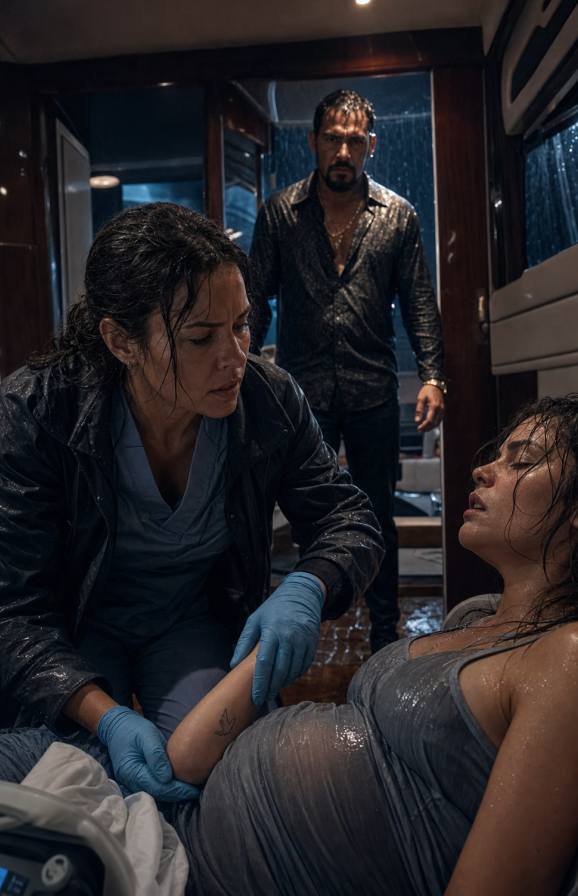
“Her pressure’s still dangerous,” I told him, keeping my voice flat and clinical. “If she seizes again untreated, I lose them both. I need to keep her stable and quiet. No noise, no crowd. Everyone out except one person to help me.”
I was betting my life on a simple fact about men like him: they are terrified of being blamed for a death they can’t control. He looked at Sofía, at the monitor of her breathing I’d cobbled together, and he cleared the cabin. He left one guard — younger, softer around the eyes, a kid who kept glancing at the girl like she was somebody’s sister.
The storm was still screaming. That mattered. It meant the coast guard channels were flooded and the men were as trapped on this water as I was.
When Sofía’s eyes fluttered open, I leaned close under the pretense of checking her pupils and I said the old name. Just once. Her whole body flinched, then stilled, and she looked at me the way you look at a door in a burning building.
“I remember the dove,” I whispered. “I was there.”
She started to cry without sound, which is a thing you only learn to do if crying out loud has ever cost you something. She told me in broken pieces: he’d found her eight months ago. She hadn’t come back willingly. The baby was the only reason she was still breathing, because a man like Mateo Vargas wanted a son more than he wanted revenge, and a pregnant woman was worth keeping alive.
I have thought a thousand times about what a braver person would have done. Something with a flare gun, a radio, a heroic dash through the rain. I am not that person. I am a fifty-something obstetrician with bad knees and a very good memory. So I used the only weapon I have ever been good with: paperwork and procedure.
I told Mateo that the baby was in distress and that Sofía needed a hospital within the hour or he would lose his son. It was half true — the situation was genuinely dangerous — and half the most important lie of my life. He didn’t want to bring her to shore, to lights and cameras and records. But he wanted a dead heir even less. He made the call. He radioed the marina to have a private ambulance waiting, discreet, paid for, no questions.
That was all I needed. A hospital meant nurses. Nurses meant a system I understood better than he ever could. The moment we docked and they wheeled her through those automatic doors, I stopped being a hostage and started being a physician in a building full of my own kind of power.
I got her admitted under an emergency hold for eclampsia. I got her a room, and then I got two minutes alone with the charge nurse, and I told her the truth — not all of it, just the shape that mattered: this patient is being trafficked, the man in the waiting room is not her husband, please call the number I’m writing down and do not let him past this door.
There is a protocol for this. Hospitals are one of the few places on earth built to quietly separate a frightened person from someone dangerous, because they see it more than anyone wants to admit. Security walked Mateo to a “family consultation room” that happened to lock from the outside. By the time he understood what was happening, there were people there who had been waiting a long time to have a reason to hold him.
Sofía delivered a healthy girl at 4:19 in the morning, as the storm finally broke apart over the Gulf and let a little gray light through.
She named her Paloma. Dove.
I didn’t do anything heroic that night. I didn’t fight anyone. I just remembered a nineteen-year-old’s tattoo and refused to unremember it, and I used the boring, patient machinery of the world I actually belong to. The girl I’d helped disappear once got to disappear one more time, this time with a daughter and a real name and a bus ticket I bought myself, in cash, the way I always did.
The dove told me who she was. What I did next was just keep an old promise: once you walk out my door, you get to stay free.
Comments are closed.