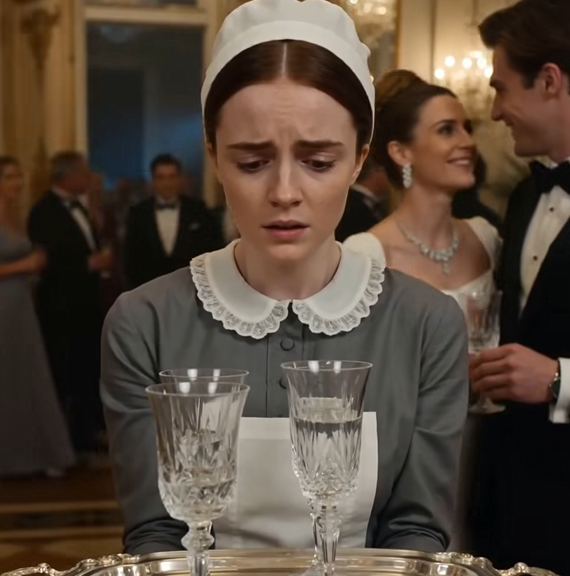
The champagne flutes slid. One by one, they tipped off the gold tray and hit the polished marble floor. The sound was extraordinary. Not a crash. A cascade. A bright, shattering melody that cut through the orchestra like a knife. Five hundred heads turned. The music stopped. The silence that followed was heavier than the crystal chandeliers hanging above us.
Victoria’s glass froze halfway to her lips. Her emerald dress caught the light as she turned, her perfect smile faltering for the first time all evening.
“Clean that up,” she said. Her voice was sharp, dismissive. She didn’t even look at me. She looked through me, the way she had for three years. “Someone get a mop. We’re in the middle of a toast.”
I didn’t move. I stood in the center of the shattered glass, my black shoes surrounded by glittering shards. I reached down and lifted the white linen napkin from the tray.
The USB drive sat in my palm. Small. Cold. Heavy with eight years of buried truth.
“Who are you?” Victoria asked. Her voice changed. The honey was gone. Something sharp and frightened lived underneath. “Security.”
“My name is Elena Mercer,” I said. My voice didn’t shake. It echoed off the vaulted ceiling, bouncing off the marble columns and the gilded moldings my father had designed. “Daughter of David Mercer. The man who built this room.”
The judge in the third row set down his champagne glass. The trustees stopped whispering. A woman in the front row clutched her pearl necklace, her mouth slightly open.
“Get her out of here,” Victoria hissed. Two men in dark suits stepped forward from the shadows near the orchestra pit.
I raised my hand. I pressed a single button on the small black remote hidden in my apron pocket.
The massive LED screens behind the podium flickered to life. The orchestra’s monitors, the side displays, the projector aimed at the ballroom ceiling—all of them lit up with a single document.
A bank statement. Dated eight years ago. Showing a transfer of fourteen million dollars from David Mercer’s personal account into a shell company registered to Victoria Sterling. Not Arthur. Victoria.
“That’s fabricated,” Victoria said. Her voice cracked. She took a step back, her heel crunching on a shard of champagne glass. “It’s a deepfake. She’s a disgruntled employee. Call the police.”
“The next slide,” I said calmly.
The screen shifted. An email chain. Victoria to Arthur. The subject line: Mercer problem. The body: If David files the patent claim, we lose everything. The firm, the estate, the foundation. Make it disappear.
The ballroom erupted. Gasps echoed off the walls. A man in a tuxedo stood up, knocking over his chair. A woman covered her mouth with her hand. The flashbulbs from the press table in the back started popping, a rapid, blinding staccato.
“That’s not real,” Victoria screamed. She lunged for the AV booth, but the two security guards who had been moving toward me stopped. They looked at the screen. They looked at each other. They didn’t move.
“The next slide,” I said again.
A video file. Security camera footage from Danbury Federal Correctional Institution. The visiting room. My father, thin and gray, sitting across from Victoria. The audio was crystal clear.
‘Sign the transfer, David,’ the video-Victoria said. She was wearing the same emerald dress. ‘Sign it, and I’ll make sure Elena gets into a good school. Refuse, and she goes into the system.’
My father’s voice was barely a whisper. ‘You killed me. You know that.’
‘I saved this family,’ Victoria replied.
The room went completely still. The only sound was the hum of the projector and the soft, rhythmic click of the flashbulbs.
The judge in the third row stood up. He was an old man with silver hair and a face carved from granite. He walked to the front of the room. He didn’t look at Victoria. He looked at the screen. He read the documents. He watched the video.
When it was over, he turned to the room. His voice was quiet, but it carried across every inch of the ballroom my father had built.
“I sentenced David Mercer based on evidence presented by this woman’s legal team,” the judge said. His hands were shaking. “Evidence that, it appears, was manufactured. I am calling an immediate judicial review. And I am recommending criminal charges.”
Victoria didn’t run. She stood in the center of the shattered champagne glass, her emerald dress catching the fractured light of the chandeliers, her face completely empty as the security guards finally moved—not toward me, but toward her.
The cold steel of the handcuffs clicked around her wrists. The sound was soft, final, and absolute. She didn’t scream. She didn’t fight. She just stared at the marble floor—the floor my father had designed, the floor she had polished her reputation on, the floor that was now covered in broken glass and the truth she couldn’t bury deep enough.
I knelt down on the marble. I picked up a single unbroken flute, and it caught the light of the arches my father designed.