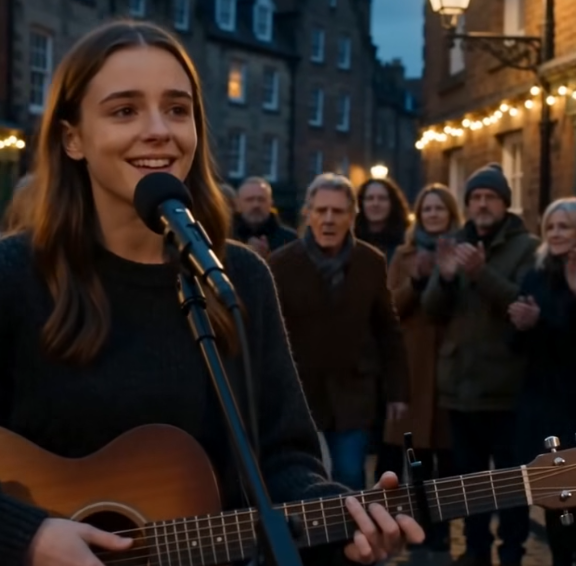
The street in the old town had always been a place for music. On clear evenings the string lights went up, the cafes put out extra chairs, and someone always brought a guitar. Clara had been coming here for three months. She didn’t have a permit, but no one seemed to mind. She played for tips and for the chance to sing the songs her mother had left her.
Her mother had died when Clara was fourteen. Cancer, quick and cruel. The songs were all that was left. Old folk tunes, some in English, some in a language Clara didn’t fully understand but felt in her bones. “The Water is Wide.” “Black is the Color.” And the one she had just finished, the one without a proper name, just a melody her mother had hummed while cooking or folding laundry.
She had just thanked the small crowd when she saw him.
He stood at the back, taller than most, a wool coat open despite the cold. His hair was silver at the temples. He carried a guitar case in one hand like it was an old friend. He didn’t move until the last note died.
Then he walked forward.
The people stepped aside without knowing why.
He stopped in front of her. Close enough that she could see the lines around his eyes, the way his scarf had frayed at one end.
“That song,” he said. “Where did you learn it?”
Clara looked at him. There was something in his face that made the usual polite answer feel wrong.
“My mother used to sing it to me.”
The old man nodded once, as if he had expected the answer and feared it at the same time.
He set his guitar case down carefully on the cobblestones.
“What was her name?”
Clara felt the tear before she felt the question land. She had not cried in front of strangers in a long time. But something about the way he asked, like the answer mattered more than anything else in the world, broke the wall she kept around that part of her life.
“Her name was Ela.”
The old man closed his eyes.
When he opened them, they were wet.
He reached into his coat pocket and pulled out a small, worn photograph. It was creased and faded, protected by a plastic sleeve that had yellowed with age. He held it out with a hand that shook slightly.
Clara took it.
The woman in the photo was young, laughing, standing on a beach somewhere with wind in her hair. She looked like Clara. The same eyes. The same mouth.
“She sang that song to me too,” the old man said. “A long time ago. Before she left. Before I knew she was carrying you.”
The crowd had gone completely still. Even the cafe music from across the street seemed to fade.
Clara looked from the photo to the man.
“You’re…”
“I’m your father,” he said. “Or I was supposed to be. She never told me. I looked for her for years. When I finally found where she had gone, it was too late. She was already gone. I never knew about you.”
Clara stood up slowly. The guitar slid from her lap but she caught it. She held the photograph like it might disappear.
“Why now?” she asked.
He looked at the guitar case at his feet.
“I heard you playing last week. I didn’t have the courage to come closer. Tonight I made myself walk to the front. I thought if I was wrong, I could just disappear again. But when you sang that song… I knew.”
Clara wiped her cheek with the back of her hand.
“I don’t know what to do with this.”
“You don’t have to do anything,” he said. “I just needed you to know that she was loved. That you were wanted. Even if I didn’t know it at the time.”
He picked up his guitar case.
“I play too. Not as well as you. But if you ever want to… I don’t know. Play together. Or talk. Or not. It’s your choice.”
He started to turn.
Clara reached out and touched his sleeve.
“Wait.”
He stopped.
“What’s your name?”
“Thomas,” he said. “Thomas Reilly.”
Clara nodded.
“I’m Clara. Clara Reilly would have been my name, I guess.”
Thomas smiled, small and broken and hopeful all at once.
They stood there under the string lights while the crowd slowly began to move again, giving them space. The rain had stopped. The cobblestones shone.
Thomas opened his guitar case and took out an old acoustic with a sticker on the back that said “Ela’s Song” in faded marker.
He didn’t ask to play. He just held it.
Clara sat back down on her stool.
She started the song again from the beginning.
This time, when she reached the second verse, another guitar joined in, quiet at first, then finding the harmony her mother had never taught her.
The crowd didn’t clap. They just listened.
Some stories didn’t need an audience. They only needed the right two people to finally stand in the same light.