Thomas had not meant to shout. He never meant to shout at Rose. But the sight of the boy kneeling in the dirt with his daughter’s feet in a bucket had hit something raw inside him.
Rose had been seven when the fever took her legs. Or at least that was what the doctors said. Thomas had spent three years telling himself that story because the other one was too heavy to carry. The story where he had been the one driving too fast on the wet road. The story where he had looked away for three seconds to answer a call from the office. The story where his wife had screamed and the car had spun and Rose had been the one trapped in the back seat.
He had buried that story under work and distance and rules. Rules like: no false hope. No silly rituals. No boys from the village filling his daughter’s head with Bible stories and buckets of water.
But now the boy was looking at him like he saw straight through the rules.
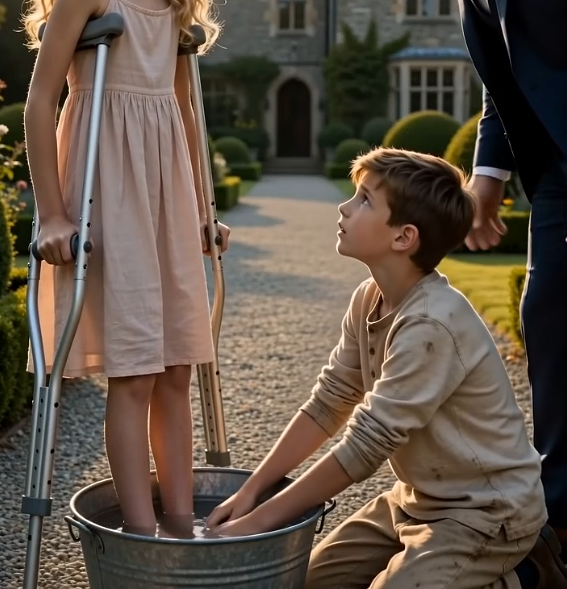
“Mr. Hale,” the boy said. His voice was steady. “My grandma says sometimes God uses small things. Water. Dirt. Hands that don’t give up.”
Thomas felt his throat close. He had fired the boy’s father last month for being late twice. The family lived in the small cottage at the edge of the property. The boy had probably been helping in the garden since he could walk.
Rose was watching both of them. She had not spoken. She rarely did when her father was angry. Thomas realized he had taught her that silence.
He looked at the bucket. The water was gray now. The boy’s knees were soaked. Rose’s crutches were leaning against her like tired friends.
“Rose,” Thomas said, quieter. “Do you want this?”
She hesitated. Then nodded once.
Thomas stood there for a long moment. The sun was dropping behind the big house. The shadows of the hedges stretched across the path like fingers.
He could order them inside. He could send the boy home and never let him near Rose again. He could go back to the study and close the door and pretend the last three years had not happened.
Instead he loosened his tie. He took off his jacket and laid it on the low stone wall. Then he rolled up his own sleeves.
“Move over,” he told the boy.
The boy blinked. Then shifted to make room.
Thomas knelt on the gravel. The stones bit into his knees through the expensive trousers. He reached into the bucket. The water was cold. He found his daughter’s other foot and began to wash it, awkward at first, then gentler.
Rose made a small sound. Not quite a sob. Not quite a laugh.
Thomas did not look up. He kept washing. The boy worked beside him in silence. For the first time in three years, the garden was quiet in a way that did not feel like waiting.
When they were done, Thomas helped Rose out of the bucket. Her feet were clean. Pink from the cold water. She balanced on the crutches. The boy stood on one side. Thomas stood on the other.
They did not speak of miracles. They did not speak of forgiveness or guilt or the call he should never have answered.
They simply walked. Slowly. Rose between them, her crutches making soft taps on the stone. The boy carried the empty bucket. Thomas carried nothing except the weight he had finally put down.
The big house watched them go. For the first time in a long time, it did not feel like a prison.