“I ASKED HIM TO PICK UP DINNER”!!! BELIEVE IT OR NOT, PROSECUTORS SAY LINDSAY CLANCY CAREFULLY PLANNED THE STRANGULATION OF HER THREE YOUNG CHILDREN BEFORE JUMPING FROM A SECOND-STORY WINDOW… AND SHE IS NOW ON TRIAL FOR FIRST-DEGREE MURDER WHILE PERMANENTLY PARALYZED FROM THE WAIST DOWN.
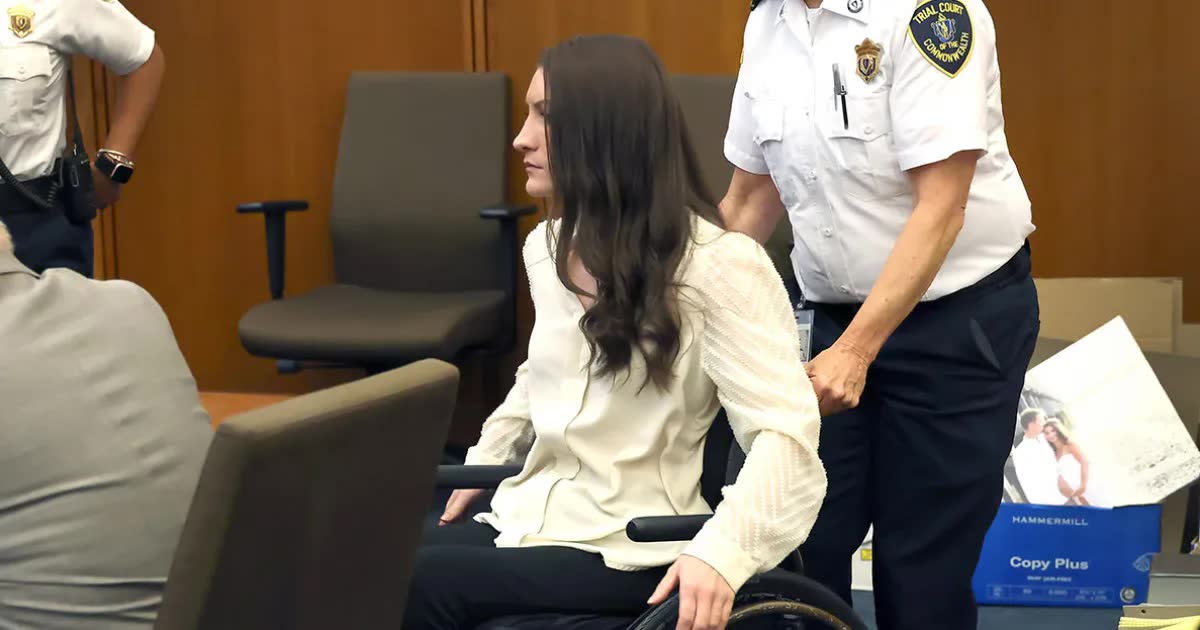
Lindsay Clancy has appeared in court in a wheelchair throughout the proceedings of her ongoing murder trial.
The Massachusetts mother is on trial for the January 2023 murders of her three young children.
On July 27, 2026, the murder trial officially began.
Clancy faces three counts of first-degree murder.
She has pleaded not guilty to all three counts.
Her physical condition has shaped every aspect of her murder trial.
Clancy is paralyzed from the waist down.
Doctors have indicated that her paralysis is permanent.
The physical disability is the lasting result of a two-story fall she took the same night her kids died.
The events that left Clancy paralyzed unfolded inside the family’s Duxbury, Massachusetts, home.
On January 24, 2023, Clancy asked her then-husband, Patrick Clancy, to leave the house to pick up dinner.
Patrick left the residence to pick up the food.
He returned roughly 25 minutes later to a devastating scene.
Patrick discovered that Lindsay had jumped out of a window from the second floor of their home.
She survived the two-story fall.
She was gravely injured from the impact.
Patrick immediately called 911.
Then, as he called 911, he realized their three children had been strangled with exercise bands tied around their necks.
The three children were Cora, Dawson, and Callan.
Cora was five years old.
Dawson was three years old.
Callan was eight months old.
Cora and Dawson were rushed to the hospital by emergency responders.
Both Cora and Dawson were pronounced dead soon after arriving at the medical facility.
Callan, the couple’s youngest child, survived the initial trauma and remained hospitalized.
He died a few days later.
Prosecutors have argued that Clancy carefully planned the killings when she sent her husband out for food.
The state has alleged that sending him away for dinner was a deliberate step to ensure she was alone with the children.
But her defense team, led by attorney Kevin Reddington, has countered that her behavior was the tragic culmination of untreated and mismanaged postpartum illness — not premeditation.
Clancy survived the two-story fall, but the impact caused permanent physical damage.
She is now paralyzed from the waist down and uses a wheelchair to get around.
The fall left her requiring long-term medical care and mobility assistance.
In the aftermath of the fall, she was hospitalized for emergency treatment.
Lindsay was initially treated at South Shore Hospital.
Her injuries were quickly deemed too severe for that facility.
During the trial, Dr. Kelly McDonough, who treated Clancy, told jurors that scans showed the defendant had a “thoracic spine injury.”
However, there was no apparent head injury.
“The decision was made by the team that her injuries were too severe to stay at South Shore Hospital, and the decision was made to transfer her to a tertiary care center,” McDonough testified.



Clancy was subsequently transferred to a tertiary care center to receive specialized treatment for her severe spinal trauma.
She was eventually transferred to Tewksbury Hospital, a state-run public psychiatric facility in Massachusetts.
At Tewksbury Hospital, the combination of her medical needs and psychiatric evaluation could be managed in one setting.
Tewksbury has become her long-term residence.
She has remained held at Tewksbury Hospital throughout the pretrial period leading up to trial.
Her physical condition has factored into logistical decisions surrounding the case.
Those logistical decisions have included her transport to and from court proceedings.
They have also included her seating arrangement in the courtroom.
She has appeared in a wheelchair at each hearing and throughout the trial itself.
While Lindsay has not denied killing her children, she has pleaded not guilty to three counts of first-degree murder.
Her defense strategy centers on an insanity plea.
Reddington has argued that she was suffering from postpartum psychosis and was overmedicated at the time of the killings.
Reddington told the court that his client had struggled with depression for a long time.
She voluntarily committed herself to a local psychiatric hospital less than a month before her children died.
Her doctors took her on and off medications to treat the depression.
Reddington said those medication adjustments only worsened her symptoms.
The defense has said Lindsay had been prescribed 15 medications in the months leading up to the tragedy.
Reddington argued that jurors should hear why Clancy and Patrick “would go to consult with doctors because of depression, because of the life that she was living, which was one of horrific misery because of medications.”
Yet prosecutors have pushed back against the defense’s claims.
The prosecution has signaled they may bring in their own experts to testify on whether Clancy was criminally responsible for the killings.
On August 11, 2026, psychiatric nurse practitioner Rebecca Jollotta testified in court about her treatment of Clancy.
Jollotta works at South Shore Hospital in the perinatal behavioral health program.
In late November 2022, Jollotta created a plan to treat Lindsay’s anxiety, depression and insomnia.
Jollotta testified that Lindsay asked several times to change her medications during her treatment in late 2022.
Lindsay repeatedly sought changes and claimed the drugs caused her to have intrusive thoughts, insomnia and numbness.
She also expressed concerns about becoming dependent on the benzodiazepine Ativan she had been prescribed.
“It’s just a very scary stressful time for me, and starting new meds with side effects is very scary to me,” Lindsay previously wrote in a note amid the medications.
Jollotta responded by explaining it would take weeks for the medication to be effective.
Jollotta told Clancy she believed her problems were more likely postpartum depression instead of side effects from the drugs.
“All of this sounds like postpartum depression,” Jollotta wrote in a note during the time she worked with Clancy.
On December 21, 2022, Jollotta treated Lindsay for the last time.
That final treatment session occurred approximately one month before the killings.
If Lindsay is found not guilty by reason of insanity, she would likely be committed to a psychiatric facility rather than sentenced to prison.
A first-degree murder conviction in Massachusetts carries a mandatory sentence of life in prison without the possibility of parole.
Regardless of the verdict, her paralysis and use of a wheelchair are expected to remain permanent.
Her physical condition remains a lasting physical consequence of the night that left her three children dead.
The defense argues she was incapacitated by postpartum illness.
The prosecution argues she acted with calculated premeditation.
The jury will decide.
The charges are allegations and have not been proven in court.
No Comments yet!