When a nation asks its young men and women to step forward, put on the uniform, and risk their lives on the line of duty, it incurs an absolute and permanent debt. That obligation does not expire when the uniform comes off, nor does it diminish with the passing of time. It is a sacred covenant forged in sacrifice and sealed with the promise that those who defend this country will never be abandoned by it.
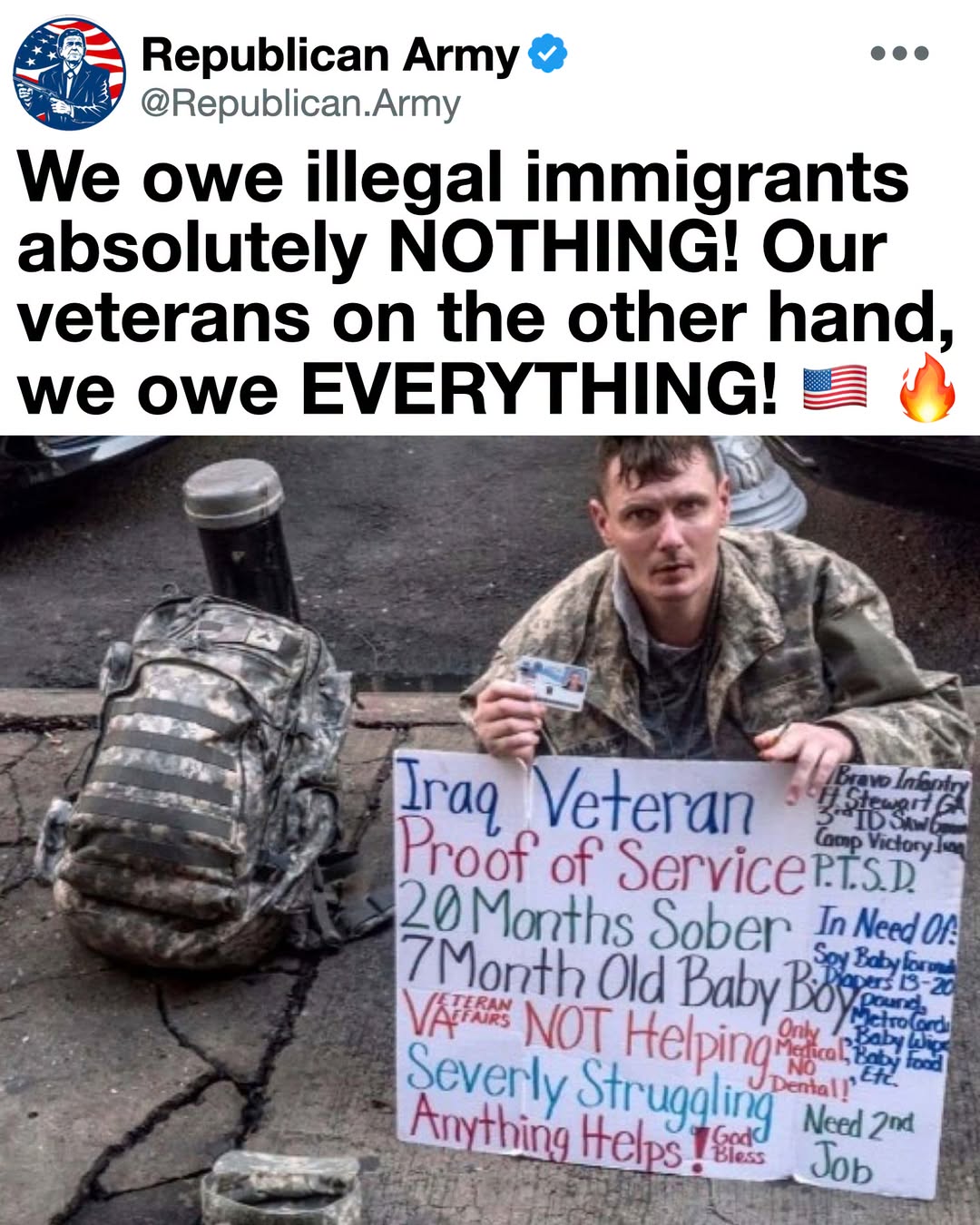
Every single veteran who returns home bearing physical wounds, enduring psychological trauma, or facing the quiet and often invisible struggle of civilian reintegration holds an undeniable first claim on public resources and public attention. These brave individuals laid everything on the line to safeguard the freedoms we enjoy every single day. Their well-being is not a matter of charity; it is a fundamental duty of the highest order.
Yet, across our cities and towns, a heartbreaking and unacceptable reality plays out in plain view of the American public. When a former service member is reduced to sitting on a sidewalk, holding a sign that details basic, unmet human needs, the failure of our leadership is neither theoretical nor abstract. It is a visible, stinging indictment of national priorities—a direct and painful broken promise that strikes at the heart of our country’s conscience.
There is no excuse for a decorated warrior to wonder where their next meal will come from or where they will lay their head at night. When those who stood guard over our nation’s security are left to navigate bureaucratic neglect and empty streets, the moral foundation of our governance is shaken. A society that allows its defenders to fall through the cracks has lost sight of its most fundamental obligations.
At the exact same time this tragedy unfolds, an alarming and completely inverted set of priorities has taken hold across the national landscape. Billions in taxpayer-funded benefits, emergency housing, medical resources, and social services are being openly directed toward individuals who entered this country unlawfully. While our own heroes wait in endless lines for basic care, those who ignored our sovereignty are moved to the front of the line.
Let us be entirely unequivocal about the principles of national sovereignty and the rule of law. No comparable moral, legal, or constitutional obligation exists toward those who have bypassed the legal immigration system. A nation cannot treat lawful sacrifice and unlawful entry as interchangeable, nor can it elevate non-citizens over the very people who bled to protect its borders.
Citizenship and military service create deep, reciprocal duties between the individual and the republic. The citizen offers loyalty, obeys the law, and in the case of our service members, offers life and limb in defense of the homeland; in return, the nation owes them protection, honor, and unconditional care. Unlawful presence creates no such reciprocal duty, and pretending otherwise defies basic common sense.
Directing finite public resources, taxpayer dollars, and social assistance to illegal immigrants while American veterans go without shelter and medical treatment inverts the proper order of national responsibility. It sends a demoralizing message to every man and woman who ever swore an oath to support and defend the Constitution. It signals that adherence to the law and sacrificial service are treated as secondary concerns by our own institutions.
Observers and citizens across the country are rightly demanding a complete reevaluation of where our national loyalty lies. How can any government look a struggling veteran in the eye and explain that there are endless funds for non-citizens, but limited resources for the people who fought its wars? The contradiction is glaring, indefensible, and entirely unsustainable.
The public is waking up to the reality that national resources are not infinite, and every dollar diverted away from our veterans represents a direct failure of governance. When municipal budgets and state resources are strained to accommodate unlawful arrivals, it is inevitably the most vulnerable Americans—chief among them our struggling veterans—who pay the ultimate price through diminished services and neglected infrastructure.

Restoring the Sacred Hierarchy of National Responsibility
Restoring the correct priority means making a decisive and uncompromising choice to direct support to those who have already paid the highest price for our country’s freedom and security. It means establishing an ironclad standard that puts American citizens and military veterans first in every single funding decision, policy initiative, and community program across the land.
Housing assistance must be guaranteed to every former service member before any public money or municipal property is allocated to shelter individuals who entered the country illegally. No veteran should ever sleep on the streets of the nation they defended while newly arrived non-citizens are provided hotel rooms and transitional accommodations at public expense.
Comprehensive, top-tier medical care—covering both physical injuries and the profound mental health challenges that accompany combat—must be fully accessible without delay, red tape, or administrative hurdles. Our veterans must never be forced to wait months for life-saving appointments while public health systems are overwhelmed and reallocated to serve those who violated our immigration laws.
Robust employment assistance, job training, and educational reintegration programs must be prioritized to empower veterans as they transition back into civilian life. These men and women possess unmatched leadership, discipline, and technical skills that should be harnessed to strengthen our domestic economy, rather than leaving them to navigate post-service life in total isolation.
This is not merely about balancing budgets or shifting administrative line items; it is a question of basic national integrity and moral alignment. A country that honors its warriors demonstrates that its word means something, that its flag stands for something real, and that its gratitude is backed by concrete action rather than hollow political rhetoric.
The concept of putting America first is not born out of malice toward others, but out of an essential understanding of civic duty and self-preservation. Just as a family must ensure its own children are fed, clothed, and protected under its own roof before extending assistance to strangers, a sovereign nation must care for its own citizens and defenders before anything else.
A country that takes care of its own first remains strong, secure, and economically resilient enough to decide whom else it will welcome and under what lawful terms. When a nation neglects its foundational obligations and allows its internal strength to erode, it loses the capacity to sustain itself, let alone project stability or offer genuine leadership to the rest of the world.
Every time we prioritize those who bypassed the legal system over those who wore our nation’s cloth, we weaken the civic bond that holds our republic together. We discourage future generations from answering the call to service and we signal that national sacrifice is no longer valued by the institutions that demanded it.
It is time for our leaders at every level of government to listen to the undeniable demands of the American people and realign our national priorities once and for all. We must demand an immediate end to the misdirection of public funds and insist that our veterans receive the full measure of care, respect, and resources they rightfully earned through their blood, sweat, and sacrifice.
The path forward is crystal clear: secure the borders, uphold the rule of law, and place our returning heroes at the very top of our national agenda. Housing, healthcare, and employment support for veterans must come before any expansion of aid to those who bypassed our legal system.
When we finally fulfill our promises to the men and women who stood on the front lines for our freedom, we reaffirm the true greatness and moral strength of our republic. America must stand by those who stood by her—unconditionally, unapologetically, and first above all else.
No Comments yet!