For decades, international diplomacy has operated on an unspoken, deeply lopsided arrangement that undermines the very foundation of Western religious liberty. While millions of dollars flow across borders to erect sweeping religious institutions across America and Europe, an ironclad domestic prohibition remains untouched on foreign soil.
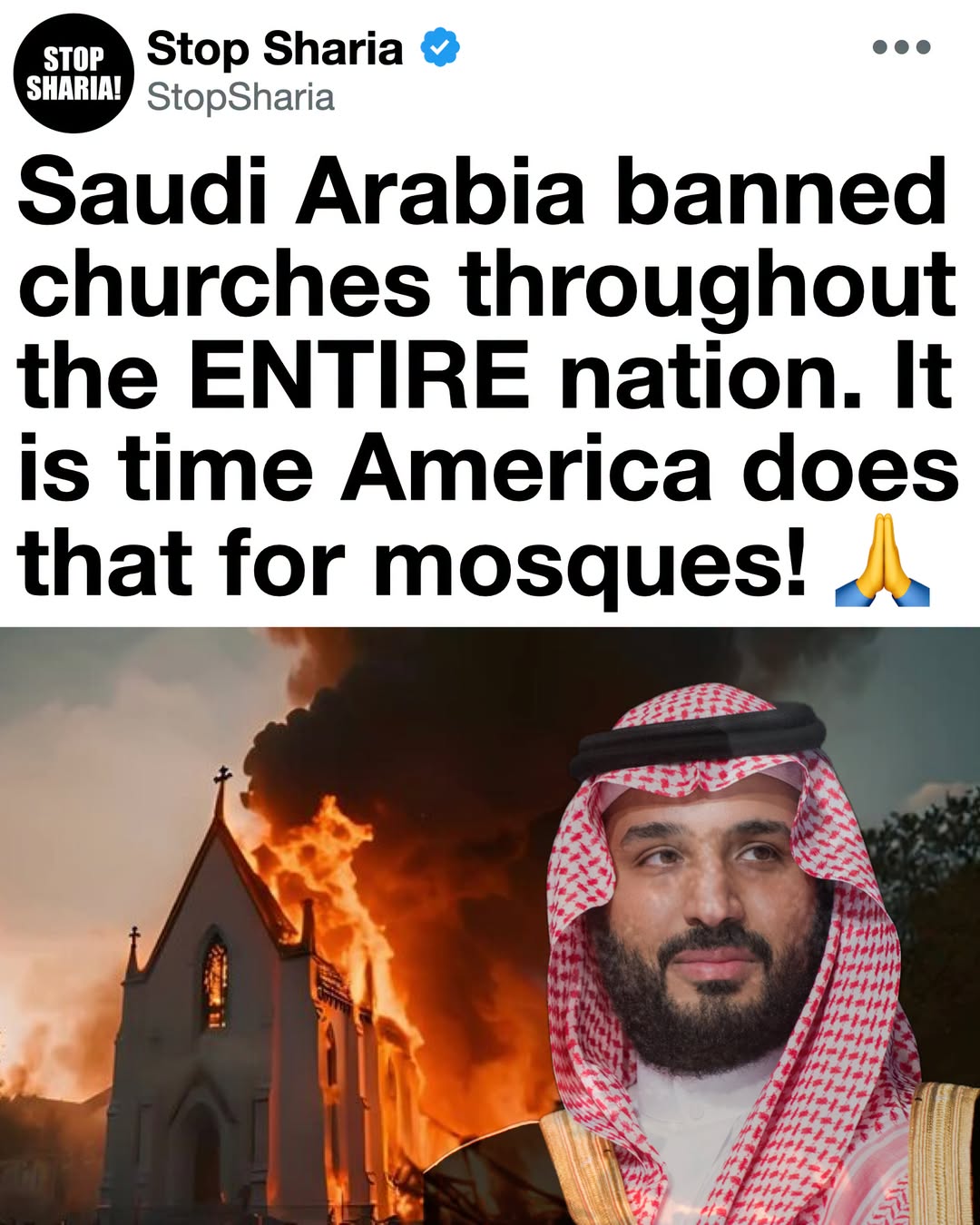
Nowhere is this stark contradiction more evident than in the Kingdom of Saudi Arabia, where not a single Christian church is legally permitted to exist. Despite years of polished diplomatic public relations and modernization pledges, the reality on the ground remains frozen in an era of absolute exclusion.
In the United States, religious freedom is a constitutional cornerstone, guaranteeing every faith community the right to build houses of worship, gather openly, and preach without state interference. Yet across the ocean, millions of expatriate Christians working inside the Kingdom must practice their faith behind locked doors, under constant threat of detention.
This dramatic disparity is no longer just a diplomatic talking point; it is a fundamental test of national self-respect and basic reciprocity. When one nation demands full cultural and legal accommodation abroad while outlawing those same fundamental rights at home, the concept of international fairness collapses.
The time has come to confront this double standard head-on, because genuine tolerance can never be a one-way street paved entirely by Western concessions.
Under Saudi Arabia’s strict interpretation of religious law, public non-Muslim worship has been entirely outlawed for generations. The country maintains a zero-tolerance policy against the public construction of churches, synagogues, or any non-Islamic religious structures within its sovereign borders.
Foreign laborers, engineers, and healthcare professionals from the Philippines, India, the United States, and Europe form the backbone of the Saudi economy. Yet these millions of law-abiding workers are legally barred from holding a public Sunday service, raising a cross, or assembling in a dedicated house of worship.
For decades, underground congregations have met in private villas and secure embassy compounds, operating under the perpetual anxiety of sudden raids. Possession of multiple Bibles or visible religious symbols has historically triggered intense scrutiny, confiscation, and immediate deportation by state authorities.
While the Kingdom’s notorious religious police, the Mutawa, have had their public enforcement powers curtailed in recent years, the statutory ban on non-Islamic religious architecture remains absolute. No amount of international diplomacy has resulted in the laying of a single legal cornerstone for a Christian sanctuary on Saudi soil.
Meanwhile, the landscape across the United States and Western Europe tells a completely opposite story of unrestricted expansion and accommodation.
The Glaring Double Standard of Global Diplomacy
Over the past four decades, tens of billions of petrodollars have flowed directly from the Persian Gulf into Western capitals to finance massive religious centers. From Washington to London, state-of-the-art facilities, cultural institutes, and educational foundations have been built without a single legal or administrative roadblock.
Western democracies have facilitated this expansion under the banner of open societies, proudly demonstrating their commitment to religious pluralism and constitutional protections. American cities have routinely approved zoning permits, protected worship sites, and welcomed foreign-backed cultural institutions into the public square.
Yet this generosity has never been met with equal openness in return, creating a massive imbalance in international relations. American diplomats have consistently prioritized commercial contracts, defense sales, and energy security over the basic cultural rights of their own citizens living abroad.
This persistent failure to demand reciprocal treatment has established a dangerous precedent that rewards selective openness while penalizing Western restraint. A foreign power is permitted to project its cultural footprint deep into the heart of the West while maintaining a fortress of total exclusion at home.
 Rhode Island Man Accused of Misappropriating $600,000 From Four Elderly Women While Frequenting Casino
 Margaret Rog allegedly left her disabled husband on a toilet for 19 hours — going to bed as he groaned
 Security Breach at Mar-a-Lago: Homeless Repeat Offender Busted Wandering Trump Estate With a Utility Cart
Genuine reciprocity requires matching standards rather than one-way tolerance. When a nation prohibits the public practice of Christianity yet demands full religious liberty abroad, the imbalance becomes impossible to defend.
In international trade, no self-respecting nation would accept a deal where its goods are slapped with total embargoes while foreign imports flood its domestic markets tariff-free. Why, then, should the foundational right of religious worship be subjected to such an asymmetrical surrender?
Foreign policy analysts increasingly argue that reciprocity is not an act of hostility, but rather the most basic tool of sovereign integrity. When a nation fails to assert its own core values at the negotiating table, it signals weakness and invites further diplomatic disregard.
For years, Western leaders were told that quiet engagement and patience would gradually encourage cultural liberalization across the Gulf. However, while modern entertainment venues and tourist mega-projects have arrived, the foundational right of non-Muslims to pray in public remains strictly forbidden.
This glaring reality exposes the difference between cosmetic public relations campaigns and true, substantive human rights reform. Opening a luxury resort or hosting an international sports tournament does not erase the systemic denial of basic religious rights to millions of people.
Grassroots frustration across America is reaching a boiling point as citizens witness their own national values being exploited by foreign regimes. Everyday Americans are asking a simple, undeniable question: why should foreign governments enjoy rights in Texas and Ohio that an American cannot exercise in Riyadh?
Reclaiming Sovereignty and National Self-Respect
The principle of reciprocal treatment is deeply rooted in historical statecraft and remains essential for maintaining balanced geopolitical relationships. A sovereign nation must protect the dignity of its people by ensuring they are afforded the same basic decencies abroad that foreign nationals receive on domestic soil.
Equal treatment must mean equal freedoms or equal restrictions, because selective tolerance inevitably leads to cultural erosion and diplomatic submission. Refusing to address this imbalance is not an act of enlightened tolerance; it is an abdication of fundamental leadership.
Legislative leaders and policy experts are now calling for concrete measures that tie diplomatic privileges and cultural expansions directly to verified human rights benchmarks. If a foreign government wishes to establish major institutional projects on American soil, it should first be required to open its own doors to Western houses of worship.
Such measures would fundamentally reset the terms of international engagement, replacing decades of passive acquiescence with a strong, principled posture. It sends an unmistakable signal that American freedoms are not open for unilateral exploitation by closed regimes.
True global respect is built upon mutual accountability, clear boundaries, and an uncompromising defense of national character. When strong nations enforce consistent standards, they elevate the security and dignity of their citizens across the entire globe.
The United States does not need to compromise its own constitutional protections to demand accountability on the world stage. Instead, American leadership must use its vast diplomatic, financial, and strategic leverage to compel its allies to live up to the basic standards of modern civilization.
The era of unilateral concessions and blind accommodation has run its course, leaving behind a legacy of diplomatic imbalance that can no longer be justified. Western nations must stand up, look their global partners in the eye, and demand the immediate end of this systemic double standard.
A country that claims to be a modern global partner must prove it by respecting the fundamental rights of all people within its borders. Until the day a church can openly ring its bells in the Kingdom of Saudi Arabia, the West must stop granting unearned privileges to regimes that deny basic religious freedom to the rest of the world.
No Comments yet!